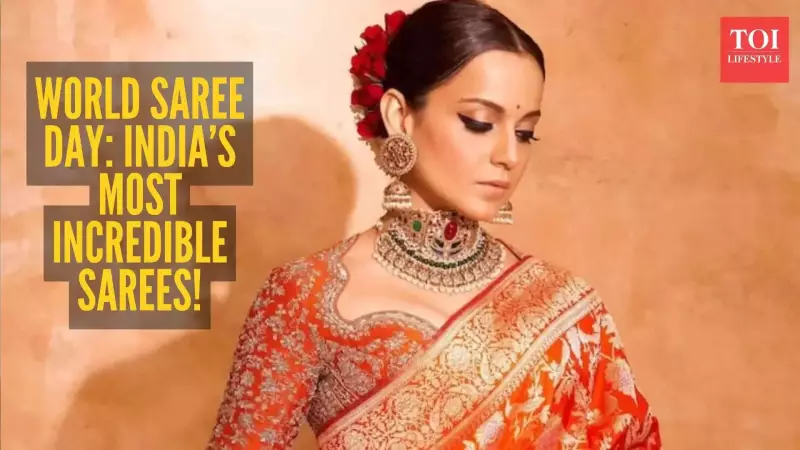
In the whirlwind of ever-changing fashion trends, one garment stands immutable, a silent testament to timeless elegance and sustainable design: the Indian saree. Long before the concepts of 'slow fashion' or 'sustainability' entered the global lexicon, the six-yard drape was already embodying these principles. With no zips, no fixed sizes, and an inherently adaptable form, the saree has traversed centuries and continents, gracing both humble homes and the world's most prestigious runways without ever needing to reinvent its core identity.
Celebrated on December 21, World Saree Day is not merely about apparel; it is a global acknowledgment of stories woven into fabric, of patient artisanship, and of regional narratives expressed through thread and dye. It honors a garment whose relevance is perennial. From this incredible legacy, five iconic sarees have emerged as powerful ambassadors, firmly placing India on the global fashion map.
The Fabric of Legacy: Sarees That Conquered Time and Taste
These sarees are more than clothing; they are heirlooms of culture, technique, and art. Each tells a distinct story of its origin, reflecting the geography and history of its weavers while commanding international admiration for its unparalleled craftsmanship.

Banarasi: The Epitome of Woven Opulence
If one were to trace the origins of luxury in Indian textiles, the journey would undoubtedly lead to Varanasi and the Banarasi saree. Born during the Mughal era, these sarees are synonymous with grandeur. Woven with heavy silk, intricate brocade (zari), and motifs inspired by nature and architecture, they possess a luminous quality, with gold and silver threads catching the light like no other.
The global journey of the Banarasi is subtle yet profound. International designers frequently borrow its elaborate patterns, celebrities drape themselves in Banarasi-inspired fabrics on red carpets, and museums preserve these pieces as textile treasures, often without explicitly naming their source. Its confidence is innate; it does not chase trends but remains a steadfast symbol of opulence at weddings, couture shows, and ceremonial events worldwide.
Kanjeevaram: The Durable Symphony of Silk and Zari
Hailing from Tamil Nadu, the Kanjeevaram saree is bold, structured, and speaks in a vibrant voice. Woven with pure mulberry silk and real gold zari, its deep colours, heavy borders, and symbolic motifs of temples, peacocks, and florals are designed to last.
What sets the Kanjeevaram apart on the world stage is its remarkable construction technique. Each saree is woven in separate parts and then locked together with such precision that it can endure for decades, often becoming a generational inheritance. In an age of disposable fashion, a Kanjeevaram is an act of resistance—a garment meant not for a season, but for a lifetime.
Chanderi: The Poetry of Lightness and Grace
In contrast to the drama of Banarasi, the Chanderi saree from Madhya Pradesh is the embodiment of calm and ethereal beauty. Woven from a blend of silk and cotton, it is celebrated for being feather-light, slightly sheer, and effortlessly graceful.
Its subtle motifs—like coins, florals, and peacocks—are understated. Designers globally cherish Chanderi for its versatility and ease of draping, while wearers adore its inherently modern feel. As global fashion continues to lean towards minimalism and comfort, the Chanderi saree fits seamlessly, proving that luxury can reside in softness and weightless elegance.
Patola: The Mathematical Marvel of Double Ikat
The Patola saree from Gujarat is not merely woven; it is engineered with scientific precision. This double ikat wonder involves the meticulous dyeing of both the warp and weft threads before weaving begins, requiring absolute alignment of patterns. A single error can unravel months of painstaking work.
This extraordinary technique has fascinated global textile experts and museums, where Patolas are displayed as much for their advanced technical knowledge as for their beauty. With bold colours and unmatched skill, the Patola saree stands as proof that Indian artisans mastered the art of 'slow luxury' centuries before it became a fashionable term.

Bandhani: A Vibrant Celebration Tied in Knots
Originating from Rajasthan and Gujarat, Bandhani is a riot of colour and joy. This vibrant tie-and-dye technique uses thousands of tiny knots to create dynamic, rhythmic patterns full of life.
Bandhani's journey to global popularity was not driven by elitism but by its authentic, handmade charm. International designers are drawn to its energy, its celebratory imperfections, and its honest craftsmanship. It is saree that embodies festivity, worn during weddings and celebrations, its universal language of happiness resonating across cultures.
Why the Saree's Global Influence Endures
The enduring power of the saree lies in its intelligent simplicity and adaptability. In a world increasingly critical of fast fashion waste, the saree presents a zero-waste marvel—requiring no cutting, leaving no leftover fabric, and magically adapting to every body type, age, and occasion.
Today, global designers openly draw inspiration from these Indian textiles, museums archive them as cultural heritage, and international celebrities wear them as bold style statements, not costumes. Yet, the saree remains deeply personal, seamlessly bridging generations—from grandmothers' treasured trunks to Gen Z's innovative drapes paired with jackets, belts, or sneakers.
World Saree Day, therefore, transcends nostalgia. It is a rightful acknowledgment of the unnamed artisans, of a garment that defies the tyranny of trends, and of India's quiet, confident leadership in global fashion. These five sarees—from five different regions—tell one unifying story: India didn't just create a garment; it crafted a living, breathing legacy that the world continues to admire.