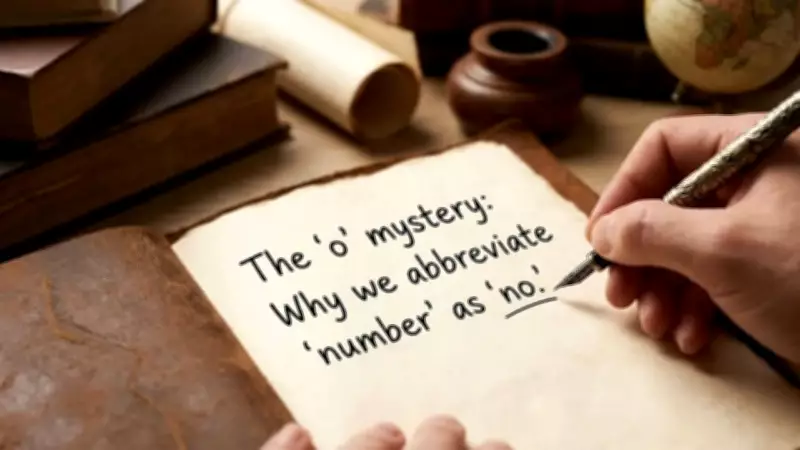
The Mystery of 'No.': Why 'Number' Abbreviates with an 'O'
Have you ever wondered why the word 'number' is abbreviated as 'no.' even though it includes the letter 'o'? This is not a case of poor spelling but a fascinating legacy from Latin. The abbreviation stems from the Latin word 'numero,' which is the ablative case of 'numerus,' meaning 'by the number.' This usage has been documented in English since around 1660, according to the Oxford English Dictionary, and has retained its Latin form despite the evolution of the English language.
The Historical Roots in Latin
The letter 'o' in the abbreviation 'no.' comes directly from the Latin word 'numero.' In Latin, 'numerus' translates to 'number,' and 'numero' means 'by the number' in the ablative case. When English speakers began using abbreviations in the 1600s, such as in ledgers or scientific notations, they adopted this Latin form. For instance, phrases like 'item, by the number 10' were common, and the 'o' was preserved in the abbreviation, ensuring its continuity through history.
The Numero Sign and Medieval Manuscripts
Long before the printing press, medieval scribes worked on expensive materials like parchment and vellum. To conserve space, they developed brevigraphs, which are combined symbols for letters. The numero sign (№) was created by placing a superscript 'o' next to the letter 'N.' This symbol was widely used in classical typography. However, with the advent of typewriters and early computers, the simpler 'no.' format became more prevalent, though the numero sign is still recognized in some contexts.

Other Abbreviations with Similar Origins
The 'o' mystery in 'no.' is not unique. Many English abbreviations derive from historical languages and retain letters that don't correspond to modern English words. Here are some examples:
- lb (pound): Derived from the Latin word 'libra,' meaning scales.
- oz (ounce): Comes from the Old Italian word 'onza.'
- & (ampersand): Originates as a ligature of the Latin word 'et,' meaning 'and,' as noted in research published on ResearchGate.
Why 'Nu.' Was Never Adopted
In early printing, 'No.' was preferred over alternatives like 'nu.' because it avoided confusion with words like 'New' or other Latin-derived prefixes. The abbreviation 'No.,' often written with a line under the 'o,' provided a clear and definitive shorthand for 'number.' This practice was established in legal and scientific documents over a century before 'number' became a standardized spelling in English.
The persistence of 'no.' in modern usage highlights how historical conventions shape language, demonstrating the enduring influence of Latin on English abbreviations.