The Symbolic Language of Divine Arms
If you have ever visited a Hindu temple or examined religious artwork, you might have noticed something striking about the deities. They often possess four, eight, ten, or even more arms. To someone unfamiliar with the tradition, this can appear mythological or confusing. However, in Hindu philosophy, nothing in sacred imagery exists merely for decoration. Every element carries deliberate, layered symbolism.
Multiple arms do not represent physical form. They serve as visual language, expressing profound inner truths that words alone cannot capture. Hindu spiritual tradition has long recognized that the divine transcends simple verbal explanation. Symbols act as bridges between the visible world and invisible realities. The extra limbs form part of this symbolic grammar.
Beyond Literal Interpretation
Gods are not depicted as human beings with additional body parts. Instead, they appear as principles, forces of consciousness, power, wisdom, protection, and transformation. A single human body cannot visually convey multiple abilities operating at the same time. Extra arms solve this artistic challenge. They silently communicate that divine power knows no limits.

More arms signify greater capacity, not more physical limbs. In Hindu iconography, arms represent shakti, the capacity to act within the world. A being with two arms can perform two actions simultaneously. A deity with many arms can act across multiple levels of reality at once. This explains why gods associated with protection and balance frequently display numerous arms.
Durga's Complete Arsenal
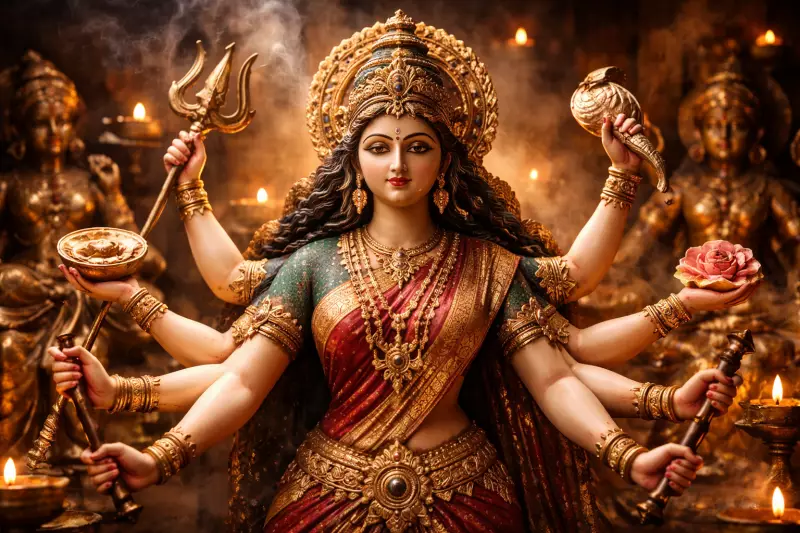
Consider Goddess Durga, often shown with eight or ten arms, each holding a different weapon. This imagery does not indicate aggression. It symbolizes completeness. Every weapon represents a distinct inner strength: courage, clarity, discrimination, patience, and resolve. Durga's many arms tell a unified story. When consciousness awakens, it possesses all necessary tools to overcome chaos.
What the Hands Hold Matters
The objects held in each hand carry more significance than the number of arms itself. Take Lord Vishnu, typically depicted with four arms. He holds a conch, discus, mace, and lotus. These are not ordinary weapons. They are ideas made visible through sacred objects.
- The conch represents sacred sound and spiritual awakening
- The discus symbolizes the mind and cosmic order
- The mace stands for strength and disciplined power
- The lotus signifies purity flourishing amid worldly chaos
Four arms correspond to four directions and four dimensions of existence. Vishnu becomes a living map of universal balance. Multiple arms enable deities to hold apparent contradictions simultaneously: power alongside compassion, action with stillness, creation alongside destruction.
Transcending Time and Limitation
Another reason gods appear with many arms involves transcending time. Humans act sequentially, completing one task before beginning another. The divine acts simultaneously. In depictions of Shiva as Nataraja, the cosmic dancer, different arms perform creation, destruction, protection, and release all at the same moment.
Creation does not follow destruction; they occur together. This represents a deeply philosophical concept expressed through movement and form. The arms demonstrate that reality operates rhythmically rather than linearly.
A Mirror of Human Potential
Perhaps the most overlooked meaning involves reflection. Hindu gods are not distant beings meant only for worship. They serve as mirrors of human potential. Multiple arms do not say, "This is what you are not." Instead, they declare, "This is what you can become."
When our minds feel scattered, we experience weakness and overwhelm. As awareness expands, we discover we can manage multiple roles without losing our center. The gods illustrate the ultimate state: consciousness that acts powerfully without inner conflict.

Why This Imagery Remains Relevant Today
In our modern world obsessed with realism, symbolic literacy has diminished. Hindu imagery invites us to read with intuition rather than logic alone. The extra arms are not meant for literal belief; they demand inward understanding. They remind us that divinity is neither fragile nor limited. It remains expansive, responsive, and fully equipped.
Most importantly, this symbolism offers quiet reassurance. When awareness aligns properly, no situation proves too complex, no challenge too many-armed to handle. What initially appears supernatural actually reveals deep psychological and practical wisdom. The gods do not possess more arms than humans. They show what happens when consciousness remembers its full range.