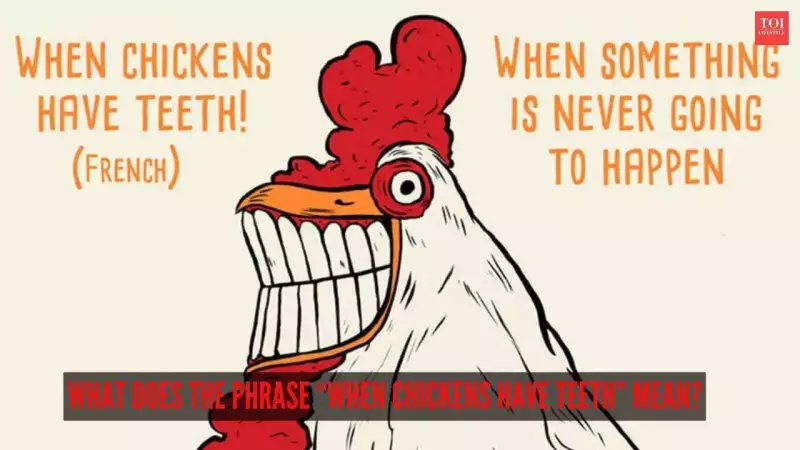
Have you ever heard someone say something will happen "when chickens have teeth" and wondered what it truly means? This colourful phrase is more than just a quirky saying; it's a linguistic gem used across cultures to express sheer impossibility. Let's delve into the meaning, origin, and fascinating reality behind this popular idiom.
The Meaning and Everyday Use of "When Chickens Have Teeth"
At its heart, the phrase "when chickens have teeth" is a sarcastic and humorous way of stating that something is never going to happen. It underscores an event's extreme unlikelihood by referencing a biological absurdity. The core logic is simple and effective: since chickens are toothless birds, the image of them sprouting teeth feels completely ridiculous and beyond the realm of possibility.
In daily conversation, you might hear it used like this: "She'll start cooking dinner when chickens have teeth!" This instantly conveys the message that she has no intention of cooking. While not as common in standard English as its counterpart "when pigs fly," this expression is widely recognized, especially in discussions about equivalent sayings in different languages.

Origin and Global Cultural Equivalents
This idiom has a rich history, tracing its roots back to the French language. It originates from the French saying "quand les poules auront des dents," which translates directly to "when hens have teeth." Historical records show this expression has been used in France since at least the 18th century to denote events that will never occur.
The beauty of such idioms lies in their universal appeal. Cultures around the world have developed their own imaginative and absurd animal-based phrases to communicate the same idea of impossibility. Here are a few striking examples:
- English: "When pigs fly"
- Spanish: "Cuando las ranas críen pelo" (when frogs grow hair)
- Brazilian Portuguese: "Quando cobra fumar" (when a snake smokes)
These expressions highlight a shared human tendency to use creative, humorous, and visually striking language to describe concepts that are firmly out of reach.
The Scientific Reality That Makes the Idiom Work
The humour and effectiveness of the idiom are firmly anchored in real-world biology. The blunt fact is that chickens do not have teeth. This is an intriguing evolutionary detail, especially considering that birds are descendants of theropod dinosaurs, which were very much toothed creatures. Over millions of years, birds lost their teeth and developed beaks adapted for their diets and lifestyles.
There is one fascinating, temporary exception: the "egg tooth." Baby chicks are born with a small, sharp projection on their beak, known as an egg tooth. This temporary tool helps them pip, or break out of, their eggshell. However, this structure is not a true tooth made of enamel and dentin; it falls off shortly after hatching, leaving the chick completely toothless for life. This precise biological fact makes the idiom's premise perfectly sound and adds a layer of scientific wit to the expression.
In summary, "when chickens have teeth" is a vivid, globally-connected idiom that masterfully uses a biological impossibility to convey that an event has virtually zero chance of occurring. It serves as a charming reminder of how language evolves to paint vivid pictures, connecting humour, science, and culture in a single, memorable phrase.