The Enigmatic Journey of Vijay Mohite: An Abstract Visionary
In the vibrant tapestry of Indian modern art, the name Vijay Mohite (1940-2002) emerges as a fascinating, albeit brief, flash of brilliance. For a short period during the 1970s, this young artist from Gwalior captivated audiences in three major cities with a series of dense, spirited abstract paintings. Characterized by bold expanses of color and kinetic lines that made the surfaces resonate, his works vibrated with what artist J. Swaminathan, contemplating them in 1972, described as an "inexorable pulsation."
Early Immersion in Art and Music
Born into an aristocratic family in 1940, Mohite's artistic journey began remarkably early. He held his first exhibition at the tender age of seven, a testament to his innate talent and early exposure to culture. Growing up in the shadow of the Maharaja of Gwalior's patronage and his own family's deep passion for the arts, Mohite was steeped in a rich milieu of classical music and modern art.
- Musicians frequently visited the Mohite family haveli, with his grandfather even carrying the young boy wrapped in a blanket to listen to maestros practicing their riyaaz.
- Visual artists from the Bombay School, including M. R. Acharekar, V. B. Pathare, Govind Salegaonkar, A. A. Almelkar, and D.D. Deolalikar, were regular guests, with Deolalikar introducing Mohite to his first art teacher.
This early environment, combined with the natural beauty of the surrounding jungle, cliffs, and rivers, profoundly influenced his sensory development. His debut show featured dreamy watercolor landscapes that already hinted at the bright colors and attenuated forms that would define his mature work.

Tragedy and Artistic Evolution
A poignant turn in Mohite's life came in 1956 when he lost both his parents within a single day. During this period of grief, Ustad Alauddin Khan, the renowned sarodist, visited and played his father's favorite ragas, transforming sorrow into a plangent expression that would later manifest in Mohite's paintings through tonal variations and melodic arrangements of motifs.
After leaving Gwalior, Mohite's itinerant years took him to Bombay, where he studied at the JJ School of Art's Commercial Art department, and later to Lucknow as a guest of the Maharaja of Samthar. In Lucknow, he indulged his mechanical curiosity by joining a flying club, an experience that influenced his paintings, which often rendered motion with dramatic, almost illusionistic effects.
The Heyday of Abstraction and Withdrawal
By the 1970s, resettled in Gwalior, Mohite had developed an improvisational vocabulary of abstraction, aided by his adoption of acrylic—a quick-drying, dynamic medium that suited his spontaneous style. This period coincided with the flourishing of abstract art in India, with contemporaries like V. S. Gaitonde and Bal Chhabda making their mark.
- Mohite's large-scale acrylics, with their rhythmic streaks and dapples of fluorescent colors, embodied this art historical moment.
- Between 1971 and 1976, encouraged by figures like M. F. Husain, he held successful exhibitions in Bombay, Delhi, and Bangalore.
Yet, just as his art was gaining public recognition, Mohite made the deliberate choice to withdraw it from public display. He continued to paint profusely in his ancestral home, sharing his works with family and friends, but eschewed the spotlight in favor of personal fulfillment.
Legacy and Exhibition
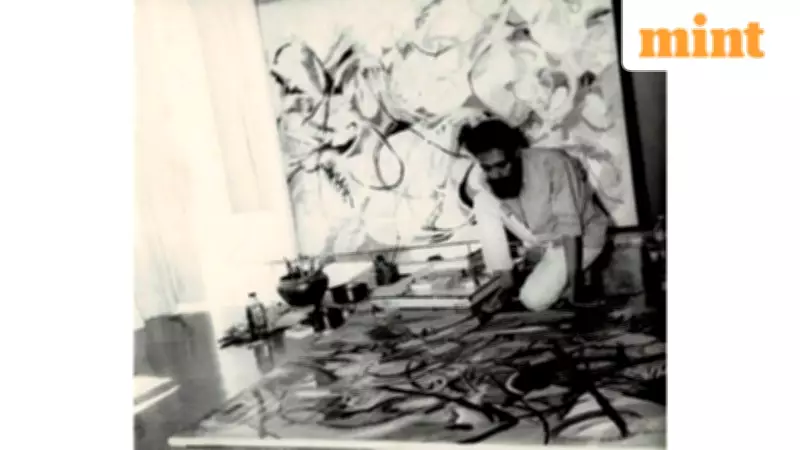
Today, Gallery Prologue in Mumbai offers a rare glimpse into Mohite's prolific yet private practice through a solo exhibition titled "Vijay Singh Mohite: Inexorable Pulsations." The showcase includes paintings in watercolor, oil pastel, and acrylic on various mediums, alongside photographs, highlighting his synaesthetic expression that distilled the phenomenal world into a vivid, musical throb.
Mohite's work, attuned to the rhythms of Hindustani classical music and the natural environment, reveals a cerebral engagement with space through overlap, interlock, and contour. As fellow artists noted, his paintings often possessed a sculptural quality, with repetitive forms and jewel-toned colors conferring rhythm upon planar constructions.

In an era dominated by the pursuit of visibility, Vijay Mohite's story stands as a poignant reminder of artistry rooted in introspection and private joy, leaving behind a legacy that continues to pulsate with life and color.