The Evolution of Urban Indian Parenting: From Silent Fear to Open Dialogue
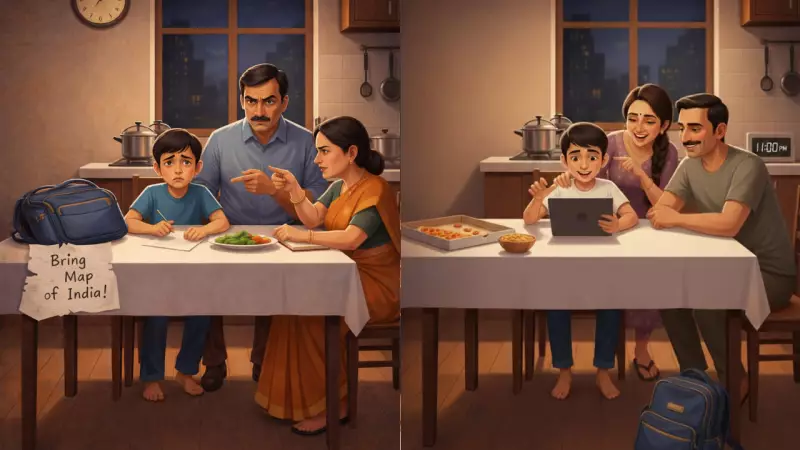
For countless individuals who grew up in India's bustling urban and metropolitan households, childhood memories often include moments of palpable anxiety. Forgetting to remind your father about bringing chart paper or a political map of India could mean a sleepless night filled with dread. The realization would typically strike around 11 pm—far too late to rectify the situation—followed by the certainty of morning consequences: anger, scolding, and that silent, heavy walk to school.
The Landscape of Childhood Discipline
Urban middle-class childhoods were frequently shaped by nuclear families, school-centric routines, and early exposure to strict rules within the home. You would sprint for safety if your mother discovered you hiding test papers, instantly transform into an Oscar-worthy performer pretending to finish notebooks when hearing your father's scooter approach, or feel that familiar knot in your stomach before parent-teacher meetings. The dreaded remark would often glare back across the table: "Sir, Ma'am, your daughter/son is very talkative."
Even casual interactions carried weight. A simple greeting from a classmate in the market could invite raised eyebrows and quiet interrogations at home. For those prohibited from using mobile phones before Class 12 boards, messages were typed secretly on keypad devices, with beeps muffled to avoid detection—sending elephant jokes or whispered secrets like clandestine communications between conspirators.

The Dramatic Shift in Parent-Child Dynamics
Today, these scenarios unfold with remarkable difference. Phones are so firmly attached to young hands that parents often become background noise, acknowledged primarily during dinner calls or chore reminders—an ironic reversal from when children moved quietly to avoid detection. Where once there were only two dinner choices—eat the green vegetables or don't—today's child might suggest a 10-minute delivery app, and parents might laugh rather than scold.
Friends are no longer viewed with suspicion but accepted as natural companions in growing up. From parents as unquestioned authority figures—stern, guarded, and rule-bound—to parents attempting to balance discipline with dialogue, the entire parent-child dynamic has undergone significant transformation. Certain music, movies, or topics once strictly off-limits are now met with children's assurances that they're "not a big deal," reflecting a more open, negotiable space where dialogue replaces silent compliance.
Voices from the Parenting Frontline
Parental Perspectives on Modern Nurturing
Parents today increasingly favor guidance and understanding over rigid enforcement. One mother navigating technology with her 15-year-old daughter explained: "While I remind her to study, I cannot ignore that phones have become integral to life. I balance this by allowing social media and even being tagged in reels my children share. What could be distraction becomes connection."
Another parent highlighted risks of excessive strictness: "If we're too firm, children might trust outsiders before coming to us. We ought to be their first confidants." Patience and empathy were emphasized repeatedly, with one parent noting: "We handle differences calmly. Anger often makes children fear rather than respect, though bad behavior still needs addressing."
Hari Shankar Soni, a media educator and father of two daughters, captured the generational shift perfectly: "My father once beat me with a pipe; I cannot imagine doing that with my kids. Punishment doesn't work for this generation. I want to be a friend, not an authority they fear."
Children's Yearnings and Expectations
From the children's perspective, the evolution is equally palpable. Rubal, a Class 10 student in Delhi, shared: "My parents usually listen to my opinions, even when disagreeing. They support me through mistakes. I wish they trusted me more regarding career choices and mobile use, understanding that mistakes are part of growth."

A Class 11 student echoed similar sentiments: "My parents are supportive and provide solutions, but we differ on issues like marriage. They value security, while I think differently. I wish they understood my personality better." A Class 6 student added: "My opinions are considered, and my parents explain things calmly. But sometimes I feel distant when they're strict about friends or social media."
Collectively, these voices reveal that contemporary children seek understanding without absence, freedom without neglect, and boundaries without fear—a delicate equilibrium that defines modern parenting challenges.
Educational and Psychological Insights
Classroom Reflections of Changing Norms
Seema Kundra, a teacher with over 25 years of experience, observes that classrooms today mirror evolving parenting styles, especially post-pandemic. "Many parents speak to teachers without filters, believing their authority is absolute. This attitude manifests in children, who are far more casual with educators." She noted that excessive screen time has widened gaps, with parents sometimes criticizing teachers before children, undermining educational authority.
Palak Sharma, a young educator, described the contrast as "worlds apart." "Parents are present but often transient due to work pressures. Discipline and emotional support are increasingly pushed onto teachers." While supporting gentle parenting, she cautioned against misinterpretation: "Gentle parenting has become an excuse to avoid discipline. Children need freedom, but also guidance and boundaries."
The Psychiatric Perspective on Emotional Climates
Dr. Rajiv Mehta, Vice-Chairperson (Psychiatry) at Sir Ganga Ram Hospital, emphasized the critical role of home emotional environments. "Over-interference, hostility, and constant criticism create damaging cycles. Parents transmit anxiety to children, who then struggle emotionally." He added that contemporary helicopter parenting often limits independence compared to earlier generations who allowed more exploration freedom.
Contemporary Parenting Styles Explained
Psychologists commonly classify parenting into four primary styles, originally outlined by Diana Baumrind and expanded by Eleanor Maccoby and John Martin:
- Authoritarian: High control, low warmth
- Permissive: High warmth, low structure
- Authoritative: Balanced boundaries with emotional support
- Neglectful: Low responsiveness and guidance
What emerges today is a distinct shift away from rigid authoritarianism. Most urban Indian families attempt authoritative parenting, though many struggle to find equilibrium amid technology saturation, time scarcity, and rising anxiety levels.
The Delicate Balance of Modern Nurturing
Parenting is never one-size-fits-all. Styles evolve with social realities, work pressures, cultural shifts, and mental health awareness. Authority has softened into dialogue, fear into negotiation, and silence into openness. Yet this transformation presents its own challenges—closeness without boundaries can be as unsettling as discipline without empathy.
Today's children are more aware and expressive, yet face heightened emotional pressures from academic competition and digital saturation. Parents, meanwhile, navigate complex territory—striving to improve upon previous generations while fearing they might be doing too much or too little. This evolution isn't judgment on any generation; most parents simply want the best for their children, often aspiring for what they themselves couldn't achieve—not to burden, but to build resilient individuals for an increasingly complex world.
Ultimately, parenting represents a continuous negotiation of fear, affection, aspiration, and trust. It involves guiding humans through unknown territories while learning to gradually release control, adapting as children grow, and discovering that yesterday's rules may not apply to today's realities. The arc from strict discipline to meaningful dialogue, from unquestioned authority to mutual respect, reflects not merely changing household dynamics, but a fundamental transformation in how we conceptualize childhood, adulthood transitions, and the intricate dance connecting them.