Hidden within the lush, forested hills of northeastern Tripura lies Unakoti, an archaeological and spiritual marvel that continues to baffle historians and captivate pilgrims. This ancient site, also known locally as Subrai Khung, is a sprawling gallery of monumental deities carved directly into the mountainside, representing one of India's most significant yet mysterious sculptural landscapes.
A Legacy Carved in Stone: History and Archaeology
The origins of Unakoti are steeped in both time and legend. Scholars attribute the creation of its stunning bas-relief sculptures to a period between the 7th and 9th centuries CE, a time before the rise of the Manikya dynasty in the region. Historical evidence suggests the site was likely developed under the patronage of the Deva Dynasty, which ruled Sribhumi in the Samatata region of eastern India.
Despite its grandeur, the site offers scant written records to decode its past. To date, only a single inscription has been discovered at Unakoti. This brief epigraph, found on a Chaturmukhalinga image, is written in early Bengali characters from the 11th–12th centuries CE. It mentions a pilgrim named Sri Jayadeva, not a king or patron, further deepening the enigma. This lack of concrete evidence has allowed rich local folklore to flourish, filling the historical gaps with compelling narratives.

Colossal Deities and Enduring Myths
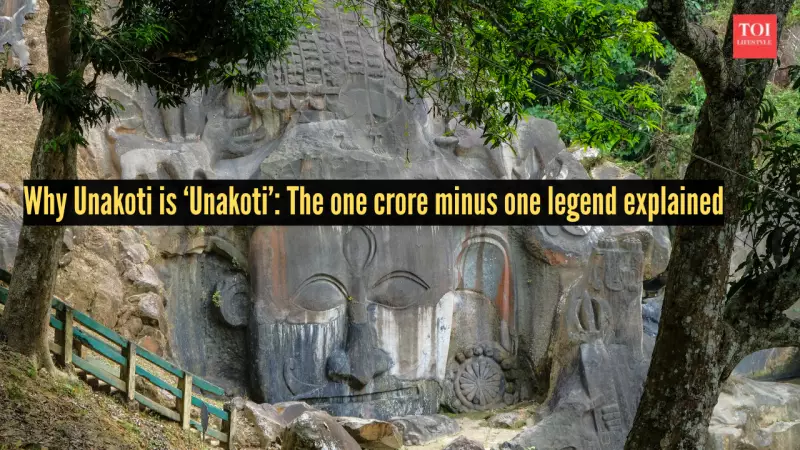
The artistic wealth of Unakoti is broadly divided into two forms: intricate rock-carved reliefs and standalone stone images. The undisputed centerpiece is the awe-inspiring 30-foot-high colossal head of Lord Shiva, known as Unakotiswara Kal Bhairava. The sculpture's ornate headdress alone towers nearly 10 feet and is flanked by full-sized figures of Goddess Durga on her lion and another female deity.
The site's very name, which translates to "one less than one crore" (or ten million) in Hindi and Bengali, is the source of its primary legend. One popular Hindu tradition states that Lord Shiva, traveling to Kashi with 99,99,999 gods and goddesses, stopped at Unakoti for the night. He instructed the divine entourage to wake before sunrise. When they failed, an angered Shiva turned them all to stone, departing alone at dawn and leaving behind one less than a crore of stone figures.
An alternative local tale speaks of a devoted artisan named Kallu Gurjar. A fervent worshipper of Parvati, Kallu wished to accompany the divine couple to Mount Kailash. Shiva agreed, but on one condition: Kallu must create one crore idols of Shiva in a single night. The devotee worked tirelessly but fell short by just one idol as the sun rose. Shiva left him behind, and the unfinished stone figures became the sculptures of Unakoti.
Preservation, Pilgrimage, and the Path Forward
Unakoti is far from a forgotten relic; it remains a vibrant living temple. It draws thousands of devotees annually, especially during the major Ashokastami Mela held in April, with a smaller festival observed in January. Its recognition has grown on the global stage, with UNESCO adding it to its tentative list of World Heritage Sites in 2022, acknowledging its outstanding universal value.
For visitors, the site is accessible about 178 km northeast of Agartala (the state capital and nearest airport), roughly 8 km from Kailashahar. The nearest railway station is in Dharmanagar, approximately 20 km away, with good road connectivity from there.
Centuries of exposure to the elements and vegetation have led to visible erosion of the sculptures. While the Archaeological Survey of India (ASI) has undertaken conservation, significant large-scale work is still needed. In a promising development, the Central government has recently sanctioned ₹12 crore to develop Unakoti's infrastructure and promote it as a premier tourist destination. This investment marks a renewed commitment to preserving a site where myth, devotion, and ancient artistry are forever frozen in stone.