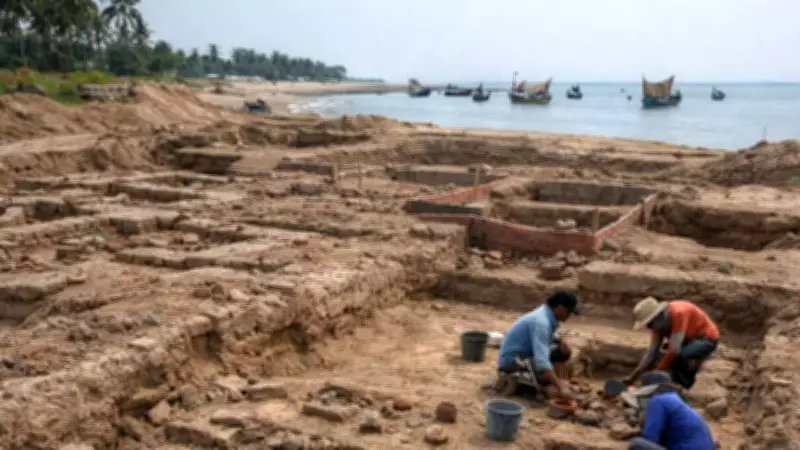
Thoothukudi's Hidden History: Marine Fossils Reveal Ancient Coastal Past
South India continues to unveil archaeological surprises that challenge conventional historical narratives. The latest discovery comes from Thoothukudi district, where an ordinary-looking landscape has revealed extraordinary secrets buried beneath its soil.
Panaiyur Village's Remarkable Discovery
Panaiyur village, located near Tharuvaikulam in Thoothukudi district, has become the focal point of archaeological interest following an unexpected find. Local farmers preparing agricultural land recently uncovered marine fossils and seashells embedded in the soil, a discovery that has sent ripples through the archaeological community.
The marine remains suggest this inland area was once part of a coastal belt, potentially indicating that ancient sea boundaries extended much further inland than previously documented. Archaeology enthusiast Rajesh Selvarathi noted, "The sea shells found near Panaiyur village could indicate that this region was once part of a coastal belt." This revelation has surprised local residents, many of whom had no idea their farmland had been submerged underwater thousands of years ago.

Reshaping Regional Geography and History
Experts believe this discovery could fundamentally reshape our understanding of Thoothukudi's ancient geography and historical significance. The marine fossils provide tangible evidence of environmental shifts and changing sea levels over millennia, offering clues about the ancient coastline of Tamil Nadu.
While detailed scientific studies are needed to confirm preliminary observations, the findings already present exciting possibilities. The fossils hint at ancient maritime life, trade networks, and environmental transformations that occurred over thousands of years. They suggest that Thoothukudi's landscape has undergone dramatic changes, with the sea retreating and leaving its secrets buried beneath layers of soil and sand.
Connection to Legendary Korkai Port
The discovery takes on additional significance when considered alongside historical records pointing to Korkai, the ancient Pandyan port famous for its pearl trade. Some experts speculate that Panaiyur might have been connected to Korkai's maritime activities, potentially serving as an extension of the port's operations or supporting related processes.
Korkai's pearls were legendary throughout the ancient world, mentioned in Vedic texts and highly prized by civilizations from Rome to Egypt. The Pandyas maintained a monopoly on Gulf of Mannar pearls, which were traded extensively across India and overseas. Royal chariots were decorated with these precious gems, and horses pulling them sparkled with pearl adornments, making pearls the ultimate status symbol of the ancient world.
Ancient Pearl Industry and Maritime Culture
The pearl industry represented more than just commerce—it was deeply embedded in cultural practices and rituals. Early forms of pearl oyster cultivation might have occurred in this region, even without modern infrastructure. Historical accounts describe dangerous pearl harvesting practices, with fishermen diving into the Gulf of Mannar to collect chanks while avoiding sharks, sometimes with convicts forced into this hazardous work.
Every traveler from Greek to Egyptian chroniclers documented the region's pearl industry, highlighting its importance in ancient trade networks. The discovery of marine fossils in Panaiyur supports the theory that Korkai's influence might have stretched further inland than previously imagined, potentially including areas for pearl processing or related maritime activities.
Archaeological Implications and Future Research
Archaeologists suggest these findings could significantly alter our understanding of Thoothukudi's role in ancient maritime trade and cultural exchange during the Sangam age. The marine fossils provide a tangible connection to a time when this region was part of a vibrant coastal ecosystem supporting extensive trade networks.

Experts caution that comprehensive research is necessary to fully understand the implications of this discovery. However, even these preliminary findings paint a vivid picture of trade, culture, and daily life in ancient Tamil Nadu. Archaeologists reportedly hope to conduct more extensive excavations in the area, potentially revealing additional historical layers.
Uncovering History Beneath Our Feet
Panaiyur's marine shells offer a fascinating glimpse into the past, allowing us to imagine ancient coastlines, bustling fishing communities, and the vibrant activity at Korkai's ports. These discoveries remind us that history often lies just beneath our feet, quietly waiting to be uncovered through careful observation and scientific inquiry.
The soil of Thoothukudi continues to hold many secrets, with each discovery adding another piece to the complex puzzle of South India's ancient history. As research progresses, we may gain deeper insights into how environmental changes, trade networks, and cultural practices shaped this region over millennia, revealing stories that have remained hidden for thousands of years.