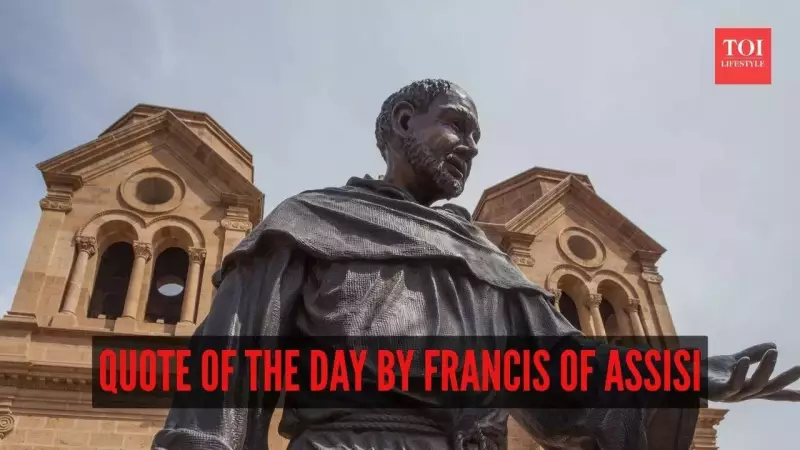
In a world often obsessed with material success and instant gratification, the life and teachings of a 12th-century Italian saint offer a profound counter-narrative. Saint Francis of Assisi, born in the late 1100s, remains a towering figure of spiritual inspiration not due to power or privilege, but because of his radical humility, deep compassion, and embracing of simplicity.
The Path from Luxury to Purpose
Francis was born into wealth but made the conscious decision to renounce a life of luxury for one of deliberate poverty. This was not an act of deprivation, but a choice to find richness elsewhere. His existence became a testament to a profound love for all humanity and the natural world. These very principles later formed the cornerstone of the Franciscan religious order he established. At the heart of his belief was a revolutionary idea: true happiness springs not from what we possess, but from having a clear and meaningful purpose.
The Power of Practical Spirituality
What makes Francis's message perennially relevant is its grounded, actionable nature. He did not preach abstract ideals detached from everyday reality. Instead, his focus was on undertaking small, spiritually significant actions. His teachings are fundamentally action-oriented, emphasizing the importance of living out one's beliefs through concrete steps. This practicality provides a accessible roadmap for spiritual growth that resonates across centuries and cultures.

Decoding the Quote: From Necessary to Impossible
This philosophy is perfectly encapsulated in a saying widely attributed to him: “Start by doing what’s necessary; then do what’s possible; and suddenly you are doing the impossible.” This statement is far more than a motivational platitude; it is a strategic blueprint for achievement and personal transformation.
The quote advocates for progress built on sanity and restraint. The journey begins not with overwhelming leaps toward a distant, daunting goal, but with attending to immediate necessities—simple tasks, ethical duties, and direct obligations. By focusing on these foundational steps, we establish order and stability. This process dismantles paralysis and fear, allowing forward momentum to build naturally. The emphasis is not on speed, but on unwavering consistency.
As one progresses to doing "what's possible," confidence and capability grow organically. These incremental, calculated efforts, sustained over time, compound into outcomes that once seemed entirely out of reach. The "impossible" is thus achieved not by a single heroic effort, but through gradual, dedicated acceleration. The wisdom reminds us that extraordinary accomplishments are often the sum of ordinary actions performed with dedication and faith.
A Timeless Lesson for the Modern Age
On a deeper level, this idea carries a spiritual optimism. It trusts in the process of growth and has faith that human effort, when aligned with purpose, can yield results greater than initially imagined. By concentrating on the present step rather than fixating on the far-off destination, progress unfolds in a more natural and sustainable way.
In today's era, where the pressure for instant success is immense, the words of Saint Francis of Assisi serve as a crucial reminder. They teach enduring lessons in patience, humility, and purposeful action. The call is not to wait for perfect conditions, but to begin right where we are, with what we have. It is through diligently handling the necessary and the possible that individuals gradually expand their boundaries and redefine their potential. The path to the extraordinary is quietly constructed, step by deliberate step.