Saptak 2024 Concludes with Mesmerizing Kirwani Performance in Ahmedabad
The Saptak 2024 music festival reached its grand finale on Tuesday, marking Day 13 of this celebrated cultural event. The atmosphere in Ahmedabad buzzed with anticipation as music lovers gathered for the closing performance.
A Stellar Ensemble Takes the Stage
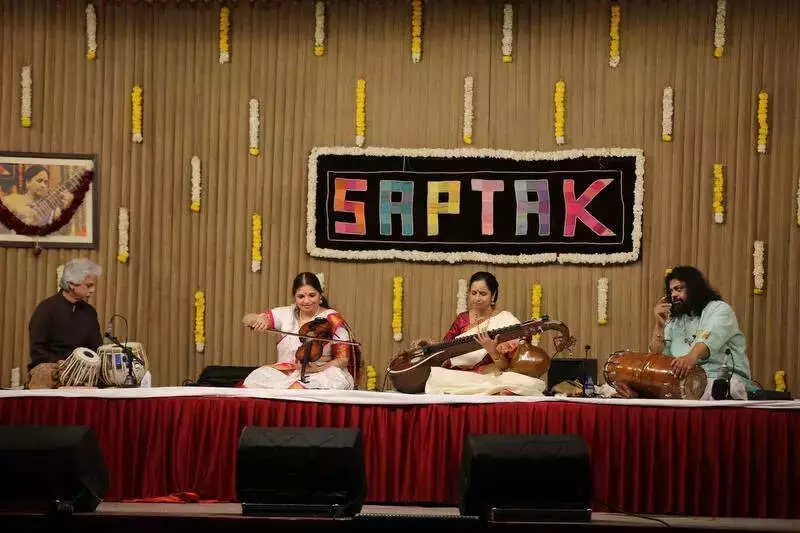
Four distinguished musicians graced the stage for this special occasion. Violin virtuoso Kala Ramnath shared the platform with Saraswati veena maestro Jayanthi Kumaresh. They were joined by tabla legend Fazal Qureshi and mridangam expert Patri Satish Kumar.
Together, these artists embarked on a musical exploration of Kirwani. They approached the raga with the charismatic energy of performers who genuinely connect with both seasoned connoisseurs and enthusiastic newcomers.

The Musical Journey of Kirwani
The performance began with powerful, complex musical phrases. The artists then skillfully transitioned into progressively shorter phrases. This created a dynamic and engaging auditory experience for the audience.
A remarkable moment occurred when the violin, veena, tabla, and mridangam collectively led the melody into a profound silence. This was not an ending, but rather a beautiful preview of the artistic excellence that Saptak promises to deliver until 2027.
On stage, the musicians exchanged knowing smiles during this brief, soundless harmony. Their expressions reflected years of dedicated practice, or saadhana, that made such a meaningful pause possible.
The Importance of Synchronization and Preparation
Jayanthi Kumaresh spoke about the collaborative nature of their performance. "We have been playing together for a long time," she told TOI, referring to her group Triveni. The legendary tabla maestro Zakir Hussain originally envisioned this ensemble.
Kumaresh emphasized that synchronization forms the foundation of their recitals. "After Zakir bhai brought us together years ago, we have been developing compositions and rehearsing together," she explained. "We do a lot of homework before we perform."
She acknowledged that the idea of classical music homework might seem daunting to aspiring listeners. However, she offered a brilliant and accessible explanation to demystify the process.
Ragas as Emotional Paintings
Kumaresh described ragas in vivid, visual terms. "Raga means colour, denoting an emotion," she said. She elaborated that this colour possesses a spectrum, much like the range from the lightest to the darkest shade of blue.
According to her, confining a raga to a single, rigid definition proves unproductive. Its essence is fluid and expressive.
"For example, Kirwani comes out to you in bluish-green form," Kumaresh illustrated. "But the colour evolves. As the artist goes through the journey, the raga becomes like a painting. The notes of a raga form the colour palette. The instrument is like a brush."
She further explained that performing a raga resembles creating a unique painting each time. While the fundamental notes remain constant, the final artistic expression on any given day depends on multiple factors.
The artist's mood, the acoustic environment, and even their physical presence influence the performance. On that Tuesday evening in Ahmedabad, the artists collectively presented a musical masterpiece.
Their rendition was so joyful and radiant, it brought to mind a Mona Lisa who had shed all mystery. She smiled openly, as if delighting a devoted admirer in the modern world.
The Saptak 2024 finale thus concluded, leaving the Ahmedabad audience with a lasting impression of classical music's profound beauty and emotional depth.