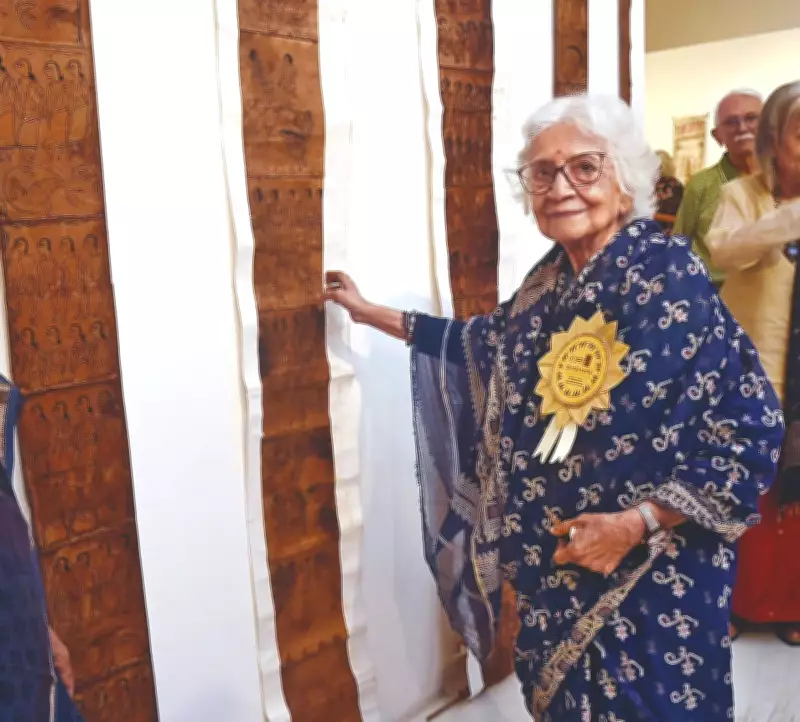
Curator Ruby Palchoudhuri has chosen to hold the Santali Katha exhibition at the Kolkata Centre for Creativity despite advice to the contrary. "People told me not to do this exhibition at this time, but I chose this week deliberately. I believe culture is more important than politics, and it must continue, no matter what the circumstances are," she says. The exposition on Santali art, culture and knowledge systems will be on view through the coming week.
Challenging Static Views of Tribal Life
The exhibition presents patachitra, textiles, music and movement, challenging static views of tribal life. "We are used to seeing tribes in a static way… ethnographically," Palchoudhuri notes, "but we forget they are active contributors to our cultural diversity." She traces her inspiration to a visit to a Santal village nearly 50 years ago, which revealed how little is understood about these cultures. "That stayed with me. This exhibition is a continuation of that impulse. It took over a year of work with my team to bring it all together. It hasn't been easy, but it felt necessary."
Mallika Sarabhai's Spontaneous Performance
A highlight of the evening was an unrehearsed performance by Mallika Sarabhai. She walked on stage without a script, inviting an audience member to share a Santali story. As the volunteer spoke, she responded through movement, translating the narrative into gesture and rhythm. "I love Kolkata. This is my favourite audience in the world, and bringing together the voices of indigenous people is very important today, especially when politically we are trying to wipe them out," Sarabhai said.

Abhijit Banerjee on Craft and Credit
Nobel laureate Abhijit Vinayak Banerjee praised the exhibition but highlighted a systemic issue. "It's really exceptional… there is both a great deal of creativity and a distinct voice," he said, before adding, "We don't embrace or acknowledge enough." He noted that children of craftsmen no longer want to pursue crafts, partly due to social media pressures. However, he speculated that AI might reverse this trend: "AI will kill many middle-skilled jobs… and that might bring people back to crafts." His sharpest observation: "Craftspeople are given the responsibility for being creative without the credit for it… and that should be offensive."
Audience Reflections
The audience, a mix of ages and professions, deepened the exhibition's narrative. Photographer Mala Mukherjee, at 87, said, "I have only 87 years of experience in photography and I still continue clicking pictures. I feel if it's too less, age is just a number." She added, "What brings us all here is the love for celebration of Santali tradition… to bring something like this together, it's a Herculean task." Sauraveswar Sen, a social sector climate action career coach, noted, "It spans over a week, with widespread discussions and so many layers." Dancer Alokananda Roy admired Palchoudhuri's spirit: "An amazing lady… a grand young lady of 97. I wouldn't even imagine doing something like this at her age." Sen added, "Urban life can actually be inspired from Santhal traditions, even education systems, even the corporate sector with sustainability."
Sari as Story: Tradition and Reinvention
Designer Lipsa Hembram's showcase, Galang Gabaan, traced the journey of traditional Santali drapes. Garments like the panhand-kanchi, once worn for daily labour, reflected design rooted in movement and climate. Earthy tones, bold borders and minimal ornamentation characterized these textiles. The show noted that the panhand-kanchi drape is rarely seen today, but reinterpretations suggested evolution rather than loss, with traditional weaves meeting contemporary silhouettes.