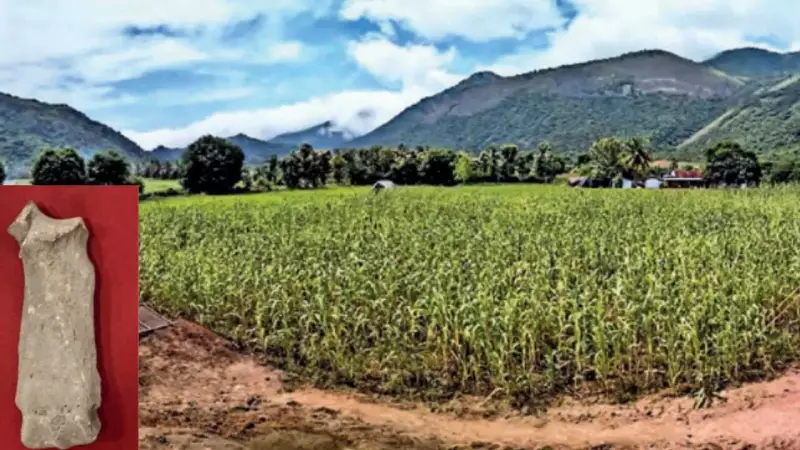
Ancient Rhinoceros Bones Discovered in Tamil Nadu Foothills
Archaeologists have made a groundbreaking discovery in Tamil Nadu, unearthing bone fragments that reveal rhinoceroses once roamed the foothills of the Western Ghats near Coimbatore approximately 3,500 years ago. This finding challenges current understanding of the animal's historical range, which today is restricted to swampy grasslands and riverine forests in Assam, Bengal, and a single national park in Uttar Pradesh.
Excavation Reveals Prehistoric Faunal Diversity
During systematic excavations in 2021 and 2024 at the Molapalayam neolithic site, researchers identified four specific bone fragments belonging to an Indian rhinoceros. The team discovered two metacarpals and two carpals from the animal's foot, with anatomical features matching reference collections of rhino bones.
"This is a significant find as rhinos survived up to the middle of the second millennium BCE," explained Abhayan G S, a faculty member at the Department of Archaeology, University of Kerala, who studied the samples with research scholar Ajith M. "According to current zoogeography, the animal is restricted to Assam and northeastern plains of India."

Third Such Discovery in Southern India
This represents the third documented discovery of rhinoceros remains in south India, following previous finds in Payyampalli in Tirupattur district and a fragmented fossilized skull in Sathankulam in Tuticorin district. The Molapalayam excavation yielded an extensive collection of bone fragments from 28 different animal species, providing unprecedented insight into prehistoric ecosystems.
Habitat Requirements and Historical Distribution
Zooarchaeologist Pramod Joglekar, a retired professor from Deccan College in Pune, explained the environmental implications: "The animal needs grasslands and marshes. The foothills of the Western Ghats might have had grassland, as a single rhino requires many square kilometres of grassland for food."
Joglekar further noted that bone remains of Indian rhinoceros have been found in multiple locations across the subcontinent:
- Gujarat and Haryana from the Harappan period
- Odisha in eastern India
- Now Tamil Nadu in southern India
"It shows that rhinos were once spread across the Indian subcontinent," he emphasized, indicating a much broader historical distribution than previously documented.
Comprehensive Archaeological Analysis
Archaeologist V Selvakumar from Tamil University, Thanjavur, who led the Molapalayam excavation, presented these findings at an international symposium on recent scientific studies in archaeology of Tamil Nadu in Madurai. His research reveals that the site's inhabitants formed a pastoral community with sophisticated subsistence strategies.
The comprehensive faunal analysis indicates:
- Domesticated animals including cattle, sheep, and goats
- Hunted wild animals such as deer and antelope
- A diverse diet including small millets and pulses
Researchers Sathish Naik and Aditya from Deccan College identified various plant remains from the site, while radiocarbon dating has established the settlement period between 1,600 BCE and 1,400 BCE.
Broader Implications for Indian Prehistory
The animal species identified at Molapalayam include both domestic and wild varieties:
- Domestic species: cattle, buffalo, goat, sheep, pig, and dog
- Wild species: nilgai, blackbuck, four-horned antelope, gazelle, chital, sambar deer, and the Indian rhinoceros
This discovery not only expands our understanding of rhinoceros distribution in ancient India but also provides valuable insights into prehistoric human-animal interactions, subsistence patterns, and environmental conditions in the Western Ghats region during the neolithic period.