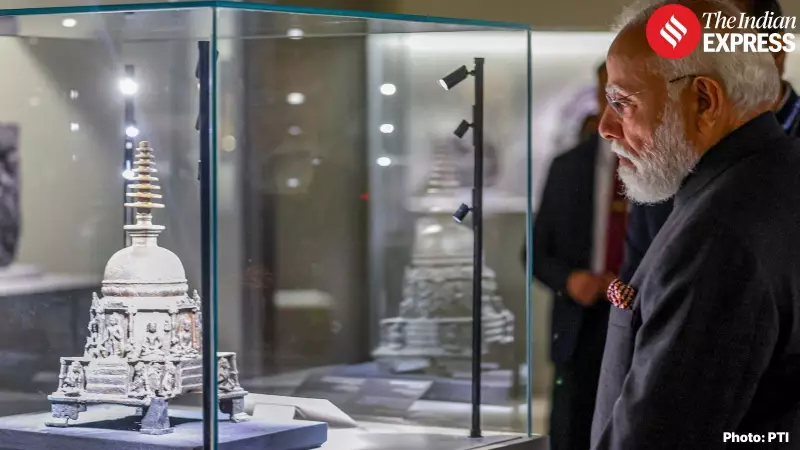
Prime Minister Narendra Modi inaugurated a landmark exposition of sacred relics from Piprahwa in New Delhi on Thursday, marking a profound moment for India's cultural heritage and the global Buddhist community. The relics, believed to be associated with Lord Buddha and his disciples, were brought to the capital for public veneration from their home at the National Museum.
A Ceremony Steeped in Spiritual Significance
The inauguration ceremony was conducted with deep reverence. Prime Minister Modi performed traditional Buddhist rituals, including offering prayers, lighting a lamp, and chanting hymns in the presence of monks and dignitaries. The exposition is being held at the National Museum, providing a rare opportunity for devotees and the public to witness these ancient artifacts of immense faith.
The relics on display hold extraordinary historical and religious value. They are the sacred Piprahwa relics, discovered in 1898 in a stupa in Uttar Pradesh's Piprahwa village, a site identified with ancient Kapilavastu. These remains are believed by many scholars and devotees to be a portion of the mortal remains of Lord Buddha himself, while others associate them with his principal disciples. Their journey to Delhi for this special exhibition underscores the government's focus on celebrating India's rich spiritual legacy.

Connecting with India's Buddhist Heritage
In his address, the Prime Minister emphasized the importance of this event in connecting present-day India with its ancient civilizational roots. He highlighted how the exposition of the Kapilavastu relics serves as a bridge to India's profound Buddhist history. The initiative is seen as part of a broader effort to promote India's role as the cradle of Buddhism and to foster cultural diplomacy with Buddhist-majority nations across Asia.
The government has made significant arrangements to ensure a smooth and dignified experience for visitors. The exposition is expected to draw thousands of pilgrims, historians, and tourists. Security has been tightened, and facilities have been set up to manage the anticipated crowds seeking blessings and a glimpse of the sacred artifacts.
A Lasting Impact on Cultural Diplomacy
The public display of the Piprahwa relics is more than a religious event; it is a strategic cultural undertaking. By showcasing these treasures, India reinforces its position as the guardian of a shared global heritage. This move is likely to resonate strongly with countries like Sri Lanka, Thailand, Myanmar, Japan, and others where Buddhism is widely practiced, potentially strengthening international bonds through shared spiritual history.
The exposition is scheduled to remain open for a limited period, allowing a wide audience to participate. This event follows a pattern of the government highlighting India's diverse religious traditions and archaeological wealth. It also aligns with projects like the development of the Buddhist circuit, aimed at boosting spiritual tourism and providing an economic impetus to related regions.
For the Buddhist community in India and worldwide, the inauguration by the Prime Minister is a moment of great honor and spiritual fulfillment. It acknowledges the deep-rooted presence and contribution of Buddhism to Indian philosophy and culture. The successful hosting of this exposition is poised to leave a lasting impression, celebrating a heritage that continues to inspire peace and wisdom across the globe.