The Backstory of the Goddess
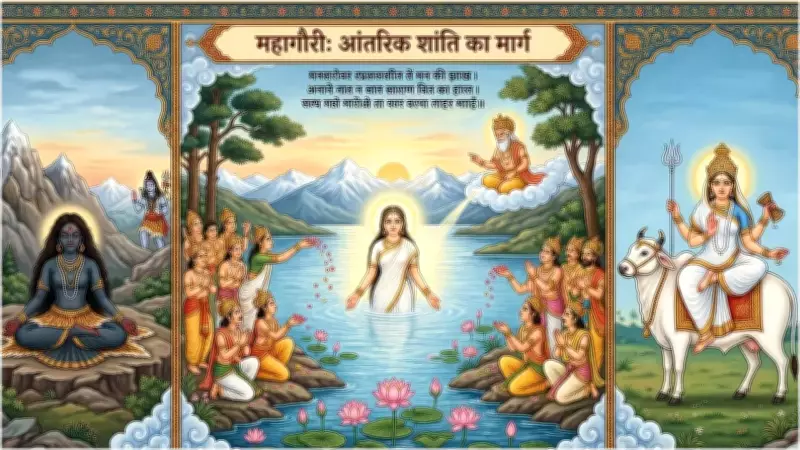
When Parvati assumed the fierce form of Kaalratri, also known as Kali, her physical appearance darkened dramatically. This was a formidable and intense transformation, reflecting her powerful state. However, Lord Shiva began teasing her by calling her Kali, a name that did not sit well with her.
Those words struck a deep chord, leaving Parvati profoundly saddened. In her sorrow, she departed from Shiva and spent an eternity worshipping Lord Brahma. This period of eternity underscores how the mind can cling to wounds, even those that start as mere teasing, highlighting the lasting impact of emotional pain.
Mansarovar and the Turning Point
Eventually, Brahma appeared before Parvati and gave her a clear instruction: to bathe in the sacred Mansarovar lake. She followed this guidance without hesitation. As she emerged from the waters, her form underwent a remarkable change, becoming as white as milk and the moon.

The same being who had darkened in fierce power now stood luminous and radiant. Because of this newfound brilliance, she became famously known as Mahagauri. On the surface, this moment seems simple—a bath leading to transformation—but it carries the profound weight of life-altering change, affecting not just the outer form but also the inner burdens that cling to it.
The Deep Philosophy in the Scriptures
This transformation conveys a profound message emphasized in the Puranas and other scriptures. When a serious problem arises, one must attack it with full force and destroy all enemies, leaving no room for half measures or confusion. The instruction is direct and uncompromising.
Yet, the second part of this teaching is even more demanding: do not carry bitterness or painful memories in your mind. Many people falter here, as the battle may end externally but continues internally. Mansarovar symbolizes the lake of the mind, urging individuals to bathe there, wash away negativity, achieve freedom, and return to enjoying life normally. It poses a critical question: what is the use of victory if the mind remains scarred?
Symbolism of Her Form, Stability and Protection
Mahagauri rides a bull named Vrishabha, which represents stability. Just as she rode a bull in her first form as Shailputri, she has now reclaimed that stability in her life after eradicating all negative forces. This stability is not accidental but regained through deliberate action.
Her captivating physical form features four arms, each with symbolic significance:
- One right hand is raised in Abhaya Mudra, granting fearlessness.
- The second right hand holds a trident, symbolizing power.
- One left hand holds a damaru, a drum representing rhythm and creation.
- The other left hand is in Var Mudra, granting boons and blessings.
Take this symbolism into daily practice: attack serious problems with all your might, then cleanse the mind by washing away bitterness, and return to enjoying life normally.
About the Author
AstroDevam is a premium organization dedicated to providing ancient and authentic knowledge in fields such as Astrology, Vastu, and Numerology, along with innovative corporate solutions from a contemporary perspective. With patrons in over 100 countries, AstroDevam is promoted by Achary Anita Baranwal and Achary Kalki Krishnan, both of whom hold Master's Degrees in Astrology and have been teaching Scientific Astrology, Vastu, and Numerology for more than three decades.