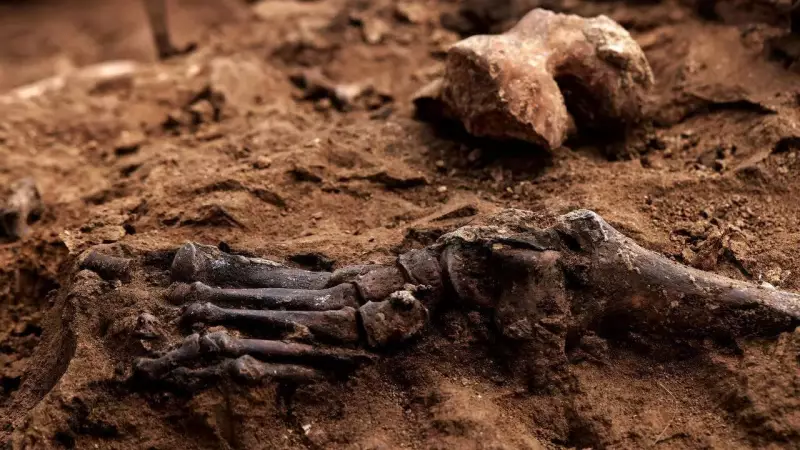
In a startling discovery that pushes the boundaries of our understanding of ancient societies, archaeologists have identified the oldest known case of a first-degree incestuous union. The evidence comes from a genetic analysis of skeletal remains unearthed at the Grotta della Monaca cave in Calabria, Italy, a site used as a burial ground between 1780 and 1380 BC.
A Shocking Revelation from Ancient DNA
The research, detailed in the journal Communications Biology on December 15, involved a meticulous study of DNA extracted from 23 individuals interred at the cave, often described as located in the "toe" of Italy's boot. While the fragmented and mixed skeletons posed a challenge, scientists successfully determined the genetic sex of 10 females and eight males. The diversity of genetic markers suggested the group came from varied backgrounds.
Initial findings pointed to two pairs of first-degree relatives—parents and their children—buried together, a common practice across cultures. One pair was a mother and daughter. However, the relationship between an adult man and a pre-adolescent boy raised immediate questions. To investigate, the team measured runs of homozygosity (ROH) segments in their DNA.

ROH levels act as a genetic barometer for inbreeding. Low ROH suggests mating outside the immediate family, while high ROH indicates close-kin unions. While most individuals at Grotta della Monaca showed ROH levels pointing to parents who were distantly related, the young boy's genome told a different story.
An "Exceptionally Rare" First-Degree Union
The adolescent male possessed the highest total of long ROH segments ever recorded in ancient genomic data. This pattern provided, as the researchers stated, "indisputable evidence" that he was the product of a union between a parent and a child. Further analysis concluded he was specifically the son of an adult male and his daughter. The remains of his mother were not found at the site.
This finding is monumental. While historical records, such as sibling marriages in ancient Egypt, and archaeological evidence, like a Neanderthal with half-sibling parents, exist, a confirmed parent-child union is of a far rarer and more extreme degree. The researchers hailed it as "an exceptionally rare and remarkable finding" and, critically, "the earliest identified in the archaeological record." Intriguingly, the boy showed no signs of genetic disorders often associated with such close inbreeding.
Unraveling the Mystery of the "Culturally Specific" Practice
The reason behind this profound taboo remains shrouded in mystery. The community was not notably small, nor was it structured around a royal hierarchy where marrying kin consolidates power and wealth. This suggests the practice was not driven by obvious political motives.
The researchers proposed that "the reproductive union between parent and offspring observed in our study may reflect a socially sanctioned behaviour" within this specific group. The fact that this is the only adult male found in a burial site predominantly containing women and children adds another layer of intrigue. Study co-author Alissa Mittnik noted that "this exceptional case may indicate culturally specific behaviours in this small community, but its significance ultimately remains uncertain."
This groundbreaking discovery at Grotta della Monaca forces a re-examination of social and familial structures in prehistoric Europe. It proves that even the most universal human taboos have exceptions, etched silently into the DNA of our ancestors, waiting millennia to tell their complex story.