Inside NGMA's New Printmaking Studio: Where Art Emerges from Metal and Acid
In New Delhi, a typical weekend afternoon unfolds with a familiar, languid pace. Traffic dwindles, the sun casts a heavy glow, and the city appears to have collectively decided to take a brief respite. However, inside a specific room at the National Gallery of Modern Art (NGMA), this tranquility is entirely absent. The moment the door swings open, a scene of intense activity replaces the outside calm.
The Rhythm of Creation
Hands are constantly in motion—wiping, scratching, dipping, pressing—without a moment's pause for rest. The air is saturated with the distinct aromas of ink and metal, mingled with a faint, burnt scent. Tables are laden with long white sheets that exist in a state of limbo, resembling neither completed masterpieces nor untouched canvases, but something intriguingly in between.
At one end of the room, artist Rm. Palaniappan is deeply focused over a zinc plate that has been darkened to a matte black. He is not drawing on its surface; instead, he is drawing into it. A fine needle etches through the metal with a soft, persistent sound. The line being created does not appear in ink; it is carved out through sheer resistance. "You start somewhere and you end somewhere," Palaniappan remarks, his gaze fixed intently on the plate. "The journey is the work."

The Quiet Work of Acid and Ink
A few feet away, another artist carefully lowers a prepared plate into a shallow bath. The liquid within appears deceptively harmless but is, in fact, nitric acid. It begins its silent, corrosive work, biting into the exposed lines carved into the metal. There is no dramatic splash or spectacle—just the patient passage of time. "This is etching," Palaniappan states, almost as a gentle reminder of the process's essence.
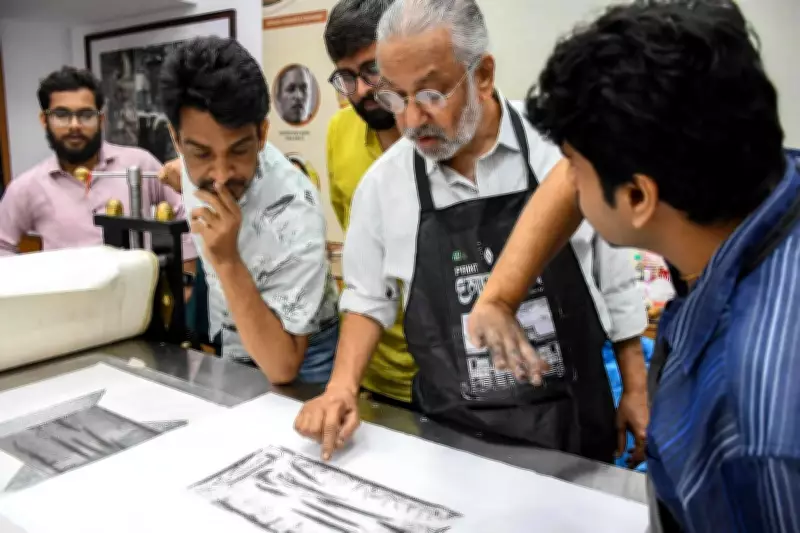
Nearby, an artist works ink into the barely visible grooves of a plate, their palms stained, moving a cloth in slow, deliberate circles. At the press, Hanuman Kambli places the inked plate onto the bed, covers it with a sheet of damp paper, and then adds a layer of felt. The wheel is turned. The machine offers a momentary resistance before yielding with a low, heavy sound.
When the paper is finally lifted, the entire room leans in with anticipation. An image has materialized—not drawn or painted, but pressed out of metal. This is the defining rhythm inside NGMA's newly inaugurated printmaking studio, the institution's first-ever dedicated space for this medium, established under the leadership of director general Dr. Sanjeev Kishor Goutam.
A Philosophy of Multiplicity and Patience
Kambli examines the freshly pulled print closely. Something seems slightly off. Without explanation, he reaches for another tool and begins polishing the plate once more. "There are many needles, many tools," he says. "I've spent my life doing this." The print is returned to the process, underscoring that nothing here is considered final until it meets the artist's exacting standards.
Across the studio, conversations ebb and flow. Artists exchange notes and techniques. Someone mentions how a single artwork can demand days of meticulous work. Artist NG Bagodi Vijay discusses adding layers and even burning resin to build texture. Each print, they emphasize, encapsulates time within its very fibers.
"Printmaking is not merely a technique. It is a philosophy of multiplicity, accessibility, and experimentation," asserts Dr. Goutam. The studio—featuring a custom-built press modeled on a rare machine from Visva-Bharati University—represents both a revival of traditional methods and a platform for reinvention.
Future Plans and Collaborative Vision
"This is just the start," Goutam reveals. "We plan to launch a three-month programme for art enthusiasts and explore future collaborations with Indian and international artists." The inaugural workshop, titled 'Chhapankan', which concluded recently, brought together artists from across the nation, each contributing their unique language of lines, textures, and temporal investment.

As artist Ananda Moy Banerji poetically describes, "From a polished zinc plate to a finished print, the process is a quiet dialogue between artist and material, where lines are drawn through resistance, bitten by acid into permanence, filled with ink, and finally pressed into paper."
Meanwhile, back in the studio, the wheel turns once again. Another sheet is lifted, and another image emerges, continuing the timeless dance of creation.