For decades, scientific understanding positioned Neanderthals as fundamentally practical beings. They were recognized for their survival skills, hunting prowess, and tool-making abilities, yet were largely dismissed as lacking the capacity for abstract thought and symbolic expression that defines modern human cognition.
Modern Humans Versus Neanderthals: The Traditional Narrative
In this established paradigm, Homo sapiens were celebrated as the pioneers of artistic creation, complex communication, and cultural sophistication. The ability to create art, convey intricate messages, and demonstrate refined cultural practices was considered the exclusive domain of our own species, setting us apart from our ancient cousins.
A Groundbreaking Discovery in Central France
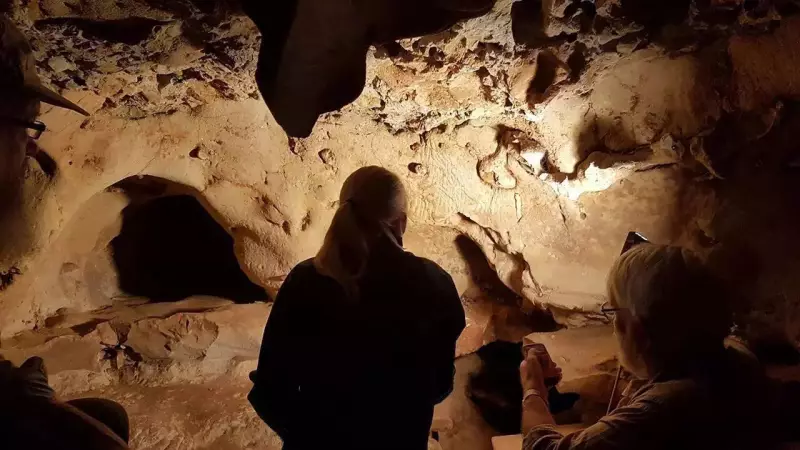
This long-standing narrative is now being dramatically challenged by a remarkable archaeological find in the heart of France. Within a limestone cave that overlooks the majestic Loire River, researchers have uncovered intricate carvings on soft chalk surfaces. These engravings have remained hidden, preserved under layers of sediment for an astonishing period exceeding 57,000 years.

The symbols discovered are not random markings. They consist of carefully executed lines, graceful arcs, precise dots, and intersecting grid patterns. What makes these engravings particularly significant is their evident spatial organization and deliberate repetition. These characteristics strongly suggest they are the product of symbolic thinking—a cognitive process that involves representing ideas, concepts, or meanings beyond the immediate physical world.
The La Roche-Cotard Cave: A Time Capsule of Neanderthal Activity
La Roche-Cotard Cave is situated within a limestone formation along the banks of the Loire River. Unlike many archaeological sites that have been disturbed over millennia, this cave has enjoyed extraordinary preservation. It remained completely untouched by humans or animals for tens of thousands of years, sealed under approximately 30 feet (9.14 meters) of natural sediment.
This deep burial created pristine conditions that protected the cave's contents. Inside, researchers found markings pressed into the soft, local chalk known as tuffeau. These engravings—comprising carefully drawn lines, arcs, and grids—were created using human fingers. Given the cave's prolonged isolation and the dating evidence, the only plausible creators of these markings are Neanderthals, as Homo sapiens had not yet migrated to this region of Europe during that period.
Compelling Evidence of Abstract Thought
The engravings at La Roche-Cotard provide powerful, tangible evidence that Neanderthals possessed capabilities for abstract thought. Previously viewed primarily as pragmatic tool users focused on immediate survival needs, these markings reveal a different dimension of Neanderthal cognition.
Scientific analysis confirms these are not accidental scratches or natural formations. Replication experiments and advanced 3D photogrammetry techniques have demonstrated that the patterns were deliberately created by human fingers. The abstract nature of these designs—their organization, repetition, and structure—points toward symbolic intent, planning ability, and a form of expressive behavior. These are cognitive characteristics that were once believed to be the exclusive province of modern humans.
Scientific Dating and Archaeological Context
Researchers employed optically stimulated luminescence (OSL) dating to determine when mineral grains within the cave were last exposed to light. The results indicate that La Roche-Cotard was sealed between 57,000 and 75,000 years ago. This timeline significantly predates the arrival of Homo sapiens in Europe by tens of thousands of years.
Adding further weight to the Neanderthal attribution, archaeologists discovered Mousterian stone tools at the site—a technology strongly associated with Neanderthals. Crucially, there is no evidence of subsequent human activity in the cave, confirming that the engravings are exclusively the work of Neanderthals and not later human visitors.

The Nature of Neanderthal Symbolic Expression
Unlike the figurative cave art of the Upper Paleolithic period, which often features depictions of animals and human forms, the markings at La Roche-Cotard are distinctly abstract. Distributed across four panels in what researchers call the "Pillar Chamber," the patterns include lines, arcs, dots, and intersecting grids.
These designs demonstrate clear repetition and careful spatial organization, indicating intentional creation rather than accidental marking. While they may not represent figurative art in the traditional sense, they undeniably demonstrate a form of symbolic behavior. This revelation highlights previously unrecognized cognitive complexity among Neanderthals, suggesting their minds were capable of conceptual thought beyond immediate practical needs.
Broader Implications for Understanding Neanderthal Capabilities
The discovery at La Roche-Cotard aligns with accumulating evidence from other archaeological sites across Europe that points toward Neanderthal symbolic behavior. In Spanish caves, red hand stencils and geometric pigment marks dating to approximately 65,000 years ago have been attributed to Neanderthal artists.
Meanwhile, at Bruniquel Cave in France, circular stone constructions dated to an astonishing 176,000 years ago indicate sophisticated planning and social organization among Neanderthals. Collectively, these findings paint a new picture of our ancient relatives. They suggest that Neanderthals engaged in behaviors once considered unique to modern humans, including various forms of symbolic representation and abstract thinking.
This growing body of evidence is fundamentally reshaping our understanding of human cognitive evolution. It challenges the simplistic dichotomy that positioned modern humans as uniquely creative and symbolic beings while relegating Neanderthals to purely practical existence. The engravings at La Roche-Cotard serve as a powerful testament to the sophisticated cognitive capacities of our closest evolutionary relatives, rewriting chapters in the story of human consciousness and cultural development.