President Murmu Inaugurates Centenary Celebrations of Ol Chiki Script
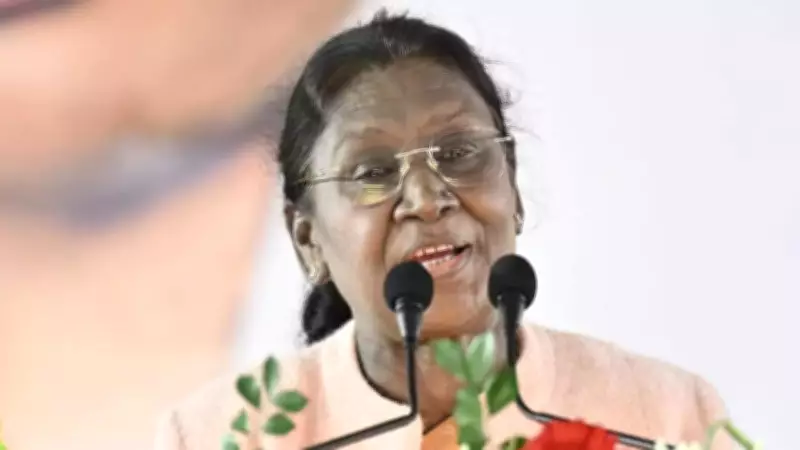
President Droupadi Murmu on Monday inaugurated the centenary celebration of the Ol Chiki script, describing it as a "powerful symbol" of Santhali identity and an effective means of establishing unity within the Santhal community. The event was organized by the Ministry of Culture in New Delhi.
Historical Significance of Ol Chiki Script
Addressing the gathering, President Murmu highlighted the historical context of the Santhali language. "The Santhal community has its own rich language, literature, and culture," she stated. However, for many years, the language faced challenges due to the absence of its own script.
"Initially, Santhali was written using Roman, Devanagari, Oriya, and Bengali scripts," Murmu explained. "Santhal community members living in Nepal, Bhutan, and Mauritius also used scripts prevalent in those countries. These scripts were unable to correctly pronounce the original words of the Santhali language."

The President noted that this changed in 1925 when Pandit Raghunath Murmu invented the Ol Chiki script, specifically designed to represent Santhali phonetics accurately.
Ol Chiki as a Unifying Force
"Since its creation, the Ol Chiki script has been used for the Santhali language," Murmu emphasized. "Today, it stands as a powerful symbol of Santhal identity worldwide and serves as an effective means of establishing unity among the Santhal community."
The President called for renewed efforts to promote the script during its centenary celebrations. She stressed the importance of mother tongue education alongside other languages.
"While children can receive education in Hindi, English, Oriya, Bengali, or any other language, they should also learn their mother tongue, Santhali, in the Ol Chiki script," Murmu advised.
Digital Growth and Literary Development
President Murmu expressed satisfaction with the growing presence of the Santhali language in digital mediums and commended writers for enriching Santhali literature through their works. She encouraged them to use their writings to awaken and inspire people.
"Language and literature are the threads that uphold unity within communities," Murmu stated. "The exchange of literature can enrich languages. Efforts should be made to make Santhali literature accessible to students of other languages through translation, and vice versa."
Commemorative Releases and Recognition
During the ceremony, President Murmu released a commemorative coin and postage stamp marking the completion of 100 years of the Ol Chiki script. She also felicitated ten achievers from the Santal community for their contributions to promoting the widespread use of the Ol Chiki script among Santhali people.
The event was attended by Union Minister for Tribal Affairs Jual Oram, Culture Minister Gajendra Singh Shekhawat, and Culture Secretary Vivek Aggarwal.
Background and Constitutional Recognition
This celebration follows President Murmu's participation in a centenary event in Jamshedpur, Jharkhand, in December last year. Notably, in December 2025, the Constitution of India was officially translated into the Santhali language using the Ol Chiki script and released by President Murmu at Rashtrapati Bhavan.
Published by the Legislative Department of the Ministry of Law and Justice, this translation marked the first time the nation's foundational legal text became available in Santhali in its indigenous script.
The Santhali language, one of India's prominent tribal languages, is spoken widely across:
- Jharkhand
- Odisha
- West Bengal
- Assam
- Bihar
Belonging to the Austroasiatic language family, Santhali has historically thrived through oral traditions. While this ensured cultural continuity, the lack of a standardized script posed significant challenges for documentation, formal education, and literary development.
The Ol Chiki script, developed in 1925, consists of 30 letters designed to accurately represent Santhali phonetics. The language was included in the Constitution of India's Eighth Schedule in 2003, granting it official recognition and status.