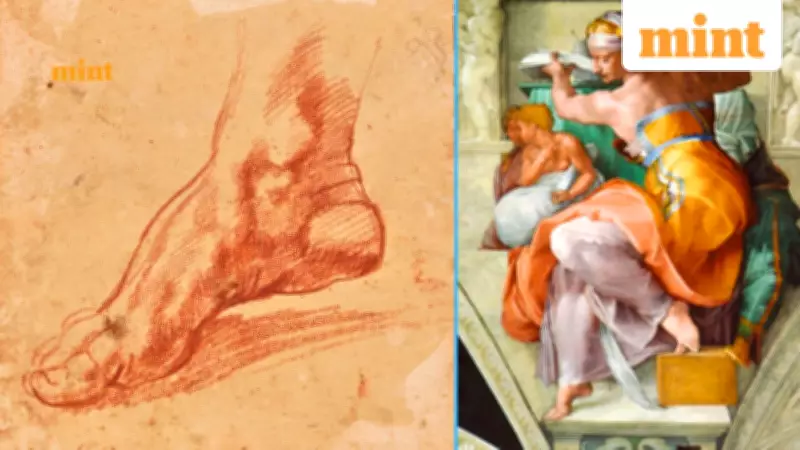
Michelangelo's Rediscovered Masterpiece Fetches Staggering ₹206 Crore at Auction
A small, previously unknown red chalk drawing by the legendary Renaissance master Michelangelo has sold for a breathtaking £16.9 million, equivalent to approximately ₹206 crore, at a Christie's auction. The sale price dramatically surpassed all pre-auction estimates, marking a historic moment in the art market.
A Family Heirloom Reveals Its True Identity
The extraordinary foot sketch had been quietly preserved within a family for centuries, unrecognized for its immense artistic and historical value. The anonymous owner, who resides on the US West Coast, inherited the work from his grandmother. The family had possessed the drawing in Europe since the late 18th century, unaware of its significance.
The owner initially submitted only a photograph to Christie's for a routine valuation. It was through the meticulous work of the auction house's experts that the sketch's true provenance was uncovered, leading to what Andrew Fletcher, head of Christie's Old Masters department, described as "one of the most memorable moments" of his career.

Scientific Analysis Confirms Michelangelo's Hand
Christie’s specialists, including Giada Damen from the Old Master Drawings department, conducted a detailed examination using advanced infrared reflectography. This non-invasive technique revealed hidden preparatory drawings on the reverse side of the sheet, which exhibited stylistic characteristics closely matching Michelangelo's known works.
Further authentication involved comparing the foot study with a confirmed Michelangelo drawing held at New York's Metropolitan Museum of Art. Based on this comparative analysis and the technical evidence, experts concluded the sketch is an authentic preparatory study by Michelangelo, likely created between 1511 and 1512. It was identified as a study for the figure of the Libyan Sibyl, which Michelangelo later painted on the iconic ceiling of the Sistine Chapel in Rome during the second phase of that monumental project.
The Paradox of Michelangelo's Wealth and Frugality
While Michelangelo's artworks now command astronomical sums, his personal financial status during his lifetime presents a fascinating paradox. Contrary to the stereotype of the "starving artist," Michelangelo was, in fact, one of the wealthiest artists of the Renaissance era. Upon his death in 1564, his estate was valued at around 50,000 florins—a fortune equivalent to tens of millions of dollars in today's currency.
Despite this considerable wealth, Michelangelo famously chose to live with extreme simplicity. He often slept in his clothes and avoided spending on personal comforts. In letters to his family, he even complained of being "poor," a claim historians believe was a tactic to manage constant financial demands from relatives.
This frugality persisted even as he received substantial payments for major commissions, such as the tomb of Pope Julius II. After his death, a locked chest discovered under his bed was found to contain thousands of gold ducats, alongside valuable property holdings in Florence and Rome. He encapsulated this contradiction in a statement to his biographer, Ascanio Condivi: "However rich I may have been, I have always lived like a poor man."
Context of Record-Breaking Art Sales
The sale of Michelangelo's foot sketch enters the annals of extraordinary art market achievements. Record-breaking auctions have become increasingly notable in recent years.
- In 2017, a 500-year-old painting of Christ, attributed to Leonardo da Vinci, was sold in New York for a staggering $450 million (approximately ₹4,061 crore).
- In November 2025, Gustav Klimt’s portrait of Elisabeth Lederer achieved a sale price of $236.4 million (around ₹2,134 crore) in New York.
- That same month, a surrealist work by Mexican artist Frida Kahlo sold for $54.7 million (about ₹493 crore), setting a new auction record for a female artist.
The discovery and subsequent multi-crore sale of this Michelangelo study underscore the enduring power of Old Master drawings to captivate collectors and redefine market expectations, turning a long-held family secret into a global art sensation.