Mawphlang Sacred Grove: Meghalaya's Living Conservation Legacy
Nestled within the undulating landscapes of Meghalaya's East Khasi Hills district, the Mawphlang Sacred Grove stands as one of India's most exceptional demonstrations of living conservation. Situated approximately 25 kilometers from Shillong, this ancient woodland has endured through centuries of societal transformation, colonial influence, and contemporary development. Its preservation has been achieved not through physical barriers or legal statutes, but through deeply ingrained belief systems transmitted across countless generations.
A Forest Protected by Sacred Tradition
The Mawphlang Sacred Grove operates under the customary laws of the Khasi people. The forest is believed to be protected by a nature deity, establishing specific behavioral norms for all who enter. According to Meghalaya Tourism authorities, visitors must leave the forest exactly as they found it—absolutely nothing may be removed, not even a single twig, pebble, or leaf. This principle ensures that every natural element remains undisturbed within its ecosystem.
An Untouched Ecological Archive
While surrounding regions have experienced logging during colonial times and developmental changes post-independence, Mawphlang has remained pristine. This is largely due to the belief that violating taboos brings misfortune not only to the individual but to the entire community. Ecologically, the grove serves as a natural repository of Meghalaya's original forest cover.

Spanning roughly 80 hectares, the sacred forest harbors some of the oldest surviving trees in the Khasi Hills, including towering oak species, subtropical broadleaf varieties, rhododendrons, laurels, and chestnuts. The area has never been cleared or commercially exploited. Its wildlife, though not dominated by large mammals, sustains healthy populations of birds, amphibians, reptiles, insects, and small mammals that rely on intact forest habitats.
Monoliths and Cultural Memory
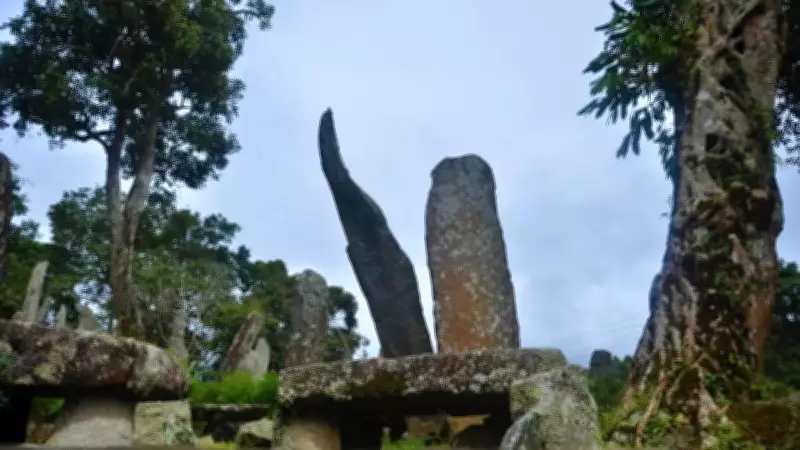
Approaching the forest, visitors encounter ancient stone monuments—some standing upright, others partially submerged in earth and moss. These monoliths are central to Khasi heritage, having historically served as markers for ritual gatherings, clan memorials, and community assemblies. Their presence underscores that Mawphlang has always been more than just a forest; it is a cultural landscape.
The surrounding area has traditionally hosted ceremonies related to agriculture, seasonal changes, and communal well-being. Although large-scale rituals are less frequent today, the grove retains profound symbolic importance, especially during major festivals. Consequently, Mawphlang functions as a living, continuously utilized site rather than a static relic of the past.
Khasi Conservation Ethics and Broader Significance
While similar sacred groves exist throughout Meghalaya, many have diminished in size over time. Mawphlang's enduring integrity is frequently highlighted by conservation experts as proof that community-driven protection can rival formal legislation in effectiveness, particularly when rooted in longstanding customs and traditions.
Visiting with Respect and Understanding
Tourism at Mawphlang is meticulously managed to maintain its delicate equilibrium. The Meghalaya Tourism Department recommends exploring the grove with local guides who elucidate both its ecological attributes and cultural meanings. These guided walks help visitors comprehend why certain actions—such as making loud noises, littering, or touching plants—are strongly discouraged.
The forest is accessible year-round, but the optimal visiting period extends from October to April, when rainfall diminishes and trails become more navigable. During monsoon months, the grove turns exceptionally lush, though paths may grow slippery, requiring careful footing.
Additionally, Mawphlang serves as the starting point for the historic David Scott Trail, a 19th-century pathway that once connected the Khasi Hills to Assam's plains—an enticing prospect for adventure travelers seeking to trace historical routes through Meghalaya's breathtaking terrain.