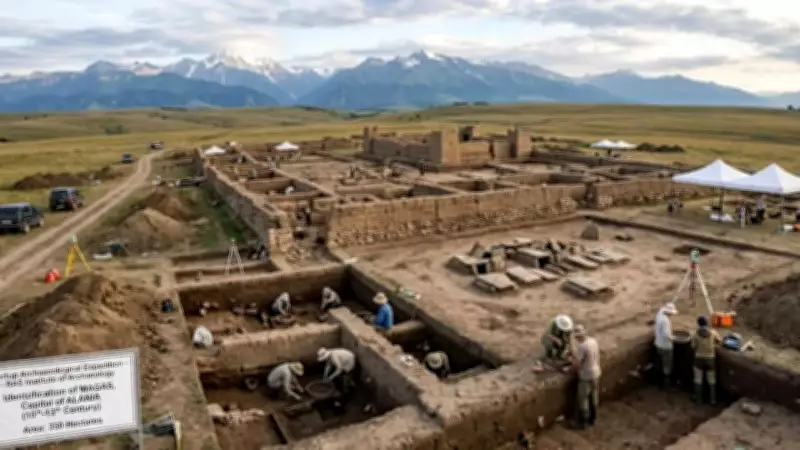
Lost Medieval City of Magas Uncovered in Chechnya After Centuries of Mystery
In a groundbreaking archaeological discovery, researchers have identified a vast site at the Mayrtup burial ground in Chechnya as the long-lost medieval city of Magas. This find solves one of Eurasia's greatest archaeological puzzles, with the ruins spanning an impressive 350 hectares, marking it as the political center of the ancient Alanian Kingdom.
Extensive Excavations Reveal a Fortified Capital
Recent rescue excavations by the Russian Academy of Sciences have unearthed extensive fortifications and structural remains, including houses and numerous artifacts dating back to the 6th century. The site features a fortified city layout with a central citadel surrounded by defensive and residential areas. Scholars note that the size and geographic layout of the Mayrtup ruins match historical descriptions by Arab historians, who referred to Magas as "the city of coins" and a residence for Alanian rulers.
This indicates Magas was highly fortified, densely populated, and a hub of significant political and military power in the region.

Magas as a Gateway for Caucasian Commerce
Magas served as the political and administrative center of Alania, an Iranian-speaking nomadic state that evolved into a rich and powerful medieval kingdom. Its strategic location allowed it to regulate commerce through the Caucasus, with artifacts such as jewelry and costume accessories from the 6th century AD suggesting strong economic ties to the Byzantine Empire and Silk Road trade routes.
- The Alans were renowned for their cavalry, and Magas functioned as the primary headquarters for their military and diplomatic activities.
- The population exhibited a complex social structure, reflecting the city's role as a bustling trade nexus.
Evidence of the Mongol Invasion and Destruction
Historical and archaeological evidence points to the city's downfall in 1239 during the Mongol Empire's expansion. Led by Batu Khan, the siege lasted months before the Mongols broke through and destroyed Magas. New excavations at Mayrtup reveal layers of destruction and domestic pits from the 10th to 13th centuries, stratigraphically aligned with the 13th-century Mongol conquest.
This site provides a unique physical record of the Alans' last stand against the Golden Horde, offering insights into the region's turbulent history.
Geophysical Surveys Map the Scale of Magas
Utilizing geophysical surveys and rescue excavations, researchers have mapped the extensive 350-hectare area, far larger than any other known medieval settlement in the Caucasus. Discoveries include major defensive fortifications and 6th-century AD burial complexes at Mayrtup 7, yielding valuable bioarchaeological data.
- These burials are helping researchers reconstruct the daily lives, diet, and health of Magas's inhabitants.
- Carbon dating of organic remains within the defensive walls shows continuous habitation from the early and middle ages to the present.
The uncovering of Magas not only illuminates the history of the Alanian Kingdom but also enriches our understanding of medieval trade, politics, and conflicts in the North Caucasus. Archaeologists and medievalists are excited by the potential to glean new information about the region's pre-Mongol era, making this a landmark discovery in Eurasian archaeology.