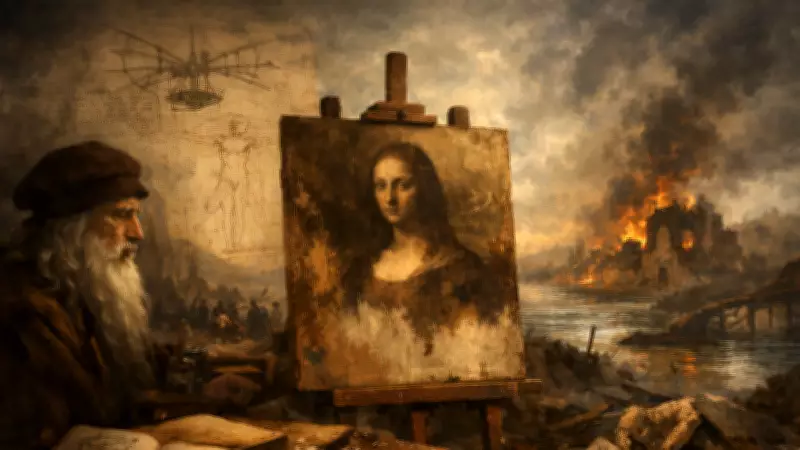
The Enigma of Leonardo da Vinci's Missing Masterpieces
Leonardo da Vinci stands as one of history's most captivating polymaths, a visionary artist, engineer, and natural philosopher whose notebooks overflow with designs for flying machines, anatomical studies, and mechanical systems that appear remarkably contemporary. Yet only a limited collection of his paintings exists today, with even fewer reaching a definitive, finished state. This disparity has long sparked speculation: Did Leonardo intentionally erase portions of his own legacy? Was he concealing revolutionary concepts too advanced for his era? Contemporary historians generally agree the reality is far less dramatic. What vanished was not deliberately destroyed but rather left incomplete, casualties of experimentation, abandonment, and the inherent fragility of art over five centuries.
Debunking the Myth of the Self-Sabotaging Genius
Popular narratives frequently portray Leonardo as an uncompromising perfectionist, allegedly destroying works that failed to meet his exacting standards. Early chroniclers noted his habitual abandonment of commissions, and later storytellers embellished this tendency into tales of secret bonfires and missing canvases. Modern academic research adopts a more measured perspective. There exists no credible evidence that he systematically incinerated completed paintings. What historical documents and contemporary accounts do substantiate is that he:
- Frequently left commissioned works unfinished
- Continuously revised and reworked compositions
- Experimented with unstable and unconventional materials
- Transported projects across decades and locations
These inclinations alone significantly account for the scarcity of surviving artworks.

The Perpetual Experimenter and Chronic Overthinker
Leonardo's boundless curiosity, perhaps his greatest asset, also presented considerable challenges. He rarely adhered to conventional techniques, instead formulating his own paints, altering ingredients, and pioneering novel methods for applying oil and tempera to walls and wooden panels. While some experiments yielded spectacular results, others ended in failure.
One of his most ambitious mural projects began deteriorating within a few years because he employed an experimental approach instead of the traditional fresco technique. When such damage occurred, compromised sections were typically restored by others, painted over, or gradually eroded by time, rather than being intentionally destroyed by Leonardo himself. He was also infamous for shifting focus to new fascinations: hydraulics, anatomy, optics, and flight. A partially completed painting could easily be neglected when a fresh scientific enigma captured his imagination.
Lost to Conflict, Natural Disasters, and Neglect
Another straightforward explanation for the limited survival of Leonardo's art is the sheer passage of five hundred years. Europe endured wars, political turmoil, religious reforms, fires, and floods. Palaces were reconstructed, art collections dispersed, and monasteries shuttered. Paintings on wooden panels fractured, wall murals disintegrated, and drawings faded.
Leonardo's notebooks persisted only because disciples and collectors safeguarded them. Numerous other works, including practice studies, design sketches, and workshop pieces, likely vanished without documentation. For historians, absence typically indicates accident and deterioration, not intentional obliteration.
Concealing Forbidden Knowledge: Fact or Fiction?
The more sensational theory that Leonardo destroyed works to hide perilous discoveries usually centers on two domains: human anatomy and unconventional religious concepts.
Leonardo conducted anatomical studies during an era when such work could provoke controversy, though it was not universally prohibited. His anatomical illustrations were exceptionally precise and centuries ahead of contemporary understanding. Some speculate that paintings incorporating this knowledge might have been concealed.
Others highlight minor deviations from religious tradition, ambiguous expressions, unusual compositions, and depictions of a meticulous artist removing images that ventured too far.

Nevertheless, most historians dismiss the notion of any clandestine purge. Leonardo exhibited no fear of recording bold ideas; he filled thousands of pages with mirror-written notes concerning anatomy, sexuality, geology, and machinery. If he had aimed to conceal knowledge, his actions contradict that objective.
In fact, many of those notebooks circulated among pupils after his death, indicating he made no effort to expunge them from historical record.
The Reality of Abandoned Projects
Where scholars largely concur is this: Leonardo consistently abandoned works. Patrons lamented protracted delays. Contracts extended indefinitely. Some paintings halted at the preliminary sketch phase, while others received color but were never finalized. When relocating to new cities, he occasionally transported panels with him, modifying them years later or sometimes never revisiting them at all.
A few incomplete works that endure today offer insight into how many more may have once existed. For every masterpiece displayed in a museum, there were likely several others that stalled mid-creation and quietly disappeared.
The Contemporary Historical Verdict
Did Leonardo ever scrape a panel to reuse it or discard a failed attempt? Quite probably, as artists have always recycled materials. However, the hypothesis that he deliberately destroyed significant works to conceal secrets finds minimal support among historians.
Why the Mystery Endures
The limited number of surviving paintings perpetuates rumors. When merely a handful of works remain from such an illustrious artist, every absence invites conjecture: What was its nature? Was it audacious? Did it transgress boundaries excessively? In truth, these gaps likely reveal less about covert schemes and more about a mind perpetually ahead of its time, experimenting with unstable materials, pursuing radical ideas, and leaving countless projects incomplete. Historians increasingly contend that Leonardo's greatest mystery was not what he erased but the extraordinary velocity of his imagination, which frequently outstripped his capacity to realize it on canvas.