A Fevered Arrival in the Pink City
I reached Jaipur on the fifteenth of January, my body aching with fever and congestion. Antibiotics filled my bag, and every bone protested the journey. Yet my spirit raced ahead, hungry for something no illness could diminish. Jaipur has that remarkable quality. It never asks how you are. The city simply receives you exactly as you arrive.
Pink walls held the soft winter light. Dust floated gently like memories. The city breathed centuries of history while pretending it was just another January morning. Before attending any festival panels or exchanging polite greetings, I heard a song. Kesariya balam, padharo mhare des. O saffron-hued beloved, please come to my land.
The Song That Said Everything
A Manganiyar voice carried those words without urgency or ornament. Rajasthan itself seemed to speak in its sleep. That single line contained a civilizational ethic perfected by the desert long before conferences and constitutions. Survival through hospitality. Continuity through welcome.

The desert endures not by exclusion but by offering shade before names are exchanged. It shares water before questions are asked. The song lingered in the air, older than its singers. It folded itself quietly into the scaffolding of what I had come to experience.
The Generous Commons of Literature
The Jaipur Literature Festival represents a great, improbable, generous commons. Conceived with imagination and shaped through years of listening, it performs quiet miracles annually. The festival makes listening fashionable again. It dignifies disagreement. Thought becomes a shared inheritance rather than a competitive sport.
As I settled into the rhythm of days, fever still hovered but something else steadied me. Mornings unfolded into conversations about astrophysics and nuclear ethics. Scientists discussed black holes and dark matter with wonder rather than intimidation. Nuclear physicists argued with precision and humility.
Historians quarreled lovingly with the past, refusing both amnesia and nostalgia. Novelists carried entire geographies in their sentences. Poets compressed lifetimes into lines that landed softly and stayed.
Resonance Across Disciplines
Over recent years, the festival has gathered voices across continents and disciplines. Scientists and storytellers. Economists and essayists. Activists and aesthetes. Each brings a different instrument to the same unruly orchestra. The result isn't shallow harmony but deep resonance. Difference doesn't dissolve here. It deepens.
Outside the tents, music threaded everything together. Not as entertainment but as argument. Percussion thudded like a collective heartbeat. Stringed instruments sighed. Voices rose and fell, carrying centuries without strain.
The song returned at one point, gentler now, almost domestic. Padharo mhare des. Please, come to my land. It sounded less like an invitation and more like a reminder of what this festival does at its best.
A Personal Launch and Public Love
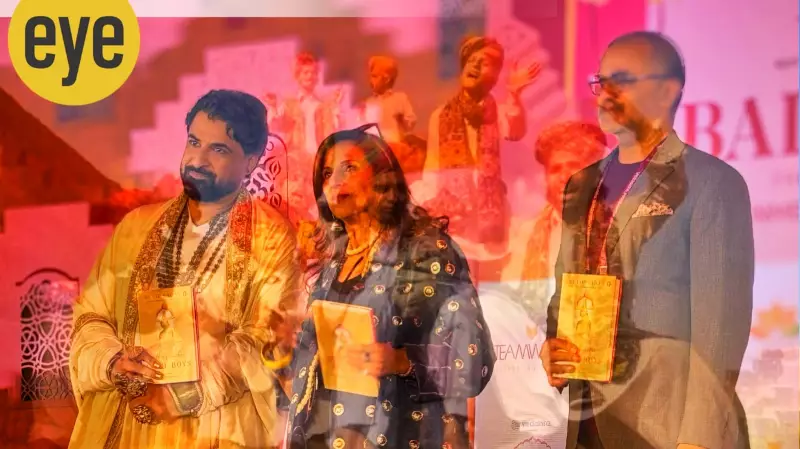
Then came another arrival, more intimate and trembling with consequence. My book, Tell My Mother I Like Boys, found its way into the world here. This memoir of a gay boy choosing repeatedly to live without fear launched at this festival felt less like coincidence and more like choreography.
Shobhaa De opened the book to the world with incisive, fearless brilliance. My family filled the first rows. My mother drove from Delhi with relatives, not as a gesture but as a given. Presence as love. Love as arrival.
What happened next undid me completely. Shobhaa stood on stage after cutting the ribbon and said she would speak from the heart. She spoke of being a co-mother. She said those words as if they had always existed, only now being named.
An Unguarded Moment of Connection
Shobhaa asked my mother to stand. She asked her to take credit for raising me. She spoke of the pages where I wrote about my mother, about the parenting I received. She marveled at it. She celebrated it. Then she praised me extravagantly, tenderly.
For the first time, this grown man cried on stage. Not a strategic tear. Not a cinematic moment. A sudden, helpless spilling. I cried because I never felt othered in that moment. I cried because my mother was being honored publicly, lovingly, without irony.

Here was Shobhaa naming herself co-mother while my own mother stood radiant and unflinching. Two women holding me up without asking me to shrink. Two cities collapsing into one embrace.
Conversation and Steadiness
When conversation began with Asad Lalljee, I was still trying to steady my breath. Asad held the discussion with grace, curiosity, and care. His questions opened rather than cornered. They allowed the book to breathe.
But that unguarded moment before the conversation stayed with me like a benediction. Something larger than a book was being said about India. About possibility. About how openness here isn't a borrowed virtue but a lived one.
A gay man telling his truth on one of the world's largest literary stages. His mother in the front row. A co-mother on stage. Applause that felt earned rather than performative. If you wanted a rebuttal to lazy cynicism about who we're becoming, it was there, untheorized and undeniable.
Preparation Through Participation
The song surfaced again in my mind. Gora gora haathon par mehndi rachayi. Henna has bloomed on these pale palms. Adornment not as vanity but as readiness. Hands prepared to receive, to bless, to hold.
That's what this festival does at its most potent. It prepares us. It readies the mind to be unsettled. The spirit to be soothed. The ego to be nudged aside. Success doesn't arrive here as armor. Vulnerability isn't treated as liability.
Accomplishment converses openly with doubt. A Nobel-level intellect can sit beside a debut poet, neither needing to shrink. A question from the audience can reroute a conversation. A sentence can loosen a certainty clutched too tightly for years.
Breaking Open and Walking Lighter
By the third day, my fever finally broke. Or perhaps something else broke first. The brittle insistence on being right. The reflex to categorize. I walked lighter. I listened harder.
I noticed children sitting cross-legged beside scholars. Elders nodded thoughtfully at challenging ideas. Strangers became temporary kin through the radical act of attention.
Another line drifted back. Mharo jeevan dhanyo ho gayo. My life has been blessed. It landed differently this year. Not as triumph but as gratitude. Gratitude for love. For welcome. For a mother who raised me without fear. For a co-mother who named that love in public.
The Festival's Lasting Gift
As days wound down, Jaipur returned to itself. Tents slowly emptied. Conversations echoed longer in the mind than in the air. I packed to leave still weak, still tender, but strangely well.
The city hadn't cured me but it had steadied me. The song closed the circle one last time. Kesariya balam, padharo mhare des. O beloved, please come to my land.
By then, I understood completely. Not just as Rajasthan speaking to the world, but as the world speaking back to itself. An ethic disguised as a melody. An invitation that doesn't end when music fades.
Come. Sit. Speak. Listen. Let words do their slow, necessary work. Let love be public. Let welcome be the point.