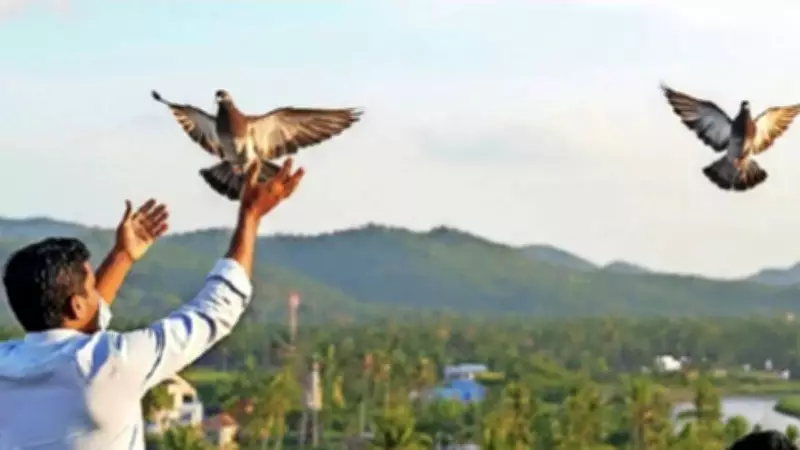
Pigeon Fanciers of Kerala: Where Passion Takes Flight
How can you identify a dedicated pigeon fancier? During an outdoor conversation, if someone's gaze frequently lifts toward the vast blue sky, you are likely speaking with one. Their profound love for pigeons and unwavering commitment to avian care is truly remarkable. Meet Saju AP from Malappuram, an IT professional by day whose evenings are entirely devoted to his feathered friends. He finds equal joy in breeding pigeons as he does in coding, maintaining a strict daily routine to tend to his pigeon loft regardless of weather conditions.
Inherited Passion and Pandemic Revival
Saju inherited his fascination with pigeon breeding from his father. "I have always harbored a passion for pigeon breeding," Saju explains. "During the Covid-19 lockdown, I rediscovered this interest that had faded while building my IT career. Now I regularly participate in pigeon flying competitions." His dedication represents a growing community of enthusiasts across Kerala who balance modern professions with traditional avian hobbies.
Veteran Expertise and Competition Formats
Saju introduced me to Hamsa Koya, a veteran pigeon fancier with over four decades of experience who serves as president of Parava Trainers, an association of pigeon enthusiasts. Koya specializes in 'time in the sky' competitions that test pigeon endurance—measuring how long birds can circle their home loft before landing.

"There are two primary competition types: Limited and unlimited," Koya elaborates. "In limited competitions, pigeons are released at 5:58 AM and must return by 7:30 PM. Unlimited competitions, where pigeons remain airborne as long as physically possible, represent a relatively new development here." Experienced breeders serve as umpires, visiting participating teams' lofts to ensure fairness. Disqualification occurs if a pigeon disappears for over an hour, though birds receive a two-hour grace period if adverse weather forces them into cloud cover.
Record Flights and Nutritional Care
Kerala's longest flight record stands at an impressive 33.28 hours, achieved in Palakkad. In the Malabar region, Falcon United of Parappanangadi holds the local record at 20 hours and 9 minutes. High-performance pigeons require specialized nutrition, including diets rich in almonds, raisins, and peanuts to maintain their aerial capabilities.
Societal Challenges and Ethical Commitment
"Unlike other regions of India, society here often looks down upon pigeon fanciers," Koya reveals. "We rarely receive family support. Yet this hobby demands tremendous responsibility, patience, dedication, and empathy. We never mistreat our pigeons. We provide excellent nutrition and never restrict their natural instinct to fly." This ethical approach forms the foundation of their practice despite social stigma.
Racing Enthusiasts and Extraordinary Journeys
While Koya and Saju focus on high-altitude flying, Saju's brother Sudesh AP, a school staff member, specializes in pigeon racing. His birds have completed remarkable journeys from distant locations to Malappuram, covering hundreds of kilometers. Sudesh also breeds fancy pigeons valued for appearance rather than racing prowess.
"Once, my pigeon departed from Goa but failed to return within the expected timeframe," Sudesh recalls. "At midnight, I received a call from a fisherman operating far off Mangaluru's coast. My exhausted pigeon had landed on his boat. I pleaded with him to feed the bird, and after eating, it miraculously flew home." Such stories highlight the unpredictable nature of their pursuit.
Long-Distance Racing Innovation
Long-distance racing, while globally popular, represents a relatively new development in Malabar. This discipline utilizes Racing Homers—a specialized breed transported far from their home lofts before release. Winners are determined by calculating the highest speed over measured distances using distance divided by time formulas.
Rafeeq Salvo (named after his loft) from Thanaloor pioneered long-distance racing in Kerala. As founding member and president of the Kerala Racing Pigeon Association and founding member of the Malabar Racing Pigeon Club, he established a remarkable record in July 2025 when his pigeon flew from Kalyan, Mumbai, to his home loft in just 18 hours.

Technological Integration and Regulatory Challenges
Beginning his journey in 2015 and competing from 2018, Rafeeq explains that modern racing utilizes specialized apps and bird bands instead of traditional umpires. Kerala's racing trend originated with one-loft racing, where multiple fanciers' pigeons train together in a single facility. "When pigeons fall ill, India lacks government-approved, pigeon-specific medicines," Rafeeq notes. "We depend on costly imports or local poultry medications." Prize money rarely covers expenses—transportation alone sometimes costs Rs 30,000. He hopes authorities will eventually recognize pigeon racing as a legitimate sport.
Aerial Dangers and Philosophical Reflections
The serene blue sky conceals numerous dangers for flying pigeons. Predators like accipiters (locally called Erladan) and falcons constantly threaten these birds. Fanciers often feel helpless watching raptors snatch their beloved pigeons, acknowledging that nature's laws remain beyond human control.
"If you're a true pigeon fancier, you become so devoted to these birds that vices like alcohol or drugs never cross your mind," Koya reflects, his eyes instinctively drifting skyward to scan for flying pigeons. This profound connection between humans and birds continues to inspire a unique subculture across Kerala, where modern professionals and traditional enthusiasts share skies filled with passion and perseverance.