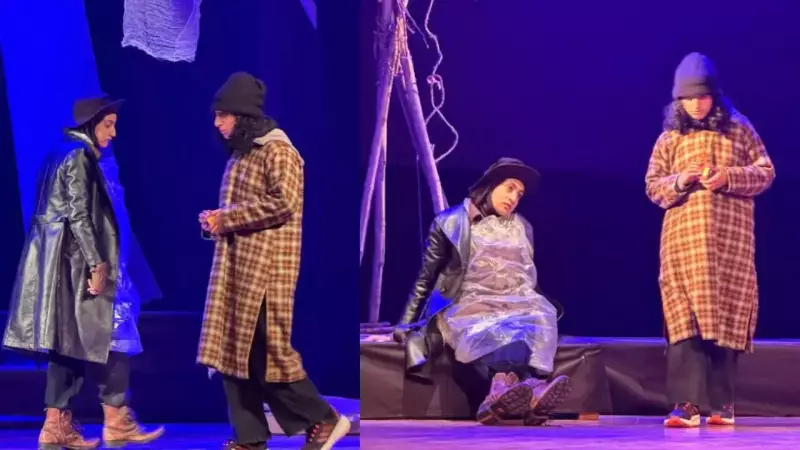
In a significant cultural event, a large assembly of senior Kashmiri theatre artists, writers, and directors convened at Srinagar's Tagore Hall this week. This marked the first such gathering in nearly two decades, sparking crucial conversations about the past, present, and uncertain future of theatre in the Valley.
A Stage for Reflection and Concern
Organized by the Sahitya Akademi in collaboration with the Srinagar-based Young Dramatists Society, the two-day seminar was steeped in nostalgia. The air, however, was also thick with anxiety about the survival of Kashmiri drama. The event itself became a rare performance, uniting the community on a single platform to passionately debate theatre's relevance, its original Kashmiri contributions, and its fading appeal among the younger generation.
Professor Shaad Ramzan, a scholar of the Kashmiri language, emphasized that theatre has remained one of Kashmir's strongest performing arts for decades, significantly enriching the region's literary life. Playwright M Amin Bhat described Kashmiri theatre as a resilient form still searching for its unique voice. "It has survived even through the past 35 years of political upheaval. What it lacks now is renewed purpose," he said, pointing out that youth are now drawn to social media reels instead of the stage.

The Golden Era and Its Unraveling
Discussions vividly recalled Srinagar's old city, particularly the historic Habba Kadal area, which served as a vibrant cultural hub. Writer Javeed Gilani noted its prominence first from the 1930s to 1950s, and again from the 1970s to 1980s. With no formal auditoriums, companies like the National Theatre Company and Maharaja Theatre Company performed in open fields and makeshift spaces. "Theatre boards were everywhere. Habba Kadal was the epicentre," Gilani reminisced.
This world began to disintegrate in the early 1990s as insurgency disrupted cultural life. Drama companies removed their signboards, and artists sought safer avenues in television and radio. Theatre activists Dildar Ashraf Shah and Sheikh Fatima recalled a time when the absence of a drama group in a village was seen as a "cultural deprivation." Troupes once traveled across north and south Kashmir, staging socially relevant plays.
Legacy, Critique, and a Glimmer of Hope
The seminar traced the evolution of Kashmiri theatre. The 1950s and 1960s saw the rise of the progressive movement, shaped by literary giants like Ghulam Ahmad Mehjoor, Abdul Ahad Azad, and Dina Nath Nadim. Folk theatre, especially Band Pather in south Kashmir, flourished. In Akingam, Mohammad Subhaan Bhagat founded the Kashmir Bhagat Theatre in 1962, training generations. Opera was introduced by Nadim in 1953, with works like 'Himal and Nagrai' performed internationally.
However, playwright Bhawani Bashir Yasir challenged the progressive movement's legacy, calling it "imported propaganda." He argued that Kashmiri theatre has lost its authentic voice but firmly rejected despair. "When voices are suppressed and books are banned, theatre must go on," he asserted. Theatre activist Nisar Naseen highlighted that while revival efforts began in the mid-1990s, contemporary productions often lack strong writing.
A hopeful note emerged just two days later at Tagore Hall. Theatre-director Arshid Mushtaq presented an English-language play, 'The travellers of Barzakh', performed by college students aged 18 to 23. Described as a "neo-absurd play," it engaged with Kashmiri philosophical themes. By casting young performers, Mushtaq made a clear statement: the Valley's youth will engage with theatre if presented with compelling scripts. For many, it was a poignant reminder that even in Kashmir's long winters, the stage can still generate much-needed warmth.