Urdu Academy Hosts Packed Event with Javed Akhtar Honoring Theatre Legend
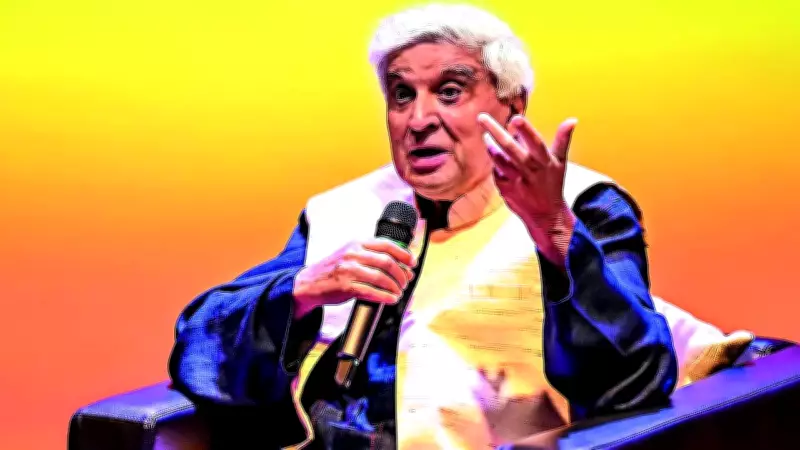
The historic Urdu Academy in Lucknow witnessed a remarkable gathering of literary enthusiasts, academicians, theatre professionals, historians, veterans, and cultural luminaries who came together to welcome celebrated poet-lyricist Javed Akhtar. The occasion marked the 105th birth anniversary commemoration of theatre doyen Shankar Dayal Tewari, creating an atmosphere brimming with intellectual discourse and cultural reverence.
Lucknow's Enduring Influence on Personal Identity
During the free-flowing conversation that spanned art, literature, society, and cinema, Akhtar immediately turned the focus to Lucknow, expressing profound pride in having spent his formative childhood years in the city. The legendary writer emphasized that Lucknow's influence has never diminished throughout his life.
"From etiquette to morality, everything I am comes from here, and even today, that influence remains," Akhtar declared passionately. "When I visit Lucknow, I feel it in people's manners, their way of speaking, their conduct—how much of Awadh still survives here. You encounter people who left Lucknow twenty-five years ago, settled elsewhere, yet they still carry pride in being from this city. They understand that being from Lucknow requires maintaining a certain language and demeanor."

The Fish and Water Metaphor for City Connection
Drawing a vivid and poignant metaphor, Akhtar compared his relationship with Lucknow to that of a fish and water. "It's precisely like a fish living in water. While immersed, it doesn't recognize the water's true value. Only when the fish ventures out and returns does it genuinely comprehend what water signifies. That's exactly what Lucknow represents for me," he explained with emotional resonance.
Distinct Linguistic Traditions of Lucknow
The discussion naturally progressed to Lucknow's distinctive linguistic characteristics, particularly the traditional use of "hum" instead of "main." Akhtar clarified this linguistic nuance that often gets misinterpreted by outsiders.
"People of Lucknow traditionally do not use 'main'; they employ 'hum.' Those unfamiliar with this custom sometimes perceive it as arrogance, but the reason was never pride. 'Hum' actually promotes gender neutrality in speech. It's considered almost vulgar to say 'main jaa rahi hoon' or 'main jaa raha hoon'—that's viewed as a crude manner of speaking in Lucknow's cultural context," Akhtar elaborated.
Formative Education at Colvin Taluqdar College
As an alumnus of Colvin Taluqdar College, Akhtar credited the institution with fundamentally shaping his ambitions and aesthetic sensibilities. He recalled a particularly memorable childhood anecdote that highlighted changing social attitudes toward children's sensitivity.
"Children today are raised with remarkable sensitivity—this wasn't the case during our childhood era," Akhtar reflected. "Contemporary parents discuss childcare with understanding, whereas in our time, discipline was more straightforward. I could have attended a school matching our financial means, but I was sent to Colvin instead. Around age eight, I desperately wanted the expensive shoes my classmates wore. After considerable crying and pleading, I finally received those shoes."
"Later, I faced such persistent taunting about it that the memory remains fresh: 'Brother, he has expensive tastes. He wears nineteen-rupee shoes, which cost more than school fees. Seventeen rupees for school fees and fifteen for tuition—altogether I was considered the family's expensive child,'" Akhtar recounted with laughter.
Literary Inheritance from Family Environment
Reflecting on his journey from struggling on Mumbai's streets to becoming Javed Akhtar, the writer addressed whether he inherited literature or struggle from his father, the renowned poet Jaanisar Akhtar.
"A child growing up never receives formal lectures on upbringing. However, the environment involuntarily affects development. Through osmotic processes, children absorb the atmosphere surrounding them," Akhtar philosophized.

That atmosphere, he emphasized, was saturated with literary discourse. "The household I grew up in featured detailed daily discussions about poets and literature. Poets were discussed as important public figures. Books were constant conversation topics. Numerous literary magazines arrived free because of Majaaz Lakhnawi, the famous poet and writer who happened to be my maternal uncle," he revealed.
Cordial Relationships and Personal Maturity
Speaking with characteristic candor about his personal life, Akhtar discussed his marriage to ex-wife Honey Irani and his relationship with actress Shabana Azmi.
"I've been fortunate in these matters. Honey is an exceptionally good person. Our thoughts, value systems, thinking patterns, and aesthetic sensibilities had significant gaps, but fundamentally, someone with different personality traits can still be an amazing individual. The cordial bond I share with Honey credits her more than me. Both of us maintained civilized behavior from the beginning," Akhtar stated.
Their priority remained consistently focused on their children. "We ensured nothing negatively affected them—that the father wasn't saying one thing while the mother said another. Both of us were sensitive about preventing relationships from turning sour. No separation is painless, but civilized people minimize that pain. If asked to name my three best friends today, Honey would definitely be among them," he affirmed.
Akhtar also acknowledged Shabana Azmi's gracious contribution. "Shabana demonstrated tremendous grace, large-heartedness, and maturity throughout. She never resented these matters. In fact, she consistently helped and cooperated with Honey, ensuring no collateral damage affected the children. Now they've become very good friends. All parties behaved with exceptional maturity and civility, which remains rare," he concluded.
Psychological Impact of Early Lucknow Years
When questioned about growing up in the City of Nawabs, Akhtar elaborated on his Awadhi roots with psychological insight.
"During a language debate, someone noted I was born in Gwalior. Yes, technically, but I resided there merely a few months. I arrived in Lucknow as a child and departed at age twelve. Psychologists confirm that personality substantially forms by age eight. Therefore, whatever qualities—positive or negative—exist in my personality, Lucknow bears responsibility for them," Akhtar asserted definitively.
Contemporary Cinema and Emotional Expression
Shifting to modern cinematic storytelling, when asked how present-day narratives might reflect contemporary youth anger, Akhtar observed that while aggression persists, society has grown increasingly uncomfortable acknowledging emotional vulnerability.
"We all harbor considerable aggression. However, society has developed a morality where people resist admitting they're hurt," Akhtar analyzed.
Comparing Hindi cinema across decades, he highlighted dramatic changes in emotional expression. "In average Hindi films from the 1950s and 1960s, you'd encounter at least two melancholic songs. Today, such expressions have nearly vanished. We've become unwilling to acknowledge our hurt and defeat. Everything must appear perfectly cheerful. In such a pretentious environment, how can a middle-class individual express anger? They develop complexes about displaying sadness," Akhtar concluded thoughtfully.