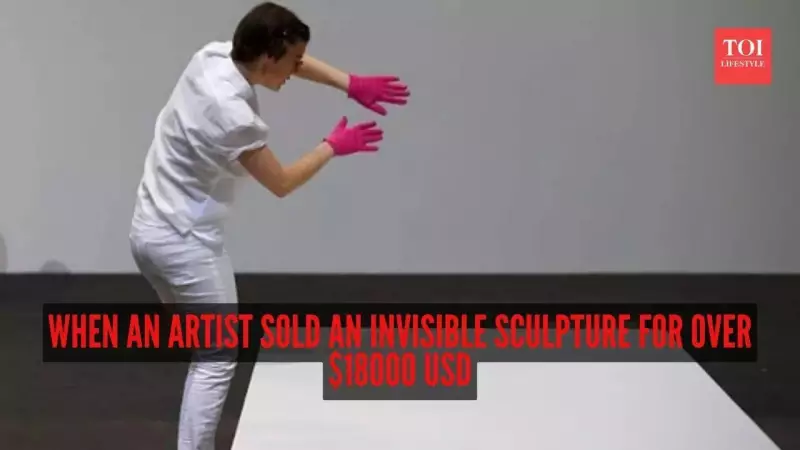
In a bold move that challenges the very foundation of artistic value, Italian artist Salvatore Garau has ignited a fierce global debate by selling an invisible sculpture. The artwork, titled 'Io sono' (Italian for 'I am'), fetched approximately €15,000 (over $18,000 USD) at an auction in Milan a couple of years ago, despite having no physical form whatsoever.
The Art of Nothing: A Certificate and Instructions
The transaction was far from conventional. The buyer did not receive a tangible object but was instead given a certificate of authenticity and a set of specific instructions. The artwork is to be exhibited in a designated, empty space measuring roughly five feet wide. This provocative act forces a fundamental question: when stripped of all physical attributes, what truly defines a piece of art?
Garau, defending his creation, argues that 'Io sono' is not an absence but a presence of a different kind. He describes it as a "concentration of thought and space." For him, the emptiness is a potent vessel, charged with meaning and intention. By eliminating the object entirely, Garau shifts the focus entirely onto the idea, making the viewer's own perception, imagination, and belief the central components of the artistic experience.

Conceptual Legacy vs. Market Skepticism
This piece sits firmly within the tradition of conceptual art, a movement that prioritizes the idea behind the work over technical skill or material craftsmanship. In this realm, the concept itself is the art, and its physical execution—or lack thereof—is secondary. 'Io sono' follows a lineage of works where creativity is divorced from traditional materials like marble, metal, or paint.
However, the substantial price tag attached to 'nothing' has drawn significant criticism and skepticism. Detractors see the sale as a glaring example of the excesses of the modern art market, where value appears disconnected from effort, skill, or accessibility. They question the logic of a market where 'nothing' can be sold as 'something,' wondering where the line should be drawn before commerce completely overshadows artistic merit.
Provocation as Purpose: The Supporters' View
Supporters of Garau and the piece counter that the widespread discomfort it causes is precisely its purpose and its value. They argue that 'Io sono' is a powerful social and philosophical provocation. It compels viewers to confront their deep-seated assumptions about worth, ownership, and reality.
The buyer, in this perspective, is not purchasing emptiness but buying into participation in a groundbreaking idea. The artwork's life is not in a gallery corner but in the discussions, disagreements, and interpretations it sparks globally. Its value is generated through dialogue and intellectual engagement rather than through static physical presence.
Ultimately, Salvatore Garau's invisible sculpture exists at the intriguing intersection of art, philosophy, and commerce. Whether it is celebrated as a brilliant, innovative concept or dismissed as a misguided commercial stunt depends entirely on one's personal beliefs about the nature of art. The undeniable fact is that it has succeeded in its core mission: to create consternation, pause, and debate. In doing so, 'Io sono' powerfully demonstrates that even a perceived 'nothing' can hold immense significance.