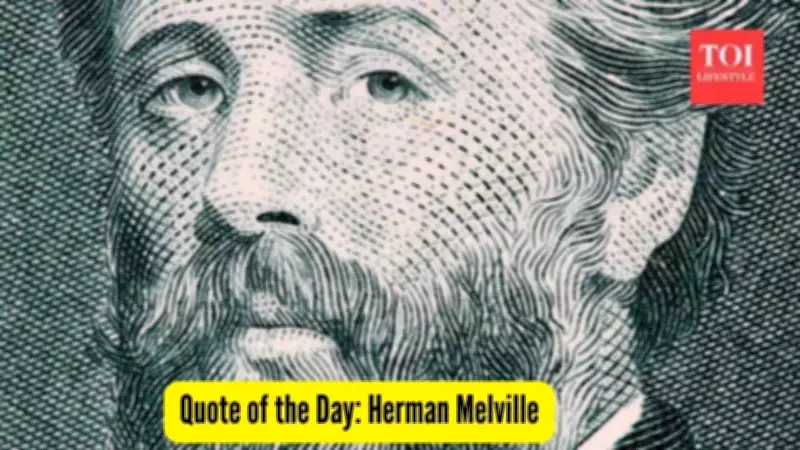
The Enduring Legacy of Herman Melville: From Whaling Ships to Literary Immortality
Herman Melville stands as one of the most courageous and influential writers in United States history. His extensive body of work masterfully intertwines elements of high-seas adventure, philosophical inquiry, and stark examinations of real-world societal issues. Born in New York City in 1819, Melville hailed from a merchant family background. His early life was marked by significant hardship following his father's business failure and untimely death, events that shaped his perspective and later writings.
A Life Forged on the Ocean Waves
At the age of 20, seeking escape and experience, Melville embarked on a transformative journey as a crew member aboard a whaling ship navigating the treacherous South Seas. This voyage ignited a lifelong fascination with the sea, its mysteries, and its metaphors, which would become central to his literary career. Drawing directly from these maritime adventures, Melville authored early successes like Typee and Omoo in the 1840s, novels that captured the public's imagination and established his initial fame as a writer of exotic tales.
The Masterpiece: Moby-Dick and a Literary Transformation
However, it was in 1851 that Melville achieved true literary mastery with the publication of Moby-Dick; or, The Whale. This monumental novel, though not an immediate commercial success, fundamentally altered his trajectory from a mere popular storyteller to a deep, philosophical thinker. Moby-Dick is narrated by the restless sailor Ishmael and chronicles the obsessive quest of Captain Ahab to destroy the enigmatic white whale, Moby-Dick, which had maimed him. Ahab's monomaniacal pursuit represents a profound struggle against fate, nature, and the divine.

The ship Pequod serves as a microcosm of humanity, with its diverse, multi-racial, and multi-faith crew symbolizing a collective journey toward an inevitable destiny. Melville's narrative is enriched by over 100 chapters detailing the minutiae of whaling—from harpoon techniques to cetacean biology—lending the story an unparalleled authenticity. This blend of factual detail with allegorical fiction creates a rich, layered text that continues to captivate readers and scholars alike.
Melville's Distinctive Literary Style and Influences
Melville's writing style is a key element of his enduring appeal. He crafted narratives that are simultaneously thrilling and intellectually demanding, weaving together themes from science, philosophy, and morality. His prose ranges from long, flowing, almost Shakespearean sentences to concise, direct declarations, demonstrating a versatile command of language. Influences from the Bible and Shakespeare are evident throughout his work, particularly in his symbolic depth and moral questioning.
His approach was experimental for its time, often pushing readers to confront grand themes such as the nature of God, human obsession, and societal power structures. By infusing his fiction with autobiographical elements and reflecting on contemporary American issues like slavery and industrialization, Melville ensured his stories resonated with a palpable sense of reality and urgency.
Why Moby-Dick Remains a Cultural Cornerstone
Moby-Dick has transcended its era to become a staple in high school curricula and book club discussions worldwide. Its legacy is celebrated in institutions like the New Bedford Whaling Museum, which hosts festivals honoring the novel. Twentieth-century critics, including D.H. Lawrence, hailed it as a "barrel of oil"—a rich, combustible source of literary energy—solidifying its status in the canon of great American literature.
The novel's opening line, "Call me Ishmael," has become iconic, drawing readers into a world of dry humor and profound reflection. Characters like Queequeg, the tattooed harpooner, embody themes of noble savagery and cross-cultural connection, while Ahab's rage serves as a timeless allegory for humanity's futile battles against insurmountable forces. Melville's deliberate ambiguity allows for myriad interpretations, ensuring the novel's relevance across generations.

A Sharp Critique of Social Hypocrisy
Beyond his nautical epics, Melville was a keen observer of social injustice. One of his most piercing quotes offers a deep and sarcastic critique of class dynamics: "Of all the preposterous assumptions of humanity over humanity, nothing exceeds most of the criticisms made on the habits of the poor by the well-housed, well-warmed, and well-fed."
This observation sharply condemns the hypocrisy of the privileged elite who judge the survival strategies of the impoverished without empathy or understanding. It reflects a core theme in Melville's work: the dangerous misunderstandings that arise from power imbalances, mirroring Ahab's harsh governance of his crew. Drawing from his own experiences with poverty, Melville exposes the arrogance of moralizing from a position of comfort, urging humility and kindness in societal judgment. This critique remains strikingly pertinent, echoing in modern debates over welfare, inequality, and social responsibility.
In summary, Herman Melville's legacy is built on a foundation of adventurous spirit, philosophical depth, and unflinching social commentary. Through masterpieces like Moby-Dick, he crafted stories that are not merely tales of the sea but profound explorations of the human condition, ensuring his place as a titan of American literature whose work continues to inspire, challenge, and resonate deeply with readers around the globe.