The Divine Warrior: Understanding Goddess Katyayani's Origins and Power
Goddess Katyayani stands as one of Hinduism's most formidable divine figures, renowned as Mahishasuramardini—the powerful slayer of the buffalo demon Mahishasura. She is also widely known by the names Bhadrakali and Chandika, each title reflecting a different aspect of her immense spiritual authority. These names are not merely decorative honors but profound indicators pointing toward a central cosmic truth about divine intervention against chaos.
Two Sacred Origins: Sage Katyayan's Devotion and the Gods' Collective Power
The origins of Goddess Katyayani are preserved through two primary sacred narratives, both carrying the same essential message about divine response to universal disorder. In the first account, the revered Sage Katyayan engaged in intense prayer and meditation, seeking to have the Goddess manifest as his daughter. In response to his sincere devotion, she appeared before him, subsequently undertaking the monumental task of destroying numerous demons, most notably the formidable Mahishasura.
This narrative reveals something quietly revolutionary about spiritual practice. A heartfelt prayer transforms into a tangible relationship, and that sacred connection becomes strength manifested in decisive action. The Goddess appearing before the sage represents far more than a mythological scene—it marks the pivotal moment where genuine devotion receives the ultimate answer through divine presence. What follows this encounter is direct and uncompromising: she systematically destroys demons and ultimately vanquishes Mahishasura. This backstory teaches that authentic devotion is never passive but actively calls forth transformative power that confronts and eliminates what causes harm.

The Markandeya Purana Account and the Celebration of Durga Puja
According to the ancient Markandeya Purana scriptures, when Mahishasura's tyranny created widespread universal unrest and threatened cosmic balance, the troubled gods gathered in council. Recognizing that scattered efforts would prove insufficient against such formidable evil, they pooled their divine energies into a concentrated, organized force. From this collective divine power emerged Goddess Katyayani, who then proceeded to confront and ultimately slay the demon, restoring order to the universe.
This monumental victory is celebrated extensively today as Durga Puja, one of Hinduism's most significant festivals. The phrase "organized, concentrated energy" captures the essential lesson here. When unrest spreads universally, fragmented responses prove inadequate. The gods demonstrate strategic wisdom by gathering, pooling their resources, and channeling their combined might into a singular, focused manifestation. The Goddess emerges from this unified power and achieves decisive victory. Reading this narrative carefully reveals a timeless lesson about how true triumph is born—not from panic or disorganized effort, but from collected, purposeful power.
The Gopis' Prayer and Profound Symbolic Meanings
Another dimension of Goddess Katyayani's significance appears in the story of the Gopis, who prayed to her seeking Lord Krishna as their husband. Beyond the surface narrative, this account holds profound symbolic meaning. "Attaining Krishna as a husband" represents the spiritual blessing of a partner possessing Krishna-like divine qualities—someone embodying love, virtue, and spiritual excellence. This reflects devotion that seeks not merely a person but an elevated quality of life and divine love.
The Symbolism of Mother Katyayani's Divine Form
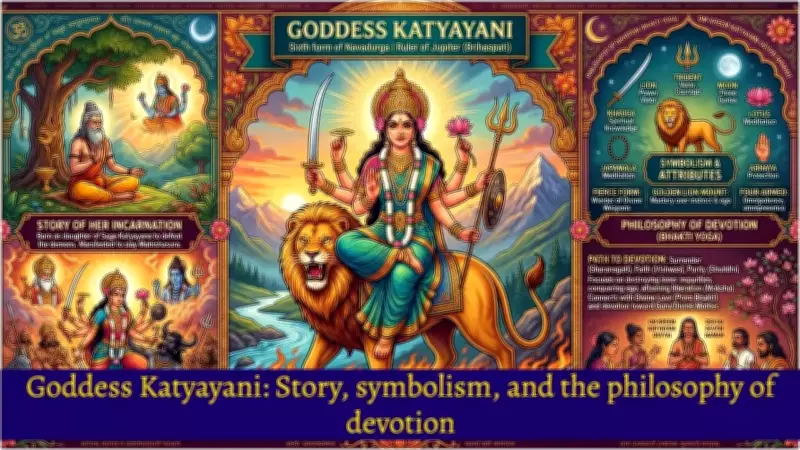
Mother Katyayani's physical manifestation carries deep spiritual significance through every aspect of her representation. She typically appears with four hands, each holding specific symbolic items. In one hand, she wields the sword Chandrahas, representing the power to cut through ignorance and evil. In another hand, she holds a lotus flower, symbolizing purity, spiritual awakening, and divine beauty.

Her remaining two hands are positioned in sacred mudras (gestures): the Abhaya Mudra, which dispels fear and offers protection, and the Var Mudra, which grants boons and blessings. She rides majestically upon a lion named Shardula, representing courage, strength, and royal authority. As the ultimate destroyer of demons and negative forces, every element of her form offers spiritual guidance. Integrating this symbolism into daily consciousness means remembering what each sign represents: fear dispelled, blessings granted, negative forces destroyed, and love sought as divine, virtuous, and transformative.
These narratives collectively present Goddess Katyayani not merely as a mythological figure but as a living spiritual principle—the divine force that rises precisely when demons and negative forces threaten cosmic harmony. Universal unrest is never treated as normal or acceptable; it is confronted directly, met with organized power, and decisively ended through divine intervention.