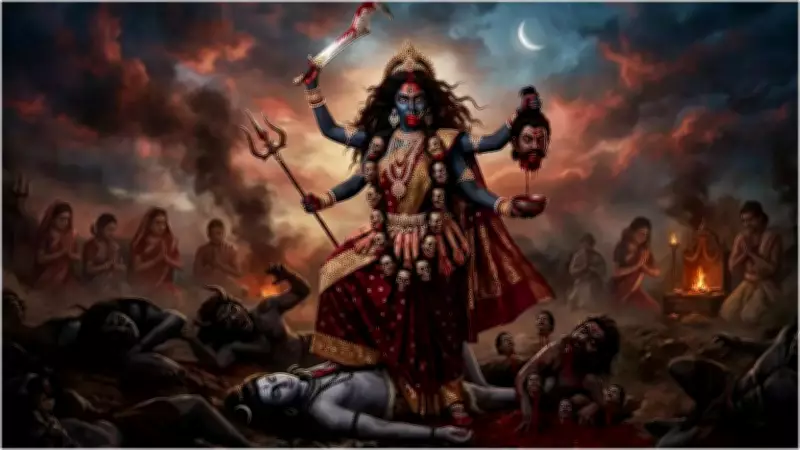
The Dual Nature of Goddess Kaalratri: Terror and Auspiciousness
The name Kaalratri carries profound meaning in Hindu tradition. "Kaal" translates to death, while "Raatri" means night, suggesting her origin at the boundary where time and sky converge. Her appearance can indeed be terrifying, yet she is simultaneously revered as Shubhkari, meaning "the one who brings auspiciousness." This duality forms the core of her spiritual significance.
The Conditions for Her Blessings
Her auspicious nature is not arbitrary or random. Kaalratri bestows good fortune specifically upon those who adhere to nature's fundamental laws and demonstrate genuine respect for women. There exists a profound truth embedded within this spiritual framework: her blessings flow toward individuals who practice discipline, exercise restraint, and maintain regard for righteous principles in their daily lives.
Symbolic Battles: External Conflicts Mirror Internal Struggles
The mythological battles of Goddess Kaalratri represent far more than historical conflicts; they symbolize the universal human experience of inner turmoil. The demons she confronts embody various aspects of human nature:

- Chand, Mund, Shumbh, and Nishumbh represent the havoc created when bodily tendencies and unchecked emotions transform into uncontrollable forces.
- Raktabeej specifically symbolizes endless, multiplying desires—every drop of his blood that touched the ground created an identical clone, illustrating how unchecked cravings regenerate and expand.
This narrative serves as a sharp mirror to human psychology, demonstrating how desires persistently return and multiply unless consciously addressed through spiritual practice.
Physical Form and Symbolic Weapons
Goddess Kaalratri's appearance is vividly described in sacred texts: she possesses a dark complexion, rides a donkey, has unkempt hair, three fiery eyes, and breathes flames from her nostrils. Her four hands hold deep philosophical meaning through their implements and gestures:
- Upper left hand: Holds a Vajra studded with iron spikes
- Lower left hand: Carries a large sword
- Right hands: Display the Var Mudra (gesture of blessing) and Abhay Mudra (gesture of fearlessness)
The symbolism is direct and powerful: her left hands represent the destruction of wickedness and those who violate societal norms, while her right hands offer blessings and protection to devotees who follow righteous principles. This combination embodies her complete nature—fierce on one side, sheltering on the other, with both aspects existing simultaneously as complementary truths.
Mythological Origins and Ultimate Victory
The backstory of Goddess Kaalratri emerges from cosmic necessity. When demons Chand, Mund, Shumbh, and Nishumbh created havoc beyond the control of even Brahma, Vishnu, and Shiva, Goddess Kali emerged from Goddess Parvati's body. Manifesting as the dark Kaalratri, she first killed Chand and Mund, earning the name Chamunda, then proceeded to slay Shumbh and Nishumbh.
During this epic battle, the demon Raktabeej presented a unique challenge with his cloning ability. Goddess Kali achieved ultimate victory by absorbing every drop of his blood before it could touch the ground, thus controlling forces that even the gods could not manage. Her depiction standing with feet on Lord Shiva (Mahakaal) symbolizes her power to transcend even the ultimate limits of time itself.
The Contemporary Message
The teachings of Goddess Kaalratri remain profoundly relevant today. Her mythology encourages individuals to:
- Follow nature's fundamental rules and rhythms
- Respect women as embodiments of divine energy
- Live according to righteous principles and ethical codes
- Confront and control endless desires before they multiply
- Cultivate fearlessness in spiritual practice
This ancient wisdom provides a framework for navigating modern challenges while maintaining spiritual integrity and inner peace.