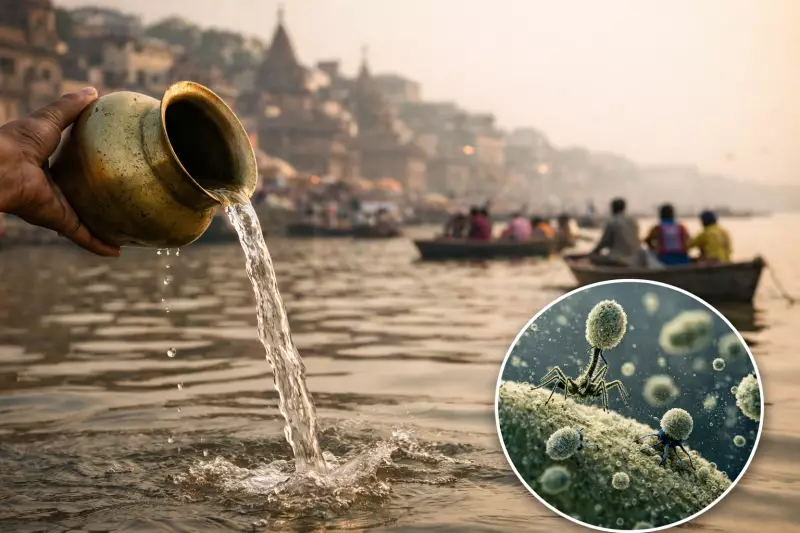
The Ganga River is far more than a mere waterway; it is the spiritual lifeline of India, a cultural magnet that has witnessed the evolution of great civilizations, cultures, and religions along its banks. For countless Hindus, Ganga jal holds profound religious significance and is considered spiritually uplifting, with almost every household storing it for various rituals and purposes. Remarkably, this water is believed to resist spoilage for years or even decades, without developing foul odors, discoloration, or microbial decay—a phenomenon that devotees attribute to divine grace, while scientists see it as a fascinating natural mystery worth exploring.
The Historical Observation That Sparked Scientific Curiosity
The enigma of Ganga water first caught scientific attention in the late 19th century, thanks to British bacteriologist Ernest Hankin. While studying cholera outbreaks in India, he observed something unusual: areas near the Ganga had lower cholera mortality rates, despite people drinking untreated river water. More intriguingly, when cholera bacteria were introduced into Ganga water, they died rapidly compared to ordinary water. This early observation laid the groundwork for subsequent discoveries in microbiology, hinting at the river's unique self-purifying capabilities.
The Role of Natural Bacteriophages in Water Purity
One of the strongest scientific explanations for Ganga water's resistance to spoilage lies in bacteriophages—viruses that infect and destroy bacteria. Ganga water contains an unusually high concentration of these naturally occurring bacteriophages, which specifically target harmful bacteria like those causing cholera and dysentery. When bacteria enter the water, these phages multiply quickly and neutralize them before they can grow or cause decay. This microbial balance helps explain why stored Ganga water remains fresh far longer than ordinary river or tap water, as highlighted in a study published in the National Library of Medicine on the self-cleansing properties of the Ganga during mass ritualistic bathing events.

High Dissolved Oxygen Levels and Their Impact
Another critical factor is the Ganga's high dissolved oxygen content, particularly in its upper stretches near Gangotri, Rishikesh, and Haridwar. Fast-flowing water over rocky terrain naturally absorbs more oxygen, which inhibits the growth of anaerobic bacteria responsible for foul odors and decay. This oxygen-rich quality gives the water a unique resilience against stagnation, even as it flows downstream. The constant motion also prevents sediment buildup, disperses organic waste, and supports aquatic life, creating a self-sustaining cycle of cleanliness and natural renewal rarely found in still bodies of water.
Antibacterial Minerals and Their Subtle Effects
Studies have found that Ganga water contains trace amounts of minerals, such as sulfur compounds and certain metallic ions, with natural antibacterial properties. Although present in small concentrations, these minerals cumulatively slow microbial growth without sterilizing the water completely, maintaining an ecological balance. Unlike harsh chemical disinfectants, they work subtly to preserve the water's purity, contributing to its long shelf life when stored.
Why Stored Ganga Water Smells Earthy, Not Foul
People often notice that stored Ganga jal emits an earthy aroma rather than a foul odor. This is due to harmless microorganisms and natural organic compounds, not decay. Spoilage odors typically arise from gases like hydrogen sulfide and ammonia released by decomposing bacteria, but since bacteriophages suppress these bacteria early, such gases never accumulate to noticeable levels. This explains why the water retains a pleasant, natural scent over time.
The Impact of Flow and Continuous Renewal
The Ganga is a living, moving system continuously fed by glaciers, tributaries, rainfall, and underground springs. This constant flow prevents the buildup of organic waste and microbial colonies, making the water inherently resistant to decay. Even when stored, Ganga water often retains this balance because it starts with a lower harmful bacterial load, thanks to the river's dynamic nature.

Faith, Science, and Environmental Realities
It is crucial to clarify that Ganga water's self-cleansing properties do not make it always safe to drink today. Industrial pollution, sewage discharge, and plastic waste have severely affected parts of the river, especially downstream of major cities. The ancient observations about its purity were made when natural systems were less stressed. Science explains its inherent resilience, not immunity to modern pollution. Here, faith and science converge in an important way: reverence alone cannot protect the river; understanding its unique properties makes preservation even more urgent.
A Rare Natural Phenomenon, Not a Miracle
Ganga water's resistance to spoilage is not magical, yet it is extraordinary. The combination of bacteriophages, high oxygen levels, mineral composition, and constant flow creates a rare ecological balance that modern science continues to study. What ancient traditions recognized through experience, science now explains through evidence. This lesson underscores that when nature is respected, it reveals qualities that seem miraculous until understood—and with understanding comes a greater responsibility to protect such wonders for future generations.