Jaipur Lit Fest Session Delves into Divergent Paths of Gandhi, Savarkar, and Jinnah
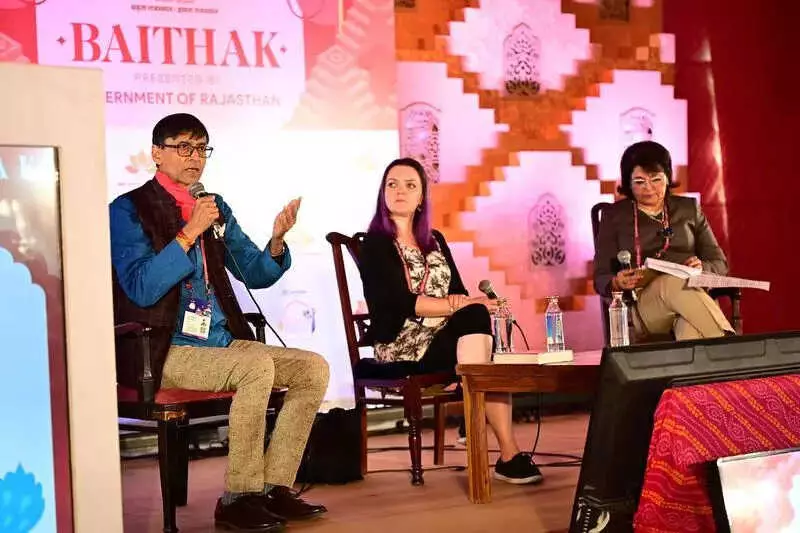
The Jaipur Literature Festival hosted a compelling discussion on Saturday titled "Polarities: Gandhi, Savarkar and Jinnah." This session brought the sharply contrasting political ideologies of Mahatma Gandhi, Vinayak Damodar Savarkar, and Muhammad Ali Jinnah into sharp focus. Scholars and historians examined how these three leaders shaped the idea of Indian nationalism in profoundly different ways.
Panelists Explore Key Historical Turning Points
The discussion featured scholar Makarand R Paranjape, historian Alex von Tunzelmann, and author Kishwar Desai. They provided deep insights into the leaders' roles during India's freedom struggle. Paranjape highlighted a critical moment after the Khilafat Movement. This movement aimed to restore the Caliphate in Turkey. Gandhi supported it to promote Hindu-Muslim unity. Savarkar, under house arrest in Ratnagiri, received a visit from Gandhi. During this meeting, Savarkar warned Gandhi. He said Gandhi's policy of Muslim appeasement could ultimately lead to the Partition of India. Paranjape noted that Gandhi's views on Hindu-Muslim unity remained steadfast despite this warning.
1909 Publications: Starkly Different Visions for India
The panel reflected on two seminal works published in 1909. Gandhi's 'Hind Swaraj' and Savarkar's 'The Indian War of Independence' both addressed India's quest for freedom. However, they offered starkly different visions. Gandhi advocated for non-violence and moral restraint in his writings. Savarkar emphasized armed resistance and a more aggressive approach. Together, these ideas profoundly shaped India's political and social discourse. Their influence extended through the run-up to Partition and beyond, leaving a lasting impact on the nation's history.

Moving Beyond Binary Views of Secularism and Religion
Paranjape cautioned against viewing early 20th-century politics through a simple binary of secularism versus religion. He observed that Jinnah was once regarded as a champion of Hindu-Muslim unity. Gandhi described himself as a Sanatani Hindu. Savarkar identified as an atheist. These personal beliefs complicated their public political stances. Paranjape cited anecdotes to underline these contrasts. He noted that Jinnah, who advocated for Muslims, preferred to eat salami, which contains pork. Savarkar openly rejected religious orthodoxy in his personal life.
Complex Relationships and Foresight in Political Analysis
Paranjape also pointed out the complex relationships between these leaders. Jinnah criticised Gandhi as impractical in his methods. Savarkar, however, praised Gandhi's influence on Indian society. He wrote in Marathi that Gandhians left a profound impact despite ideological differences. Additionally, Savarkar foresaw several external threats to India. He believed that Congress leaders failed to anticipate these dangers. Paranjape added an interesting historical note. The Hindu Mahasabha was initially founded by Congress figures. Notable founders included Madan Mohan Malaviya and Lala Lajpat Rai. This highlights the intertwined nature of political movements during that era.