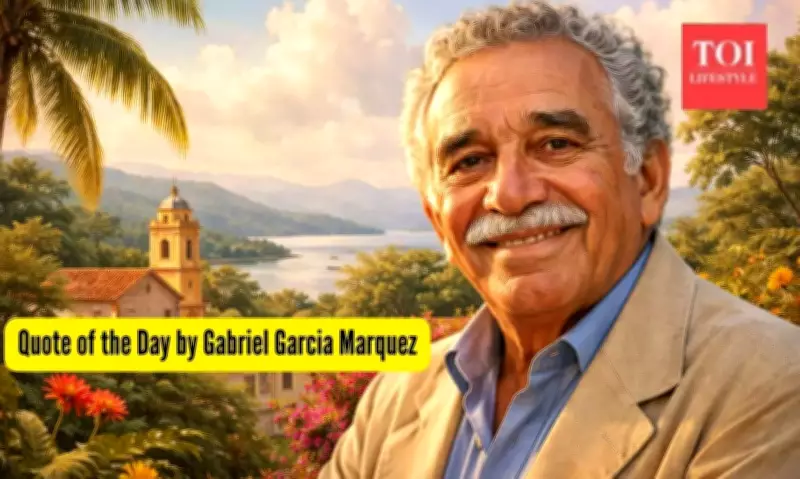
The Birth of a Literary Legend in Aracataca's Sweltering Embrace
In the humid, tropical cradle of Aracataca, Colombia, where vast banana plantations stretched endlessly beneath skies pregnant with monsoon potential, Gabriel García Márquez entered the world on March 6, 1927. This small town, once booming under the United Fruit Company's empire before being shattered by the tragic 1928 Banana Massacre, provided the raw, historical clay that would later be molded into literary masterpieces.
A Childhood Steeped in Myth and Oral Tradition
From ages five to eight, young Gabo lived not in an ordinary home but in his grandparents' house—a living, breathing myth ruled by two formidable figures. His grandfather, Nicolás Márquez, was a liberal war veteran with a storm-cloud mustache who taught the boy violin, jungle river swimming despite piranha threats, and vivid stories from Colombia's Thousand Days' War.
His grandmother, Tranquilina Iguarán, served as the family sorceress, casually conversing with spirits over coffee and insisting their yellow flowers bloomed only before calamities. She spun tales of ghosts and omens as effortlessly as she stirred traditional sancocho stews, creating an atmosphere where the improbable felt utterly real.

"The world was sad, strange, and oversweet," Gabo would later reflect, capturing the essence of those formative years when he absorbed family epics of feuds, floods, and massacres instead of conventional schoolbooks.
The Evolution from Rebellious Student to Literary Pioneer
Formal education arrived later in Barranquilla and Zipaquirá, where strict Jesuit instruction clashed with García Márquez's rebellious nature. By 1947, studying law at Bogotá's National University bored him profoundly, while journalism beckoned with irresistible allure.
He voraciously consumed Kafka, Hemingway, and Joyce, but found his true literary compass in William Faulkner, whose techniques for capturing the American South showed him how to tame Colombia's wild, complex realities. This fusion of influences would eventually birth his signature style: magical realism.
The Literary River: From Early Works to Global Recognition
Foundational Novels and the Birth of Macondo
García Márquez's literary journey began in newspapers like El Espectador, where he published "The Third Resignation" in 1955—a story about a boy's stoic suicide that hinted at the tender absurdities to come. His debut novel, Leaf Storm (1955), already breathed the enchanted air of Macondo, the fictional town mirroring Aracataca.
This was followed by No One Writes to the Colonel (1961), a lean exploration of poverty and pride, and In Evil Hour (1962), which captured small-town scandals with the intensity of street vendors hawking tamales.
One Hundred Years of Solitude: A Comet Over Latin America
The 1967 publication of One Hundred Years of Solitude erupted like a literary comet, selling half a million copies in just three years and igniting the Latin American Boom. The novel traces seven generations of the Buendía family in Macondo, featuring unforgettable characters like:
- José Arcadio Buendía, inventor of war machines and magnets of fate
- Úrsula Iguarán, the matriarch whose spine straightens against time itself
- Aureliano Buendía, the colonel who leads 32 uprisings then forges tiny gold fishes in solitude
The novel masterfully blends incestuous family curses, Sanskrit prophecies, flying carpets over coffee plantations, and a beauty so radiant she sweats flowers—all culminating in a wind that erases all traces, with the haunting conclusion that "races condemned to one hundred years of solitude did not have a second opportunity on earth."
Later Masterworks and Nonfiction Achievements
García Márquez's subsequent works continued to redefine literary boundaries:

- The Autumn of the Patriarch (1975): A dictator's endless, looping monologue
- Love in the Time of Cholera (1985): Florentino Ariza's 51-year, 9-month, and 4-day wait for Fermina Daza's love
- The General in His Labyrinth (1989): A humanizing portrait of Simón Bolívar's final days
- Of Love and Other Demons (1994): A girl's saintly possession in colonial Cartagena
His nonfiction shone equally bright, particularly Chronicle of a Death Foretold (1981), which transformed real gossip into a masterpiece about a murder everyone knew would happen but nobody prevented, and News of a Kidnapping (1996), raw reportage on drug lords' terror.
The Magical Realism Style: A Revolutionary Literary Approach
García Márquez's signature style—magical realism—represents a sly fusion where the marvelous invades the mundane without explanation or fanfare. Levitating priests and insomnia plagues simply exist, much like Aracataca's butterflies. His sentences cascade in golden, sinuous waves, packed with synesthetic adjectives that paint sounds with colors and regrets with scents.
Time folds accordion-like in his narratives, with flashbacks within prophecies and centuries compressed into single pages. Characters float within collective fates, their passions both epic and intimate, always laced with gentle, mocking humor. This oral, rhythmic prose was born from grandmothers' yarns and Barranquilla's bohemian nights with poets like Álvaro Mutis.
A Nobel Recognition and Enduring Legacy
In 1982, García Márquez received the Nobel Prize in Literature—not for mere literary fireworks, but for novels and short stories "in which the extraordinary and the real... mingle in a world where Latin American reality is reflected." Critics celebrated his approach as the "total novel," seamlessly blending history, myth, and gossip into unified artistic visions.
One of his most iconic observations comes from Love in the Time of Cholera: "The problem with marriage is that it ends every night after making love, and it must be rebuilt every morning before breakfast." This reflects his realist perspective on relationships as ever-changing constructs requiring constant effort rather than static, idealized institutions.
Gabriel García Márquez passed away in Mexico City in 2014, having lived there since 1961, his eyesight fading like Macondo's disappearing ink. Yet his words endure as literary butterflies over our gray mornings, reminding us through eighteen books and countless stories that reality remains the least certain thing of all.