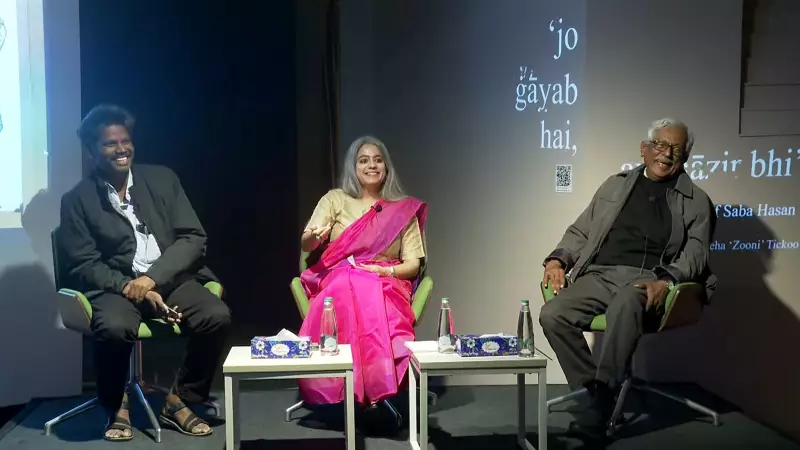
In an era where the presence of political cartoons in mainstream Indian newspapers appears to be dwindling, a recent panel discussion sought to examine the past, present, and future of this vital art form. The session, titled "Political Cartooning in India Today," was held at the Kiran Nadar Museum of Art (KNMA) in conjunction with the exhibition "Please Touch Gently: A Colloquium on Zines, Comics, Ephemera." Moderated by Neha Khurana, the conversation featured insights from two prominent voices: EP Unny, chief political cartoonist at The Indian Express, and Unnamati Syama Sundar, an anti-caste cartoonist.
From Colonial Roots to Inherent Dissent
The discussion opened with a historical deep dive. EP Unny traced the origins of Indian political cartooning back to the 18th and 19th centuries, highlighting the initial influence of British publications. The role of magazines like Punch and its Indian adaptations, most notably the Oudh Punch (Awadh Punch), was examined in detail. Moderator Neha Khurana drew a parallel between the iconic satirical figure of Mr. Punch and older Indian traditions of critique, such as the Vidushaka in Sanskrit drama. This established that while the visual form of cartooning arrived with print culture, the spirit of satire has ancient roots in the subcontinent.
This historical context led to a pivotal question: did the emergence of cartooning under colonial rule make dissent its natural language? For Unny, the answer was clear. "An element of subversion is inherent to this medium," he stated, connecting modern cartoons to historical traditions where satire served as a sanctioned method of speaking truth to power.

Archival Gaps and the Shadow of Caste
The conversation took a critical turn when Unnamati Syama Sundar raised pressing issues of caste and historical erasure within the cartooning archive. He pointed out that some crucial cartoons, including controversial depictions of B.R. Ambedkar, are conspicuously missing from historical records. Sundar suggested this absence is not a simple oversight but a revealing indicator of the power dynamics and prejudice that have shaped the documented history of Indian cartooning.
While the panelists had differing interpretations on specific artworks, they found common ground on the importance of preservation. "Cartoons are a contribution to history-making," Unny asserted, lamenting that "there isn't any proper archiving of cartoons in India." This lack of a formal archive, Sundar implied, allows certain narratives and voices to be systematically forgotten.
The Emergency's Impact and the Modern Landscape
A significant rupture in the history of Indian cartooning was identified during the Emergency period (1975-1977). Khurana described how stringent censorship directly altered cartoonists' practices. She cited the legendary R.K. Laxman, whose work was often rejected based on how much laughter it might provoke. The instant stamp of "not passed by censor" represented a decisive shift. However, cartoonists learned to adapt, embedding subtle critiques within seemingly compliant imagery, thereby teaching readers to decode newspapers in new ways.
Addressing the contemporary scene, Unny linked the shrinking space for cartoons in print to a broader decline in nuanced public debate. He argued that weak access to reliable information and the rampant spread of fake news undermine the very foundation of effective political cartooning. Despite these challenges, he expressed cautious optimism. "Humour is by definition subversive," Unny noted, confident that satire will persist and evolve, finding new life in digital comics, graphic reportage, and other emerging formats.
In her concluding remarks, Neha Khurana reflected that political cartoons uniquely occupy the intersection of journalism, art, and satire. Their apparent lightness, she suggested, is a powerful tool—a way to insist that authority can always be sketched, questioned, and, ultimately, laughed at.