Ralph Waldo Emerson (1803–1882) stands as a towering American philosopher, poet, and lecturer, renowned as a leading figure in the Transcendentalist movement. This intellectual school championed the idea that truth is discovered through direct intuition, nature, and inner experience, rejecting purely empirical approaches.
Emerson's Intellectual Pursuits and Influences
Emerson's interests spanned diverse fields, including Eastern philosophies, natural science, and astronomy. His holistic worldview saw the universe as alive and symbolic, rather than mechanical. He famously articulated that nature serves as a visible expression of invisible spiritual laws, emphasizing a deep, mystical connection between the cosmos and human existence.
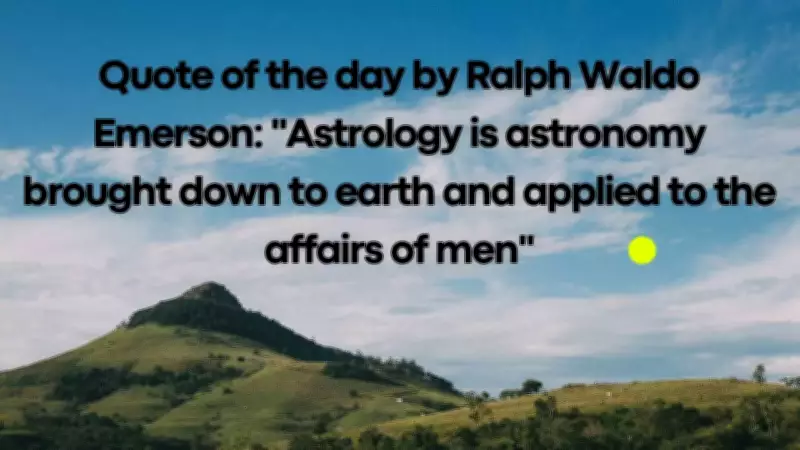
The Famous Quote: "Astrology is astronomy brought down to earth and applied to the affairs of men"
This insightful statement by Emerson encapsulates his belief in astrology as a practical application of astronomical knowledge to human life. For him, astrology was not mere superstition but a meaningful interpretation of cosmic patterns that influence human affairs. He viewed it as a bridge linking the vastness of the cosmos with the intricacies of daily human experience.

Nature and Cosmos: A Symbolic Relationship
Emerson posited that every natural fact symbolizes a spiritual fact. In his view, stars, planets, and cosmic rhythms are not distant, inert objects but expressive elements of the universe. Nature, he argued, embodies divine energy, with astrology acting as a tool to understand how cosmic movements resonate with human character and experiences.
Astrology Versus Astronomy: A Comparative Analysis
Emerson drew a distinction between astronomy and astrology, not to dismiss science but to highlight their complementary roles. Astronomy analyzes celestial phenomena scientifically, while astrology interprets these phenomena in the context of human life. He believed humans are intrinsically connected to the universe, with stars and planets influencing our being. Astrology, therefore, translates the cosmic order into insights about personal and collective human dynamics.
Astrology as a Guide, Not a Deterministic Force
Importantly, Emerson did not endorse fatalism through astrology. Instead, he saw it as a map that outlines potential events and influences in one's life, without dictating a fixed destiny. It functions as a bridge between the stars and the human soul, facilitating a deeper understanding of how the universe interacts with individual lives. This perspective aligns with his broader Transcendentalist ideals, emphasizing personal intuition and spiritual growth over rigid doctrines.
In summary, Emerson's thoughts on astrology reflect his profound belief in the interconnectedness of all things. By viewing astrology as astronomy applied to human affairs, he offered a unique lens through which to explore the cosmic dimensions of our existence, encouraging a reflective and intuitive engagement with the world around us.