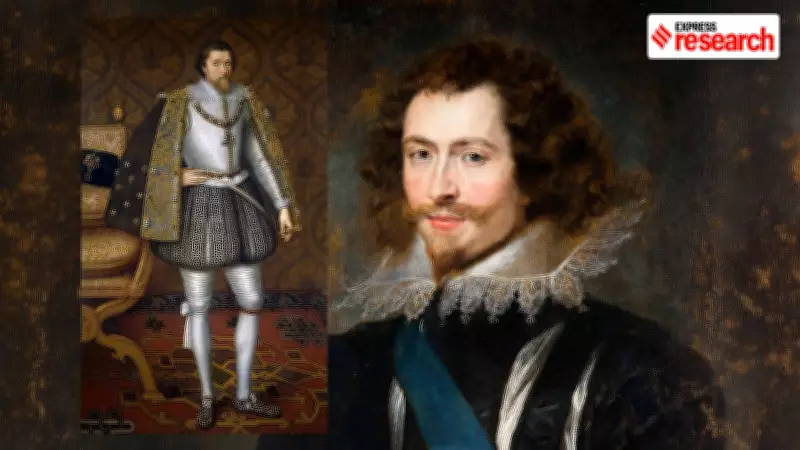
The Assassination That England Celebrated
In August 1628, a dramatic political murder unfolded in a Portsmouth lodging house that would reverberate through English history. John Felton, a disgruntled former army officer, stabbed George Villiers, the first Duke of Buckingham, to death. What followed was extraordinary: church bells rang across England, pamphlets circulated celebrating the assassin, and crowds treated the murder as an act of public justice rather than private crime.
This reaction reveals the extraordinary position Buckingham occupied in Stuart England. As the favourite and intimate companion of King James I, and later the de facto chief minister to Charles I, Buckingham had risen from modest gentry to dominate English politics, patronage, and foreign policy in little more than a decade. Yet by the time of his death, he had become what historian Lucy Hughes-Hallett calls "the grievance of grievances" - a figure onto whom all political discontent could be projected.
The Making of a Hate Figure
Four centuries later, Buckingham remains one of the most reviled figures in English history. Contemporary descriptions called him "a devil, a spotted monster, a comet that disrupted the natural order." He was accused of being a traitor to his country, an enemy of the people, and even a regicide who poisoned the king who loved him. These accusations sat uneasily alongside other contemporary testimony describing Buckingham as "modest, courteous, kind, obliging, affectionate, generous, gracious, loving and, again, modest."

According to Hughes-Hallett in her 2024 book The Scapegoat: The Brilliant Brief Life of the Duke of Buckingham, this contradiction is precisely the point. Buckingham was not merely hated; he was deliberately made hateful. He became what she calls a "scapegoat" - a figure onto whom political anxiety, religious hostility, and cultural panic could be projected at a moment when direct criticism of monarchy remained dangerous.
The Royal Relationship That Defined an Era
Buckingham's political usefulness was inseparable from his extraordinary intimacy with King James I. "That word 'favourite' can mean a lot of different things, but in this particular case it certainly meant that the king was madly in love with him," Hughes-Hallett explained. The evidence survives in remarkably direct form through passionate letters between the two men.
James, already middle-aged when they met, was "passionately in love with Buckingham," while Buckingham addressed him as "my dear old dad" and was fond of him in a filial way. They shared a bed, and their letters make clear they had a sexual relationship of some kind, though its exact nature remains unknown. This relationship gave Buckingham unprecedented access and influence, which continued when Charles I succeeded his father in 1625.
The Political Utility of a Scapegoat
Hughes-Hallett argues that scapegoating Buckingham allowed mutually opposed political factions to preserve incompatible beliefs. Royalists could maintain that "there's nothing wrong with the institution of monarchy, and there's nothing wrong with our King Charles, we love him. But he was led astray by his evil advisers." Meanwhile, for the parliamentary party and republicans, "Buckingham came to personify everything that was wrong with monarchy, with the idea of having a king as head of state."
In both cases, Buckingham absorbed blame that could not safely be directed at the crown. As Hughes-Hallett noted, "It was easier for anyone to blame Buckingham than to think anything wrong about either of the kings he'd served. Because the king was God's representative on earth. So to criticise the king was a kind of blasphemy."
Homophobia and Cultural Panic
The role of homophobia in Buckingham's vilification was significant, though contemporaries wouldn't have used that term. Within the court, James's desire for men was often tolerated - Buckingham wasn't his first male favourite. But outside the court, particularly among Puritan preachers, the hostility was fierce.
Attendance at church was compulsory, and the pulpit served as a political platform from which preachers denounced Buckingham relentlessly. "For them, what the king was doing, engaging in an intimate relationship with Buckingham, was sinful and disgraceful and also politically corrupting," Hughes-Hallett explained.

Critics often spoke obliquely, discussing Buckingham's story in terms of the reign of King Edward II and his relationship with Piers Gaveston. This historical proxy provided "a useful way of being able to express the way people felt about what was going on in their own time" without directly criticizing living monarchs.
The Watershed Moment in English History
Buckingham's career coincided with what Hughes-Hallett calls "a very crucial moment in English history as a kind of watershed, a turning point." He died in 1628, and a decade later the English Civil Wars began, which would lead twenty years later to the execution of King Charles I.
Buckingham's assassination seemed to resolve tensions that no constitutional mechanism could address at the time. Yet as Hughes-Hallett emphasizes, scapegoating only deferred a more radical reckoning. The violence visited upon the favourite ultimately returned to the sovereign himself twenty-one years later.
A Case Study in Political Blame
Buckingham's life represents more than just a biography of a fallen courtier. It serves as a case study in how societies manage dissent by personalizing blame. He was ambitious, flawed, and sometimes reckless, but above all, he was politically useful. England needed someone to hate so that it did not have to confront its king directly. Buckingham became that someone - the convenient villain through whom England learned to criticize power without naming the monarch.
His story reveals the complex interplay between personal relationships and political structures, between private intimacy and public accountability. The love between James I and Buckingham, unequal and scandalous as it was, made Buckingham powerful but also made him expendable when political tensions needed release.