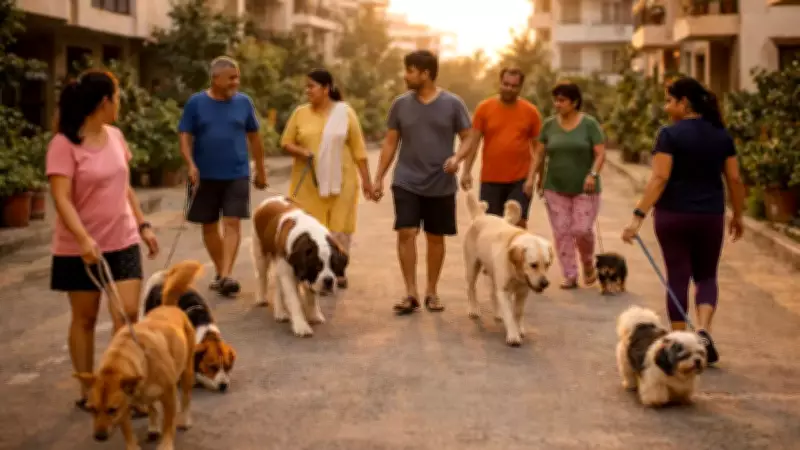
Dog Walking in Chennai Transforms from Solitary Task to Social Ritual
At 6:30 AM in a gated apartment complex in Chennai, the lifts open in quiet succession. A Labrador eagerly tugs forward, an Indie pauses to sniff its favorite patch, and a Beagle insists on greeting everyone before moving. Within minutes, individual routines merge into a familiar formation—a loose circle of residents who never planned to walk together but now do so regularly. Across the city's apartment complexes, dog walking is quietly shifting from a solitary chore to a shared ritual, driven by chance encounters that have evolved into loosely organized groups.
From Chance Encounters to Organized Groups
What began as spontaneous meetings has turned into structured gatherings, often coordinated through simple WhatsApp chats and the comfort of consistent timing. In a Velachery apartment, the group is named "Block C night round," while in Uthandi, it's called "Dog walking circle." These names are purely functional, with no branding involved. On most evenings, six to ten dogs participate, though some days see only three. The dynamic includes residents who are always late, others who are early, and frequent messages like, "Going down now, who all?"
Amrutha explains, "It started because our dogs would stop and wait for each other anyway. Now, even if I'm tired, I know there'll be at least two familiar faces downstairs. That's enough to get me moving." For Arjun S, the group serves as a gentle nudge: "If no one texts, I might skip. But if I see 'Coming?' on the group, I go—it doesn't feel like an obligation, just company."

Expanding Beyond the Gates
Occasionally, the routine extends beyond the apartment gates. Once or twice a month, when schedules align, the group plans longer walks to nearby parks or quieter streets. Abigail, a marketing executive who helps coordinate weekend walks, notes, "It's never formal. Someone just texts, 'Sunday walk?' and whoever's free shows up." On these days, the group feels fuller and more synchronized, with dogs enjoying more space while staying within familiar company.
Mikhail, a software engineer in the evening walking group, observes, "It's like they're a pack at this point. They wait for each other, stick together... it's not even just our community anymore, it's theirs, too."
Benefits for Dogs and Owners
Over time, these walks become more than just routine. Residents share vet contacts, swap recommendations, and watch out for each other's pets, quickly integrating newcomers. For dogs, the advantages are significant. Dr. Rachita highlights, "Regular, familiar interactions can significantly reduce anxiety in dogs, making them calmer and less reactive." The predictability of the same route, timing, and faces helps immensely.
Akhil shares, "My dog used to be very jumpy. Now, he waits by the lift at 7 PM and even looks around if a regular is late—it's like their own circle."
Community Support and Routine Favors
In an Anna Nagar community, two regulars—a school student and a college-goer—walk a neighbor's dogs every weekday evening. What began as a one-off favor has quietly become a routine. Sai Lekha says, "No one told us to do it. We just liked coming down to see them. Then, it became our thing." Surya, now in college, adds, "It doesn't feel like helping. It's just part of my day now and the nicest part, actually."
This evolving trend in Chennai showcases how simple activities like dog walking can foster stronger community bonds, enhance pet well-being, and create meaningful social connections among residents.