

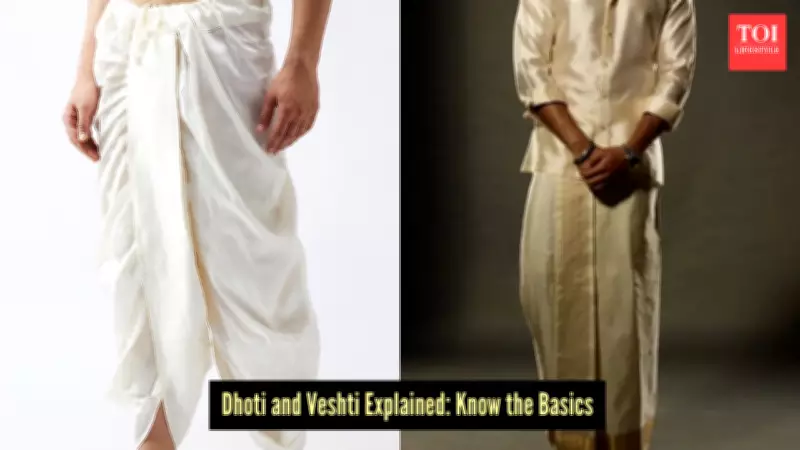
We see a beautifully draped piece of unstitched fabric on a man and immediately assign a name to it. Usually, we just call it a dhoti. Sometimes, we call it a veshti. More often than not, we get it completely wrong.
People toss these words around interchangeably all the time. But treating these two iconic garments like simple synonyms wipes out centuries of distinct regional history. Getting the terminology right matters. It is about respecting the structural nuances and the deep heritage of Indian menswear. So, here is a breakdown of how these two silhouettes actually differ.
Drawing the Geographical Lines
Geography is your absolute best clue. The dhoti firmly belongs to the North, East, and West of India. It has been around for centuries, slowly taking its shape and form from the ancient antariya. The veshti is a strictly South Indian affair. You will find its roots planted deep in Tamil Nadu, with mentions popping up in ancient Tamil Sangam literature. Oddly enough, despite its heavy Southern heritage, the name itself comes from a Sanskrit root word—Dhauta.

The Geometry of the Drape
Here is where things get highly structural. The dhoti is entirely defined by its bifurcated drape. Historically, this technique is called the sakaccha style. The wearer takes the fabric, pulls it right between the legs, and tucks it securely into the back of the waist. What you get is a trouser-like fit. It is incredibly practical. Farmers, martial artists, and soldiers wore it specifically because it actually allows you to move and work without restriction. Throw in those precise, cascading front pleats, and you suddenly have a surprisingly tailored look for an entirely unstitched piece of fabric.
The veshti does something completely different. It relies on the vikaccha style. You wrap it around the waist, knot it securely, and simply let it fall straight down to the ankles. Think of a sarong silhouette. The fabric never passes between the legs. If the wearer needs to do some heavy lifting, navigate muddy roads, or just beat the severe summer heat, they fold the bottom hem up and tuck it into the waist. It is breezy, simple, and effortlessly elegant.
Yardage, Borders, and Looms
You need a massive amount of fabric to pull off a proper dhoti drape. We are talking roughly 3.7 to 4.5 meters just to manage those trouser-like folds and front pleats. Veshtis give you a bit more breathing room on length. A single veshti—known as an Otte—is just about 2 meters long. Need more volume? The double Rettai matches the standard dhoti at 3.7 meters.
When it is time for a wedding or a major cultural ceremony, both garments completely level up. Premium silk dhotis often borrow heavily from Northern and Eastern weaving hubs. You will frequently see heavy Banarasi brocade borders utilized to add some serious visual weight to the drape. There is also the pitambar, a rich yellow silk dhoti reserved specifically for high religious rites.
Veshtis, on the other hand, make the border the absolute star of the show. Your everyday cotton veshti is crisp white or cream with a bright, horizontally striped border. Those specific stripe colors can even act as subtle hints regarding the wearer's political leanings. But grooms wear the venpattu. These are pure silk veshtis anchored by solid gold or copper zari borders. They are woven using the exact same heritage techniques found in authentic Kanjeevaram silks, bringing a touch of unmistakable Southern luxury.
Where the Lines Blur
Traditional fashion rules are made to be bent. Sometimes, draping styles cross state lines depending on the specific ritual or the community wearing them. South Indian Brahmins, for example, switch things up for religious ceremonies. They use the Panchagachham style. It involves five very specific tucks, and the fabric actually passes between the legs to create a kacham drape. Structurally, it ends up closely mimicking the mobility and shape of a Northern dhoti. Ultimately, both the dhoti and the veshti hold their ground. They are distinct, masterful approaches to unstitched design.

About the Author: The TOI Lifestyle Desk is a dynamic team of dedicated journalists who, with unwavering passion and commitment, sift through the pulse of the nation to curate a vibrant tapestry of lifestyle news for The Times of India readers. At the TOI Lifestyle Desk, we go beyond the obvious, delving into the extraordinary. Consider us your lifestyle companion, providing a daily dose of inspiration and information. Whether you're seeking the latest fashion trends, travel escapades, culinary delights, or wellness tips, the TOI Lifestyle Desk is your one-stop destination for an enriching lifestyle experience.





