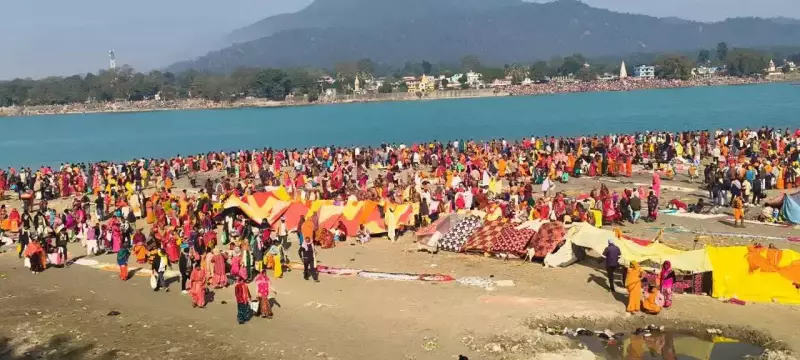
Thousands of devotees from across Bihar, Uttar Pradesh, and Nepal flocked to the Triveni Sangam on the Gandak Narayani river in Valmikinagar, West Champaran district, on Sunday. They took a holy dip on the occasion of Magh Mauni Amavasya, starting at the crack of dawn.
Pilgrims Arrive Early Despite Cold Weather
Despite the biting cold, a large number of pilgrims began arriving at the site nearly two days in advance. The sacred confluence, located on the India-Nepal border where the Gandak, Tamsa, and Sonaha rivers meet, is a major pilgrimage destination during the Hindi month of Magh. A three-day fair accompanied the event, with stalls selling oranges, cardamom, and bay leaves in abundance.
Personal Stories from Devotees
Narendra Kaushik, a resident of Padrauna in Kushinagar district, Uttar Pradesh, left for Valmikinagar late on Saturday night. He arrived around 2:30 am with his wife Sudha and their children. "We reached early to complete the rituals in peace before the crowd swelled," he said. "We bathed at the Triveni Sangam and offered prayers. On Magh Mauni Amavasya, after bathing, we followed the tradition of donating rice, sesame seeds, and cows. Afterward, we visited the Jatashankar Temple and Nar Devi Mata Temple in the Valmiki Tiger Reserve to offer prayers."

Krishna Thapa, from Bhumahi village in Gandaki Pradesh district, Nepal, stood waist-deep in the river. He prayed for his family's health and prosperity. "They say bathing at the Triveni Sangam washes away all sins and fulfills the deepest wishes," he explained, clutching a small brass pot filled with rice, sesame, and vegetables.
Religious Significance Explained
Nandkishore Tiwari, a priest from Raxaul in East Champaran district, visits the Triveni Sangam every year for a holy dip. He detailed the religious significance of the day. During the month of Magh, when the Sun transits along with the Moon in Capricorn, the period is known as Mauni Amavasya.
"On this day, there is a tradition of donating sesame seeds, rice, cows, and money after bathing in the holy river," Tiwari said. "There is also a tradition of worshipping Lord Vishnu and Shiva. Bathing and donating are done while observing silence and behaving like sages."
He added that after Prayagraj, the Triveni Sangam of the Gandak Narayani river is considered the second-largest confluence point. A massive crowd gathers here on Mauni Amavasya.
Priest Shares Insights on Rituals
Hare Krishna Mishra, a priest facilitating cow donations on the riverbank, said bathing in silence on Mauni Amavasya yields excellent results. "Not speaking ill of anyone on this day is also considered equivalent to silence," he noted. "After bathing, there is a tradition of donating umbrellas, beds, bedding, especially cows and gold. It is said that bathing on Mauni Amavasya today gives the same merit as penance in the Satya Yuga, devotion in the Dwapar Yuga, and knowledge in the Treta Yuga. Those who perform tarpan for their ancestors bless them eternally and attain salvation."
Security Arrangements in Place
Bagaha SP Ramanand Kaushal confirmed elaborate security arrangements. Joint teams of police and the Sashastra Seema Bal managed the crowds at the Triveni Sangam. The district administration deployed over 200 police personnel and imposed a ban on vehicular movement on the road leading to the ghats.