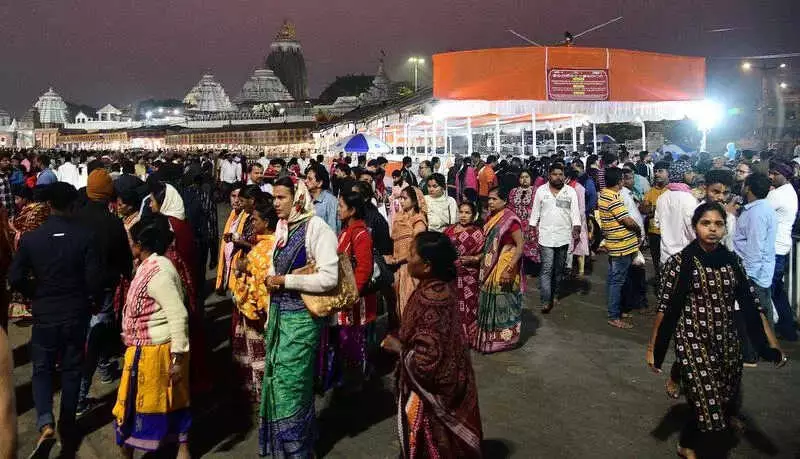
A unique controversy has gripped the holy city of Puri as the New Year approaches, centering on a profound question: should the deities of the revered Jagannath Temple be kept awake past midnight on December 31 to accommodate lakhs of devotees seeking darshan on January 1?
Committee Member Flags Violation of Tradition
The issue entered the formal discourse after Mahesh Kumar Sahu, a member of the powerful Jagannath Temple Managing Committee, wrote to the government on Saturday. In his letter, Sahu argued that the practice of keeping the temple open all night for New Year darshan is inappropriate. He emphasized that New Year celebrations are rooted in Western culture, while the 12th-century shrine operates strictly according to ancient Hindu scriptures and prescribed timings.
"Keeping the temple open all night between Dec 31 and Jan 1, thereby forcing the deities to remain awake, is neither appropriate from a religious standpoint nor aligned with long-established traditions," Sahu stated in his communication. The letter was addressed to Law Minister Prithiviraj Harichandan, SJTA chief administrator Arabinda Padhee, and temple committee chairman Gajapati Dibyasingha Deb.

Sahu described the gradually institutionalized midnight darshan as a "religiously sensitive matter" that requires urgent reconsideration to prevent further erosion of sacred rituals.
Clash of Perspectives: Rest vs. Rush
The proposal has found support among a section of servitors, cultural custodians, and devotees who believe the sanctity of rituals must be paramount. Binayak Dasmohapatra, a servitor, echoed Sahu's sentiment, stating, "We should not allow the deities to remain awake to promote Western culture."
Manoj Rath, founder of the cultural preservation body Utkal Bidwata Parishad, confirmed that there has been a longstanding demand to stop this practice to honour the deities' need for rest.
However, another perspective prioritizes crowd management and devotional access. Retired SP Gyana Ranjan Mohapatra contended that extending darshan hours is a practical necessity during special occasions to handle the massive influx safely. "To handle the unprecedented rush of devotees during special occasions, extending darshan hours is necessary to avoid untoward incidents," he explained, while affirming respect for tradition.
Awaiting a Final Decision
The Shree Jagannath Temple Administration (SJTA) has acknowledged the developing debate. An official clarified that a final decision will be made only after consultations with the government. "We are aware of the matter and awaiting govt guidance," the official said.
The scale of the issue is underscored by the temple's visitor numbers. On regular days, the temple sees around 40,000 devotees. This number skyrockets to between 2 to 4 lakh during festivals. The shrine typically operates for 18-20 hours daily, from 5-6 am until past midnight, with actual darshan permitted for about 9 hours to facilitate the smooth conduct of at least 22 daily rituals.
As Puri awaits a resolution, the debate highlights the delicate balance between accommodating modern devotional fervor and preserving ancient, unchanging temple traditions.