The Enduring Legacy of Dante Alighieri: From Florentine Exile to Literary Immortality
Dante Alighieri stands as one of history's most pivotal figures, a poet who transformed personal exile into an eternal cartography of the human soul. Often hailed as the Shakespeare of Italian literature, Dante distinguished himself with a sharper philosophical edge that reshaped Western thought on sin, redemption, and divinity.
Early Life and Education in Turbulent Florence
Born in Florence around May or June 1265, Dante grew up amidst the violent Guelph-Ghibelline conflicts that tore the city apart. These wars pitted the Guelphs, who supported papal authority, against the Ghibellines, who backed the Holy Roman Emperor. His family aligned with the Guelphs, providing young Dante with tutors who introduced him to classical giants like Virgil, Ovid, and Aristotle, alongside theological studies influenced by Thomas Aquinas. Though he briefly trained as a pharmacist, poetry proved his true calling.
A fateful encounter at age nine with Beatrice Portinari sparked a lifelong muse—a pure, idealized love that would become the foundation of his greatest works. This brief meeting ignited a spiritual and artistic obsession that would guide his creative output for decades.

Political Turmoil and Exile
Politics dramatically altered Dante's life trajectory. By 1300, he had become a White Guelph, part of a faction opposing papal overreach. In 1302, Black Guelphs seized power in Florence, exiling Dante on fabricated charges of barratry. He never returned to his beloved city, spending his remaining years in Verona, Bologna, and finally Ravenna, where he died from malaria or fever on September 14, 1321, during peace negotiations.
Despite an arranged marriage to Gemma Donati in 1285 that produced seven children, Beatrice remained his spiritual lodestar—the symbol of salvation that permeated his writing. His nineteen years in exile were marked by a potent blend of rage against Florentine betrayers and a profound yearning for divine connection.
Literary Innovations and Philosophical Works
Dante's literary output encompassed love poetry, philosophical treatises, and epic verse. La Vita Nuova (circa 1295) interwove thirty-one poems with prose commentary, documenting his spiritual awakening through Beatrice rather than conventional romance. This work pioneered his revolutionary decision to write in Tuscan vernacular instead of Latin, elevating Italian into a legitimate literary language.
His unfinished treatise De Vulgari Eloquentia (1304–07) systematically analyzed Italian dialects to champion Tuscan as the superior literary medium. Similarly incomplete, Convivio (1304-07) presented itself as a "banquet of wisdom," exploring morality, fate, and nobility through commentary on his own canzoni. The bold political work De Monarchia (1312-13) argued for separating papal spiritual authority from imperial temporal power to achieve world peace—a dangerous proposition that later led to its burning by authorities.
The Divine Comedy: A Masterpiece of Cosmic Proportions
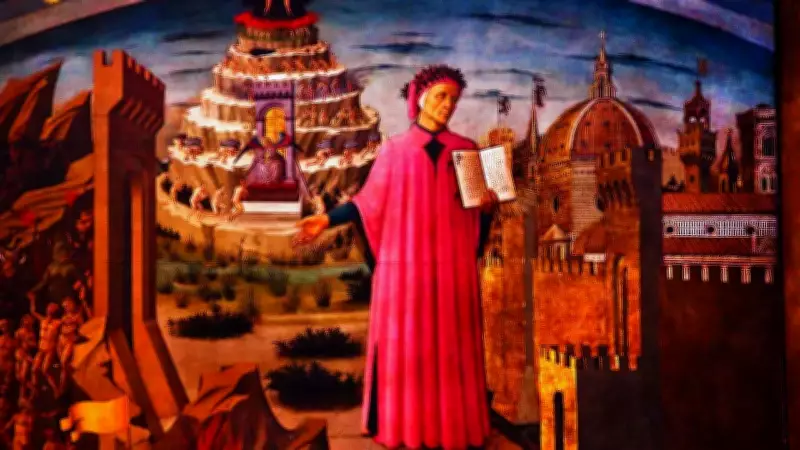
The Divine Comedy, composed between 1308 and 1321, remains Dante's crowning achievement. This 14,233-line epic, divided into three canticles—Inferno, Purgatorio, and Paradiso—employs Dante's innovative terza rima rhyme scheme (ABA BCB CDC) to propel its narrative momentum. The poem follows Dante the pilgrim's journey through the afterlife beginning on Good Friday 1300.
Virgil, representing human reason, guides him through Hell's nine concentric circles where sins like pride, treachery, gluttony, heresy, and tyranny receive vividly imagined punishments. Beatrice, embodying divine faith, leads him up Mount Purgatory's seven terraces where souls purge their sins. Finally, divine grace ushers him into Paradise's nine celestial spheres culminating in the beatific vision of God.
The poem teems with historical figures—from damned popes like Boniface VIII to honored emperors like Justinian—while Beatrice's radiance outshines the stars. Each layer contains autobiographical barbs targeting Dante's political enemies and celebrating allies, blending medieval cosmology with psychological insight: sin as misdirected love, grace as its reorientation.

Moral Philosophy and Lasting Influence
One of Dante's most famous moral assertions, often paraphrased as "The hottest places in hell are reserved for those who, in times of great moral crisis, maintain their neutrality," encapsulates his ethical vision. He condemns neutrality as moral treason—worse than active sin because it permits evil to flourish unchallenged. For Dante, character reveals itself not in tranquility but during crises, demanding courageous commitment to justice over safe passivity.
Writing from exile and poverty, Dante achieved posthumous fame that birthed modern Italian literature, influencing writers from Chaucer to T.S. Eliot. His work finds resonance in diverse traditions, including India's Bhakti poets like Kabir who explored devotion beyond formal constraints. The Divine Comedy endures because it captures universal human experiences—fear, rage, and awe—guiding readers from darkness toward light through verses that remain profoundly relevant across centuries.