In the popular word game Wordle, the answer "conch" might evoke images of sandy beaches and seaside souvenirs. It seems a simple, harmless object. Yet, within the vast narrative tapestry of the Mahabharata, one of the world's greatest epics, the conch transforms into an instrument of profound consequence. It is the sound that marks the point of no return, the moment when avoided conflict becomes inevitable war.
The Etymology of Power: From Latin 'Concha' to Sanskrit 'Shankha'
The journey of the word itself reveals a cultural chasm. The English term "conch" traces back to the Latin concha and Greek konkhē, meaning simply a shell or mussel. This Western lineage is descriptive and utilitarian, naming a natural object without layering it with deeper meaning.
In stark contrast, the Sanskrit word "shankha" carries immense weight. In Vedic and later epic literature, it is never just a shell. It is a sacred object, intrinsically linked to ritual purity, cosmic order (dharma), and divine authority. This linguistic divergence is telling: one tradition sees an object; the other recognizes a symbol burdened with duty and power.

The Sound of Inevitability: Conches in the Kurukshetra War
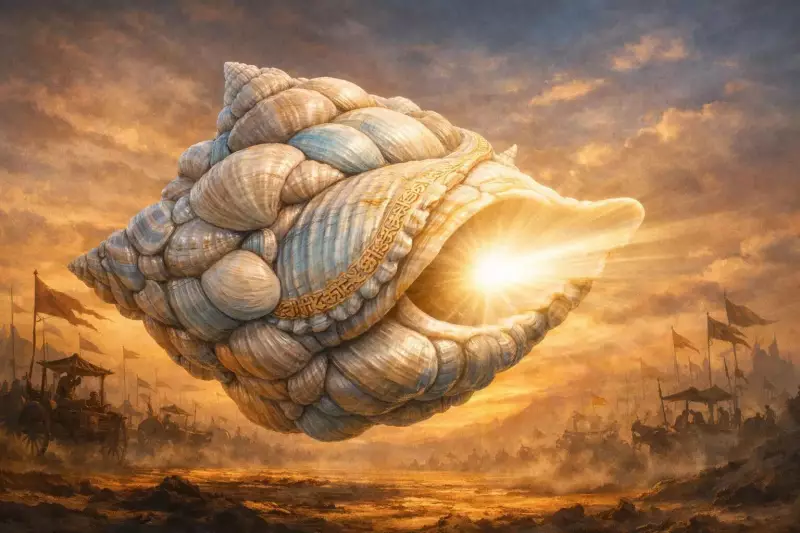
The Mahabharata masterfully uses the conch to signal a monumental shift. The cataclysmic Kurukshetra War does not commence with the first clash of steel. It begins with sound. Before any arrow is fired, the warriors raise their conches and blow. This act is ritualised intent, the formal declaration that negotiations have utterly failed.
Significantly, each major warrior possesses a named conch, for names in the epic are never accidental. They reveal character and destiny:
- Krishna's Panchajanya: Taken after slaying the demon Panchajana, it represents divine authority reclaimed from chaos.
- Arjuna's Devadatta: Meaning "God-given," it underscores his role as an instrument of dharma, not personal vengeance.
- Bhima's Poundra: Its thunderous roar mirrors his brute, overwhelming strength.
- Yudhishthira's Anantavijaya: Translating to "endless victory," it reflects his moral aspiration rather than bloodlust.
When blown together, the epic describes the collective sound as terrifying enemies and steadying allies, filling heaven and earth. This is not mere poetry but a worldview: war must first be announced to the universe itself.
From Battlefield to Temple: The Conch's Enduring Legacy
The conch's power stems from elegant simplicity. A large, spiral sea snail shell is chosen, its tip carefully cut to form a mouthpiece. When blown, air travels the spiral cavity, amplifying human breath into a deep, resonant tone that carries over great distances. Ancient societies valued this—a sound that commanded attention without complex technology.
While it has vanished from battlefields, the shankha remains vibrantly alive in Indian culture. Today, its primary domain is the sacred:
- It is blown in temples to mark the start of puja, during rituals, and at auspicious occasions like weddings.
- Its sound is believed to purify the atmosphere and mark sacred time.
- In iconography, the god Vishnu is consistently depicted holding a shankha, symbolizing order emerging from the cosmic ocean of chaos.
Beyond religion, it persists as cultural memory in art and literature—a universal shorthand for announcement, ceremony, and inevitability. The sound of a conch is never casual; it still demands a pause, a moment of attention.
The Mahabharata teaches us that the war began not with a weapon drawn, but with breath forced through a shell. The conch does not wound or persuade. It declares. It tells all—kings, soldiers, gods—that a line has been crossed and the coming events are irreversible. The conch endures not merely because it is efficient or beautiful, but because it remembers. It transforms the most fleeting human act—a breath—into a permanent, unretractable sound. In doing so, it becomes history's most resonant whisper, marking the precise moment when hesitation ends and consequence begins.