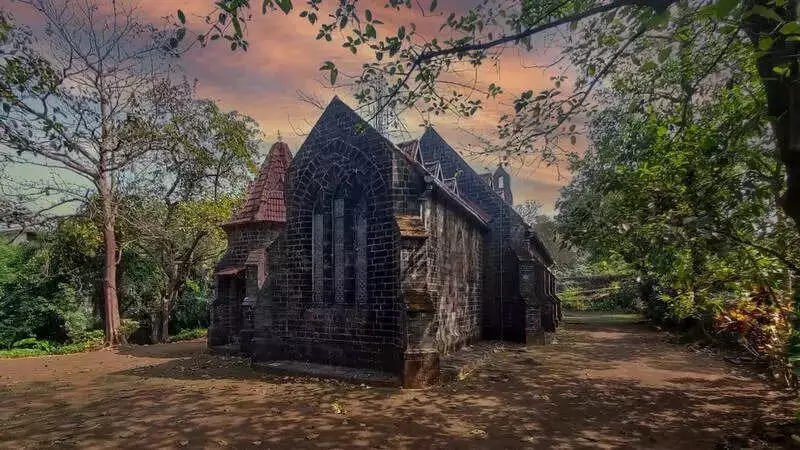
In a remarkable transformation that bridges colonial heritage with contemporary creativity, a nearly 200-year-old decommissioned chapel nestled in Khandala's picturesque Sahyadri Hills is poised to begin a new chapter as a vibrant cultural sanctuary. This Gothic Revival structure, whose distinctive black basalt silhouette has long evoked comparisons to Scottish landscapes, will officially reopen its arched doors on January 30 as Abbey 301—an intimate venue dedicated to music, spoken word, and artistic dialogue.
From Sacred Robes to Artistic Robes: A Family's Stewardship
Held by the Kotak family for over six decades since 1973, the chapel's journey from a place of worship to a cultural nexus has been guided by Kamini Kotak and architect Adil Dholakia of Five Cross Architects. "We don't own the property," reflects Kamini Kotak with profound reverence. "The property owns us." This sentiment echoes the family's deep connection to the space, where her father-in-law once sought solace through music and contemplation. "Lying silent in his wake, we wanted to breathe life and music back into its walls," she explains, highlighting the emotional impetus behind the restoration.
Architectural Grandeur Meets Conservation Ethics
Constructed in the mid-19th century, the chapel exemplifies Gothic Revival architecture with its pointed arches, five buttresses, and exquisite stained-glass windows adorning the nave, altar, and octagonal vestry. The restoration, meticulously executed between September and December 2025, adhered to a conservation-first philosophy prioritizing repair over replacement. Architect Adil Dholakia notes that over 70% of the 2,500-square-foot structure was repaired using salvaged stone, wood, and Mangalore tiles, significantly reducing the project's carbon footprint. "Only the octagonal vestry required replacements and renewal," he clarifies.

All contemporary interventions—including electrical systems, climate control, and lighting—were designed to be reversible, ensuring future generations can easily adapt the space. "The idea was to support the building rather than steer it away from what it already is," Dholakia emphasizes. The stained glass, locally replicated based on references from a Scottish chapel, and structural reinforcements have extended the vestry's life by decades, while the pitched roof was restored to its original mahogany hue from black paint.
A Cultural Oasis in the Mumbai-Pune Corridor
The transformation responds to a palpable hunger for authentic cultural engagement in the region. Creative director Pushan Kripalani, who leads Abbey 301 alongside independent producer Xerxes Unvala, recalls a trial event last year that attracted nearly triple the expected audience. "The moment we tested the space, we realized how starved the area was for cultural activity that wasn't about selfies," he observes. Artists have responded with enthusiasm, inquiring eagerly about performance opportunities and creative contributions.
Conservation architect Vikas Dilawari, who previously restored the chapel's walls and roof twice, notes its historical significance as one of three churches in Khandala where traveling communities once congregated. The recent restoration involved meticulous documentation of every inch, with team members braving the pitched roof to ensure its preservation.
Inaugural Celebrations and Future Vision
Abbey 301 opens on January 30 with a lineup that includes musician Nikhil D'Souza, lyricist Kausar Munir, the Sanjay Divecha Trio, and bansuri maestro Rakesh Chaurasia. Equipped with modern amenities like speakers, fire extinguishers, a versatile wooden deck, and air-conditioners, the venue will host not only public performances but also rehearsals, artist residencies, and closed-door conversations.
Positioned as perhaps the only non-traditional cultural centre in the Mumbai-Pune corridor, Abbey 301 symbolizes a movement leveraging heritage to catalyze contemporary art. An outdoor exhibition of 32 ceramic works by artist G Reghu in the surrounding grounds further enriches its offerings, promising a holistic artistic experience amidst the serene Sahyadri Hills.