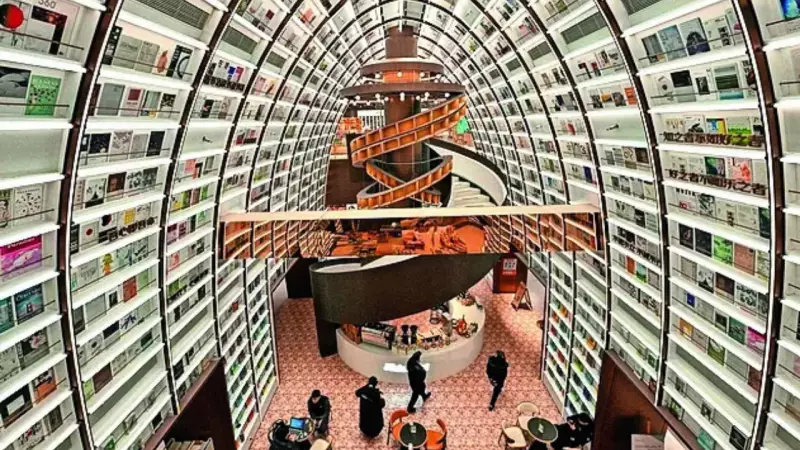
In the northern Chinese city of Tianjin, a new bookstore has become a sensation, but not necessarily for its literary collection. The recently opened Zhongshuge outlet captivates visitors with its towering accordion-style steps and a fantastical spiral staircase, creating an interior so striking that it attracts more camera-wielding tourists than dedicated readers.
The Selfie Magnet: Architecture Over Books
The store, which launched in September 2024, has drawn widespread comparisons on social media to the gothic halls of Hogwarts from the Harry Potter series. Graduate student Li Mengting, aged 24, visited with a friend specifically to capture pictures. She noted that while "the photos come out looking really beautiful," finding the perfect angle was a challenge due to the sheer number of people inside.
The scene is dominated by tourists armed with selfie sticks and tripods, all crowding around the central cobalt-blue staircase that extends into massive, ceiling-arching columns spanning three stories. The popularity of certain spots is so well-known that faded prints labeling "The Best Spot for Photos" are still visible on the floor.

A National Trend: Survival Through Spectacle
This phenomenon is part of a broader trend across China. Despite data showing that sales of hard-copy books have not recovered to pre-pandemic levels, the number of physical bookshops has seen steady growth. Ai Limin, head of a publishing industry group, highlighted this in January, pointing to "a wave of bookstores with unique characteristics."
Beijing-based architect Zheng Shiwei from the China Architecture Design and Research Group confirms that investing in photogenic interiors has become "relatively mainstream" for new bookstores. "This has become relatively mainstream," Zheng said. However, he also issued a caution: this focus might lead to many visitors coming not to read, potentially causing "some unintended consequences."
Balancing Act: Commerce, Culture, and Crowds
The influx of photographers has forced some stores to set boundaries. In June, a famous bookstore in Nanjing that had become a tourist hotspot took action by banning flash photography, tripods, and unauthorized photoshoots, citing interference with readers' experiences. Finance worker and avid reader Yuan Jia from Nanjing supported this move, acknowledging the disruption caused by nonstop picture-taking.
Yet, architect Zheng Shiwei sees a silver lining. He argues that encouraging bookstores to curate photo spaces should be viewed positively. "At least people are 'punching in' at bookstores, right? Instead of doing that elsewhere," he remarked, using the Chinese term for checking in at a trendy location.
The economic reality is driving this transformation. At a Beijing bookstore housed in a converted former Taoist temple, founder Juli Hu explained the harsh truth. "Books bring in relatively low profit," said Hu, who opened her store in 2024. She actively welcomes online posters and frequently changes cultural displays to attract visitors. Her conclusion is stark: "Selling books definitely cannot be the core of what sustains an entire bookstore. There must be other things."
This new model represents a fundamental shift for China's retail book industry. While traditional sales struggle, physical stores are finding renewed shelf life by becoming experiential landmarks—part cultural venue, part architectural marvel, and entirely a backdrop for the perfect social media post.