Chandra Grahan 2026: Your Complete Guide to the March 3 Lunar Eclipse
The celestial calendar for 2026 kicks off with a spectacular astronomical event: the first lunar eclipse of the year, commonly known as Chandra Grahan. Scheduled for March 3, 2026, this eclipse promises to be a brief but captivating sky show for observers across India and beyond. While visibility conditions will vary significantly depending on location, this natural phenomenon offers a unique opportunity to witness the intricate dance of celestial bodies.
Eclipse Timing and Visibility Across India
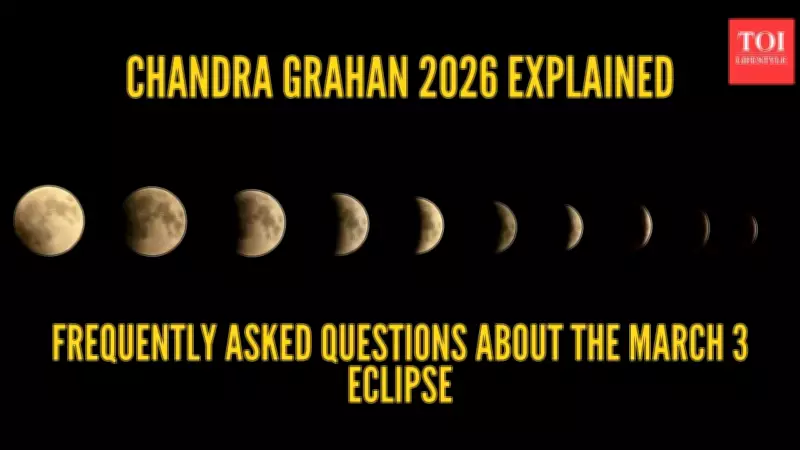
According to detailed data from Time and Date, the eclipse will unfold in distinct phases. The penumbral phase, marking the initial subtle dimming, commences at 4:58 PM Indian Standard Time (IST). The totality phase, when the Moon is fully within Earth's shadow, also begins at 4:58 PM IST and concludes at 5:32 PM IST. The entire event, including the final penumbral phase, will wrap up by 7:53 PM IST.
For many regions in India, a significant challenge arises: the Moon will already be in eclipse as it rises above the horizon. This means most observers will only catch the final portion of the spectacle, primarily around sunset, with a visible window potentially lasting a mere 20 minutes. However, the northeastern part of the country is poised for a much clearer view.

Prime Viewing Locations in Northeast India
While much of India will experience limited visibility, several cities in the Northeast are forecasted to witness the eclipse in its full glory, with 100 percent obscuration during totality. Key locations expected to have optimal viewing conditions include:
- Dibrugarh, Dispur, and Guwahati in Assam
- Itanagar in Arunachal Pradesh
- Shillong in Meghalaya
These areas, according to publicly available astronomical data, offer the best chance within India to observe the complete transformation of the Moon into the famed Blood Moon.
The Science Behind the Blood Moon Phenomenon
A total lunar eclipse occurs when the Earth positions itself directly between the Sun and the Moon, casting its shadow upon the lunar surface. The direct sunlight is blocked, but some light filters through Earth's atmosphere. This atmospheric passage bends and scatters the light, preferentially allowing longer red wavelengths to pass through and illuminate the Moon. This results in the Moon taking on a striking reddish or deep orange hue, earning it the dramatic nickname "Blood Moon." It is a breathtaking demonstration of celestial mechanics and atmospheric physics.
Safe and Simple Viewing Guidelines
One of the greatest advantages of a lunar eclipse is its complete safety for naked-eye observation. No special protective glasses are required, unlike during a solar eclipse. You do not need any specialized equipment; if the skies are clear, you can simply step outside and look up. While binoculars or a small telescope can enhance the view by revealing more surface detail, they are entirely optional for enjoying this event.
Global Viewing and Alternative Options
For those in regions of India with poor visibility, the eclipse will be more prominently visible from other parts of the globe. The best viewing regions for the full blood moon include Australia, the Pacific region, and western North America. If local conditions are unfavorable, enthusiasts can still participate by following live streams from observatories or using popular astronomy applications to track the eclipse's progress in real-time.
Significance of the March 3 Eclipse
While lunar eclipses occur a few times each year, not every event is visible from India. The March 3, 2026, Chandra Grahan, even with its brief visibility window for many, represents a valuable opportunity to connect with a grand natural spectacle. It invites us to pause, look skyward, and appreciate the predictable yet awe-inspiring rhythms of our solar system. Ultimately, clear weather conditions will be the most critical factor in determining the quality of the view on the evening of March 3.