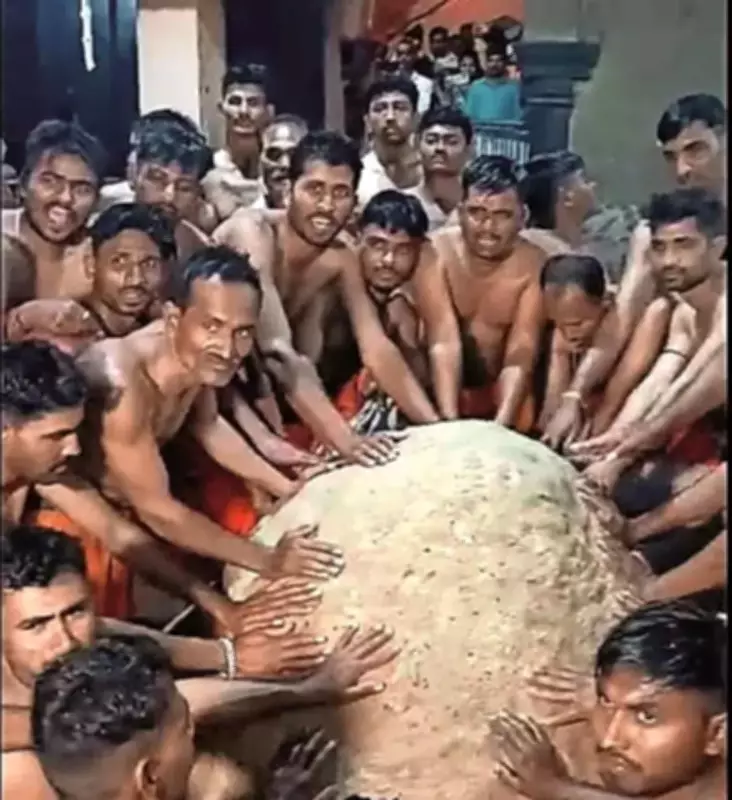
175-Year-Old Maha Roth Tradition Thrives in Buldhana Village on Mahashivratri
In a remarkable display of unwavering faith, strict discipline, and deep community devotion, the small border village of Palshi Jhansi in Sangrampur taluka, Buldhana district, continues to uphold its 175-year-old tradition of preparing a massive Maha Roth on the night of Mahashivratri at the historic Shankar Giri Maharaj Temple.
Annual Gathering and Sacred Ingredients
Every year, villagers gather to prepare an enormous sacred offering weighing nearly 11.50 quintals. This ritual involves a meticulous process using wheat flour, sugar, dry fruits, milk, and pure ghee. According to traditional practice, devotees begin arriving at the temple from the evening of Mahashivratri, offering ingredients as a profound mark of their devotion.
This year, the collection for the ritual was immense, with nearly 350 quintals of wheat flour, over 300 quintals of sugar, two quintals of dry fruits, about 1.25 quintals of pure ghee, and around 1.25 quintals of milk gathered from the faithful. These ingredients form the basis for the massive Maha Roth, symbolizing the community's collective spiritual effort.

Strict Religious Discipline and Preparation Process
The preparation follows stringent religious discipline. All ingredients are first mixed thoroughly in large iron vessels. The dough is then shaped layer by layer into a huge circular form, measuring nearly four to five feet in diameter. Once formed, the giant Roth is carefully wrapped in a white cotton cloth and later covered with banana leaves to preserve its sanctity.
Around 50 to 60 villagers participate in this sacred process after performing ritual purification and abhishek. During the preparation, they maintain a solemn atmosphere by avoiding physical contact with outsiders and observing silence and spiritual discipline throughout the ritual, ensuring the offering's purity.
Ritual Baking and Divine Phenomenon
After the Roth is prepared, a 9-by-9-foot pit, nearly five feet deep, is dug on the temple premises. Cow-dung cakes are set ablaze inside the pit, and at around 1 am, the massive circular Roth is placed into the burning fire. It remains there until it is taken out between 6 am and 6:30 am the next morning.
Devotees consider it a divine phenomenon that even after remaining in the blazing fire for nearly five and a half hours, the white cloth wrapped around the Roth does not burn. The faithful believe this miraculous preservation is a clear sign of the grace of Shankar Giri Maharaj, reinforcing their spiritual beliefs.
Spectacular Removal and Distribution
The removal of the Roth from the pit is itself a major spectacle. Heavy iron chains are used, and more than 100 villagers jointly pull it out amid loud chants of "Maharaj ki Jai." This collective effort highlights the unity and strength of the community. The sacred offering is then distributed to devotees as Mahaprasad on the following day, serving as a blessed token of the ritual.
Regional Pilgrimage and Historical Significance
Pilgrims from all Vidarbha districts, several parts of Maharashtra, and neighbouring Madhya Pradesh visit Palshi Jhansi every year to witness this unique ritual and receive the sacred prasad. The village lies close to the Maharashtra-Madhya Pradesh border at the foothills of the Satpura range, giving the annual Mahashivratri gathering the scale of a major rural pilgrimage.
Speaking to TOI over the phone, Shankar Giri Maharaj Sansthan president Gulabrao Marode emphasized that the centuries-old tradition continues to be carried forward with the same devotion by the younger generation. He noted that the temple and the spiritual institution of Shankar Giri Maharaj have existed in the village for over 350 years.
The Shiva lingam at the temple was established by Shankar Giri Maharaj himself, who performed years of worship and meditation under large banyan trees on the campus. Shankar Giri Maharaj attained samadhi in 1935, but the sacred tradition of preparing the Maha Roth on the night of Mahashivratri, initiated by him, continues to grow in scale and faith every year.

"This is not merely a ritual of preparing prasad. It reflects our collective devotion and emotional bond with Maharaj," Marode said, adding that the tradition will be preserved for future generations, ensuring its legacy endures as a testament to community spirit and spiritual dedication.