RSS Chief Mohan Bhagwat Stresses Family's Role as India's Core Social Foundation
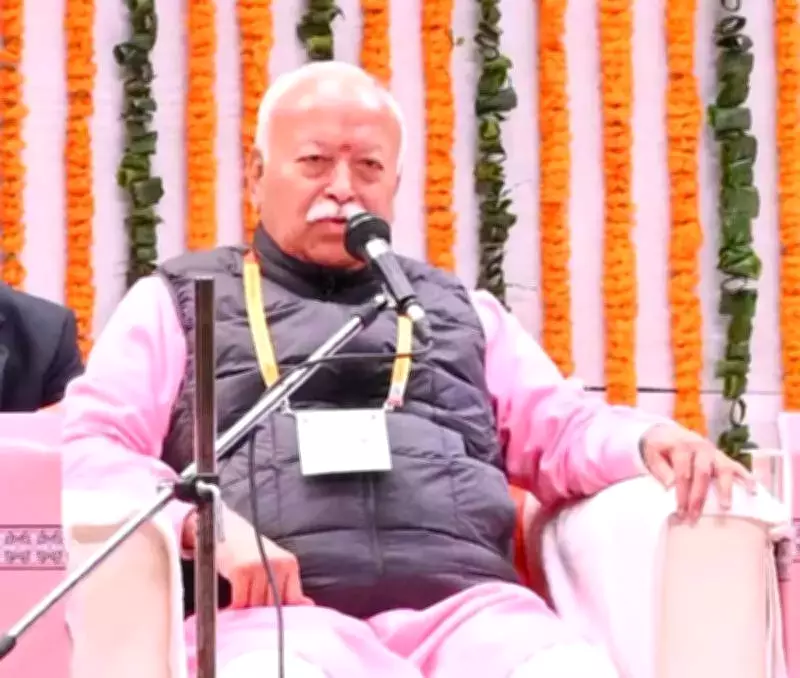
In a significant address at a Kutumb Sneh Milan (family gathering event) held in Gorakhpur on Monday, Rashtriya Swayamsevak Sangh (RSS) chief Mohan Bhagwat articulated the profound importance of the family unit in shaping Indian society. Bhagwat emphasized that the family serves as the fundamental building block that molds future generations and imparts essential training for societal living.
India's Unique Family System: Emotional Bonds vs. Contractual Relationships
Bhagwat drew a sharp contrast between India's familial structure and those prevalent in many Western nations. "In many countries, relationships are often contractual in nature," he stated. "In India, a child is born into a family and grows within it, while in some Western societies, individuals become independent of the family at an early stage." He elaborated that India's concept of family is uniquely rooted in emotional belonging and affection, rather than transactional dynamics.
The RSS chief asserted that society's very functioning depends on this robust family system, which also forms the basis for livelihood, business activities, savings, and national wealth accumulation. "A family is not merely formed by a man and a woman living under one roof. It is built on relationships rooted in affection and belongingness," Bhagwat explained.

Historical Examples and Cultural Transmission
To illustrate the strength of familial and social bonds in India, Bhagwat cited the example of former Prime Minister Lal Bahadur Shastri. He recalled how citizens voluntarily donated gold and valuables for the nation when appealed to do so, showcasing deep-seated collective responsibility nurtured within families.
Bhagwat highlighted the family's role in teaching individuals to think beyond personal needs. "Social education, economic activity and cultural transmission from one generation to another take place within the family," he said. He identified the mother as the nucleus of the family, playing a pivotal role in shaping future generations. "This is how we understand the concept of Bharat Mata and we are sons of Bharat Mata," he added.
Contrasting Indian and Western Perspectives
The RSS chief further delineated differences between Indian and Western thought regarding family and individuality. "In our tradition, the family is greater than the individual, whereas in Western thought, the individual is considered above the family," Bhagwat noted. He stressed that this perspective must translate into conduct, beginning at home. He also remarked that in India, women are traditionally accorded the respect of a mother, except within marital relationships.
Bhagwat expressed concern that a lack of values at home could potentially lead to religious conversions. He reiterated, "We regard marriage as a duty, not a contract," underscoring the non-transactional essence of Indian familial bonds.
RSS Growth and Family Support
Acknowledging the instrumental role of families in the RSS's expansion, Bhagwat stated, "If you want to understand the Sangh, observe its shakhas, its swayamsevaks and their families. The organisation cannot be adequately described in words; it is understood through conduct." He revealed that without familial support, the RSS could not have achieved its current growth.
Bhagwat advocated for organizing small-scale family gatherings two to three times annually to deliberate on social issues and dispel misconceptions arising from Western influences.
Call for Behavioral Change and Practical Actions
Emphasizing the need for behavioral transformation starting at home, Bhagwat outlined essential family responsibilities: "Food, clothing, shelter, health, education and hospitality are the essential responsibilities of a family." He urged RSS volunteers to remain five steps ahead of society in their conduct, ensuring that 'Panch Parivartan' (five transformations) is reflected in daily life rather than confined to speeches.
Bhagwat also called upon families to assume responsibility for environmental protection at the household level. His recommendations included:

- Saving water and reducing plastic usage
- Planting trees regularly
- Using traditional attire and consuming indigenous food
- Displaying portraits of national icons at home
- Promoting swadeshi (domestically produced) products
- Adhering strictly to civic discipline
He encouraged linguistic practices that honor tradition while fostering unity: "Speak in the mother tongue at home, learn the language of the state you live in and adopt a language that can serve at the national level."
Weekly Family Discussions and Social Contributions
Bhagwat proposed that families dedicate one day each week for collective discussions involving all members, from children to elders. These dialogues aim to build consensus and translate insights into practical actions. "Every day, we should think about and perform at least one good deed for society," he advised.
Concluding his address, the RSS chief affirmed, "Change in society becomes visible when it is reflected in the conduct of individuals and families." His message reinforced the family's indispensable role in sustaining India's social fabric, cultural heritage, and national progress.