Bhagoriya Festival in Alirajpur: A Vibrant Tribal Gathering
In the interior belt of Alirajpur, the annual Bhagoriya fair serves as a pre-Holi celebration where tribal villages converge to honor community, color, and continuity. This traditional event transforms the landscape into a hub of cultural exchange and joyous reunion.
Preparations and Arrival at the Fair
Just after noon in Walpur, a group of teenage girls from a hillside hamlet stood near the entrance of the haat, carefully adjusting their silver necklaces and straightening each other's dupattas before stepping in together. They had saved for months for this special day, reflecting the significance of the occasion. Behind them, fathers parked tractors along the dusty edge of the ground, while younger siblings eagerly ran ahead at the sound of drums.
By the time the first drumbeat rolled across Walpur on Friday, the village had already changed shape. From narrow approach roads to the open haat ground, people arrived in waves for Bhagoriya. Jeeps were packed so tightly that young men stood wedged against one another, and buses slowed under the weight of passengers seated on the roof. Tractors carried entire families, with elders seated in the centre and children gripping the wooden sides.

Bheru Lal, who travelled from a nearby hamlet with over a dozen relatives, shared, "We go to all the nearby melas. If we come late, we miss the best part of the mela." This sentiment highlights the deep-rooted importance of timely participation in the festival.
Cultural Celebrations and Traditional Attire
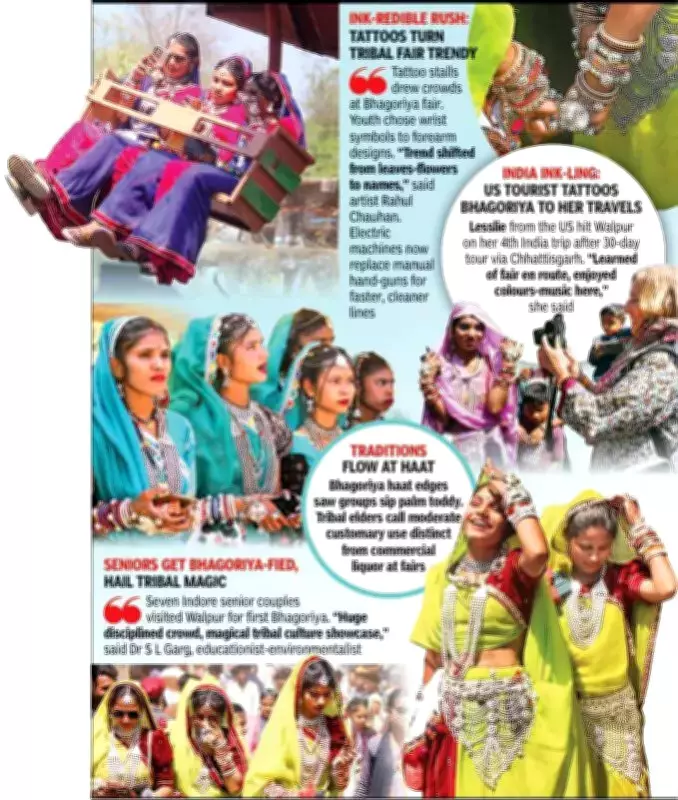
The fairground did not feel like a marketplace alone; it felt like a grand reunion. Women in bright traditional ghagras walked in groups, their heavy silver necklaces resting against colourful blouses, with bangles stacked up to the elbow. They paused to greet relatives, compare outfits, and share laughter, often coordinating their attire in groups.
Ritu Bhilala, standing with five cousins dressed in similar shades of green and red, explained, "Preparation begins weeks before the mela. We plan colours together. We clean the jewellery. This is not done in a hurry." Even the tiny tots were seen dressed in coordinated attire with their mothers and other family members, emphasizing the collective effort in preserving tradition.
As the mandal and dhol gathered pace, a group of young women stepped forward to form a circle and began to dance. Their feet struck the ground in rhythm, shoulders swayed in unison, and the sound of anklets blended with the drums. Older women watched from the side, some nodding in approval, others joining briefly before stepping back. Three generations shared the same space, dressed differently or similarly, yet bound by the same beat, showcasing the intergenerational connection.
Modern Elements and Community Safety
Young tribal boys and girls moved through the crowd with selfie sticks held high, angling for the perfect frame as the mandal played behind them. Groups paused mid-dance to record short clips, adjusting turbans or smoothing dupattas before the camera rolled. Mahesh, an 18-year-old participant, laughed as he replayed a video with his friends, saying, "We upload our reels the same day. Our relatives in other villages and even in cities wait to see Bhagoriya online." This integration of modern technology highlights how traditions are being shared beyond physical boundaries.
For those who now live away from the village, Bhagoriya remains non-negotiable. Sunita, a nurse in Indore, returned home specifically for the fair, stating, "This is the time we come back home for two or three days to be a part of Bhagoriya. It is an essential part of our identity. We feel connected." Her words underscore the festival's role in maintaining cultural ties for diaspora communities.
Vendors selling ornaments, sweets, and farm tools reported steady business through the afternoon. From Holi colours to ornaments to household essentials, all were on display near the mela area, contributing to the local economy. Police personnel remained stationed across the venue, and officials confirmed that the celebrations were peaceful.

District administration staff members were also present at the Bhagoria festival, maintaining law and order while enjoying the traditional vibe, dressed in traditional attire. Nisha Chauhan, a patwari on duty at Walpur Bhagoria, explained, "We keep a check on all the villagers here so girls and women feel safe and no untoward situations arise." This ensures a secure environment for all participants.
Conclusion: A Lived Tradition
As dusk settled and vehicles once again filled beyond capacity for the journey back, the drums did not stop immediately. In Walpur, Bhagoriya was not a performance for visitors. It was a lived tradition, carried on shoulders, sung in rhythm, and renewed each year by those who return. This annual event continues to strengthen community bonds and preserve the rich cultural heritage of Alirajpur's tribal communities.