The Unmasking of Banksy: From Bristol Streets to Global Icon
For nearly three decades, the art world has been captivated by a peculiar cultural ritual. People gather in front of walls, staring with intense seriousness, attempting to decipher the witty messages left overnight by an elusive figure. A rat holding a placard, policemen in an embrace, a child reaching for a drifting red balloon—these stenciled images, always signed "Banksy," have become iconic symbols of modern street art.
The Power of Anonymity in Art
Banksy's anonymity was far more than a mere curiosity; it was an integral component of his artistic expression. Street art has always existed in a tense relationship with legal authorities, and the artist who mocked governments and corporations with spray paint could not easily step into the spotlight without diminishing his rebellious essence. Over time, this mystery became inseparable from the artworks themselves. The world was not only admiring Banksy's murals but also perpetually searching for the individual behind them.
The Investigation That Cracked the Code
The revelation of Banksy's identity did not arrive through a dramatic public unmasking but emerged gradually through meticulous investigative journalism. A Reuters investigation painstakingly followed clues spanning continents and decades. The trail began in the vibrant graffiti culture of Bristol, extended to war-torn buildings in Ukraine, and ultimately led to a forgotten police file in New York City. What reporters uncovered was not a theatrical exposure but the careful dismantling of a myth that had been meticulously maintained for years.

Bristol: The Birthplace of a Legend
The story originates in Bristol, a port city in southwest England that, during the late twentieth century, nurtured a thriving underground scene of musicians, graffiti artists, and political activists. The 1990s in Bristol provided fertile ground for creative experimentation. Spray paint was affordable, public walls were abundant, and authority figures offered a constant source of satirical inspiration. In this environment, a young graffiti artist began developing the distinctive style that would later define Banksy's global reputation.
A pivotal technical choice proved decisive: the adoption of stencils. This method allowed for rapid and repeatable application of images, enabling the artist to work swiftly—a crucial advantage when police patrols could appear at any moment. The stencil technique produced the clean silhouettes and sharp outlines that became synonymous with Banksy's visual language.
Themes and Global Expansion
The thematic elements of Banksy's work emerged just as quickly. War, policing, capitalism, and consumer culture all featured prominently in early pieces, often infused with a mischievous sense of humor. Banksy's characters, though visually simple, carried a sharp political edge. Children confronted soldiers, animals mocked authority, and everyday objects were transformed into subtle acts of rebellion. One image, in particular, captured the public's imagination: a small girl reaching for a heart-shaped balloon drifting away into the sky. This work was emotionally resonant, instantly recognizable, and quietly devastating.
As Banksy's murals began appearing in cities worldwide—from London and Paris to New York and the Middle East—the mystery surrounding the artist intensified. Journalists and enthusiasts proposed various candidates for the identity behind the pseudonym. Persistent names included Robin Gunningham, a Bristol artist whose background aligned with Banksy's early career timeline, and Robert Del Naja, a musician from the band Massive Attack who had been part of the Bristol graffiti scene. Speculation evolved into a minor cultural industry, with communities analyzing travel schedules and stylistic similarities in an effort to identify the elusive creator.

The Ukrainian Connection and Investigative Breakthrough
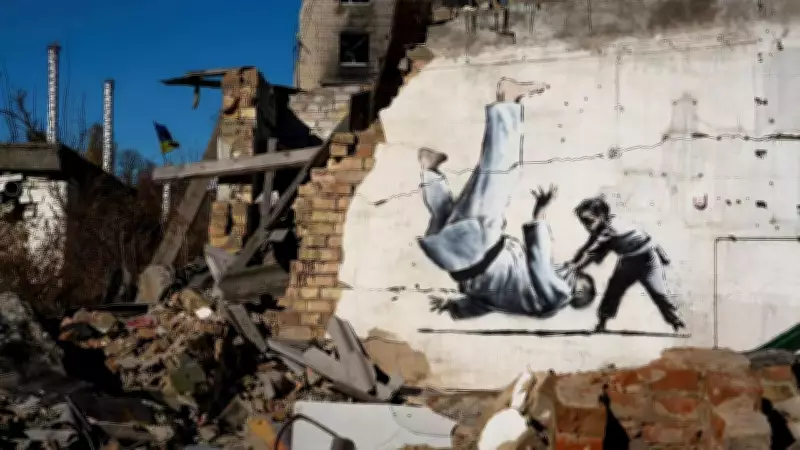
The modern investigation into Banksy's identity took an unexpected turn in 2022 during the war in Ukraine. Several new Banksy murals appeared on damaged buildings near Kyiv, depicting gymnasts balancing on rubble and children facing armed soldiers. These works garnered international attention and raised practical questions: if Banksy had traveled into an active war zone to create them, someone must have witnessed the process.
Reporters interviewed residents in the villages where the murals appeared. Witnesses described a small group arriving in an ambulance, with two masked painters working swiftly using stencils and spray paint, accompanied by a third man with prosthetic legs and one arm. This individual was identified as a British war photographer who had previously collaborated with artists and musicians in Banksy's broader circle, suggesting links to the Bristol scene.
This lead connected to long-standing suspect Robert Del Naja, who had traveled to Ukraine around the time the murals appeared. However, the real breakthrough lay elsewhere, in a piece of paperwork that had been quietly stored in an American archive for over two decades.
The New York Police File: Concrete Evidence
In September 2000, a young British graffiti artist climbed onto a Manhattan rooftop during New York Fashion Week, targeting a large billboard advertising Marc Jacobs clothing. As he altered the advertisement by adding exaggerated teeth and a speech bubble, police officers apprehended him mid-act. At the time, the incident seemed like a routine vandalism case, resulting in reduced charges, a modest fine, and release. No one realized this individual would soon become one of the most influential artists of the twenty-first century.
Yet, the case left behind a crucial trace: a handwritten confession in the police file, signed by the man who had defaced the billboard. The signature read Robin Gunningham. This discovery provided the strongest evidence to date that Banksy and Gunningham were the same person, transforming years of speculation into concrete fact. The mysterious street artist whose work had spread globally appeared to have started his career as a graffiti painter from Bristol, once arrested for vandalism in New York.
The Paradox of Modern Fame
Even this revelation did not fully resolve the story. After the mid-2000s, public records for Robin Gunningham nearly vanished entirely, with addresses and property filings disappearing. Former associates suggested a straightforward explanation: the artist had changed his legal name to something deliberately ordinary, allowing him to blend into everyday life without attracting attention.
Ultimately, the Banksy narrative highlights a peculiar paradox of modern fame. The artist created some of the most widely recognized images in contemporary culture while remaining personally invisible. His works critiqued power structures and commercial systems, even as those same systems commodified his paintings into highly valuable assets. The myth of Banksy became as potent as the artworks themselves.
The investigation tracing his identity back to Robin Gunningham does not erase this myth. Murals continue to appear overnight, images still speak with a mischievous voice, and the artist avoids public appearances and interviews. What has changed is merely the knowledge that behind the legend stands a man who once roamed the streets of Bristol with a stencil and spray can, discovering that invisibility could be the most powerful artistic tool of all.