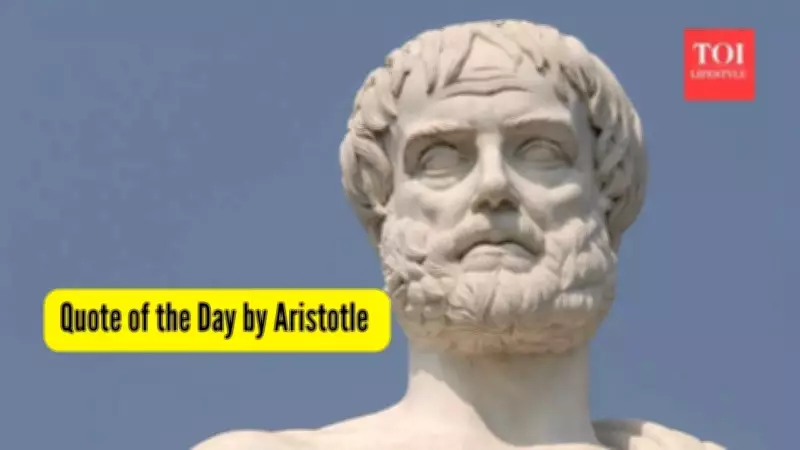
Aristotle: The Enduring Legacy of a Western Philosophical Giant
Aristotle, widely revered as the father of Western philosophy, transcended the role of a mere thinker to become a meticulous observer of the natural world, a mentor to monarchs, and a polymath whose insights permeated disciplines ranging from science to ethics. Born in 384 BCE in Stagira, a modest town in northern Greece, he was raised in a family deeply immersed in medical knowledge, as his father served as the physician to the Macedonian king. At the age of 17, Aristotle journeyed to Athens to enroll at Plato's Academy, where he dedicated two decades to intellectual exploration, eventually challenging his teacher's foundational beliefs.
From Plato's Academy to the Lyceum: A Journey of Intellectual Evolution
Plato advocated for the existence of perfect, eternal Forms as superior blueprints beyond our imperfect reality. In contrast, Aristotle adopted a more empirical stance, urging a direct examination of the tangible world. Following Plato's death in 347 BCE, Aristotle embarked on extensive travels, spending time in Asia Minor, studying biology on the island of Lesbos, and ultimately accepting a position in Macedonia to tutor the young Alexander the Great. This tutelage profoundly influenced Alexander, instilling in him an appreciation for Homeric epics, ethical principles, and natural sciences, with Alexander later contributing exotic specimens from his campaigns to Aristotle's research endeavors.
In 335 BCE, Aristotle returned to Athens and established the Lyceum, his own educational institution. Here, students engaged in philosophical discussions while walking, giving rise to the term "peripatetic" philosophy. He led the Lyceum until 323 BCE, when rising anti-Macedonian sentiments after Alexander's death forced his departure, famously remarking, "I will not allow Athens to sin twice against philosophy." He passed away a year later in Chalcis at the age of 62.

The Vast Corpus and Systematic Approach of Aristotle's Works
Aristotle authored over 200 works, though only approximately 30 survive today, primarily as lecture notes compiled by his students. His writings spanned an impressive array of subjects, including logic, metaphysics, biology, politics, poetry, rhetoric, and ethics. Unlike Plato's dialogic style, Aristotle's prose was dense and methodical, resembling detailed blueprints for understanding reality. He categorized knowledge into three distinct domains: theoretical (concerned with what exists), practical (focused on how to live), and productive (addressing how to create), a framework that continues to influence modern academic structures.
Core Philosophical Contributions: Causation, Metaphysics, and Logic
At the heart of Aristotle's worldview lay his theory of causation, which identified four causes for any entity: material (its composition), formal (its structure), efficient (its maker), and final (its purpose). This teleological perspective, where purpose drives existence, infused his thought, positing that nature operates with intentionality, such as an acorn inherently striving to become an oak tree.
In metaphysics, Aristotle grappled with the concept of "being qua being," rejecting Plato's separate Forms in favor of substance as paramount. He proposed that individual entities, like a specific horse, combine form (essence) and matter (physicality). His notion of the "prime mover," an eternal, unchanging mind that initiates motion without itself moving, influenced theological discourse from Thomas Aquinas to Albert Einstein's references to Spinoza's God.
Aristotle pioneered formal logic through his work Organon, where he systematized syllogisms—deductive reasoning tools exemplified by: All men are mortal (major premise), Socrates is a man (minor premise), therefore Socrates is mortal (conclusion). This foundation underpins contemporary scientific and legal methodologies.
Empirical Biology and Ethical Frameworks
His empirical approach shone in biology, where he dissected marine life on Lesbos, cataloging around 500 species and observing embryonic development, laying groundwork for embryology. He asserted, "Nature does nothing in vain," seeing purposeful design in anatomical features from fish gills to human thumbs.

In ethics, Aristotle's Nicomachean Ethics, named for his son Nicomachus, emphasizes eudaimonia (flourishing or happiness) achieved through virtue rather than fleeting pleasure. He distinguished between moral virtues (e.g., courage, temperance) and intellectual virtues (e.g., wisdom), with moral virtues cultivated through habitual practice, akin to strengthening muscles. Central to this is the "doctrine of the mean," where virtue represents a balance between extremes—courage between cowardice and recklessness, generosity between stinginess and extravagance—guided by phronesis (practical wisdom).
Politics, Rhetoric, and Lasting Influence
Ethics naturally extended to politics, with Aristotle describing humans as "political animals" thriving within the polis. He advocated for a mixed constitution blending monarchy, aristocracy, and democracy, a concept echoed in modern republics. Justice, he argued, entails treating equals equally and unequals unequally based on merit, though his defense of slavery as natural for "barbarians" reflects a hierarchical worldview critiqued by contemporary standards.
Aristotle's contributions to rhetoric highlighted the interplay of logos (logic), pathos (emotion), and ethos (character) in effective communication. In Poetics, he explored tragedy's cathartic effect, purging pity and fear through art. His legacy endured through medieval scholastics like Aquinas, Renaissance humanists, and scientists from Galileo to Darwin, with his ethics informing business education, his logic underpinning computing, and his biology inspiring ecological studies.
Aristotle's Timeless Quote on Merit and Action
One of Aristotle's most enduring quotes states, "Just as at the Olympic games it is not the handsomest or strongest men who are crowned with victory but the successful competitors, so in life it is those who act rightly who carry off all the prizes and rewards." This analogy draws from ancient Greek Olympics, where victors earned olive wreaths not merely for innate beauty or strength but for disciplined training and strategic effort. Aristotle applies this to life, suggesting that true rewards—honor, wealth, friendship—are bestowed upon those who engage in purposeful action (praxis) and virtuous conduct.
This quote encapsulates his ethical philosophy: eudaimonia crowns the active soul, where potential (dunamis) is realized through habitual practice (hexis). It champions a meritocracy based on character, contrasting with reliance on luck or superficial traits. In today's fast-paced world, Aristotle's emphasis on righteous deeds remains profoundly relevant, urging individuals to cultivate excellence through consistent effort. His legacy endures by making philosophy accessible and practical, offering guidance for living well amidst modern complexities.